My cousin couldn’t have biological children.
After years of trying, countless appointments, and honestly, a lot of heartbreak, her fertility doctor suggested egg donation.
She felt two things at once: hope and confusion.
“How does it even work?” she asked me over coffee.
“Where do I find a donor? How much will this cost? Is it even legal in Ontario?”
I realized I didn’t have solid answers either.
So I did what I always do, I researched the hell out of it.
And now, after digging into Ontario’s egg donation landscape, I want to share what I found with you.
Because if you’re reading this, you’re probably asking the same questions my cousin did.
Maybe your doctor mentioned egg donation as an option.
Maybe you’ve been trying to conceive for years and you’re exploring every path forward.
Or maybe you’re just starting to research and want to understand what this means—practically, emotionally, and financially.
That’s exactly what this guide covers.
What is egg donation?
Let me start simple.
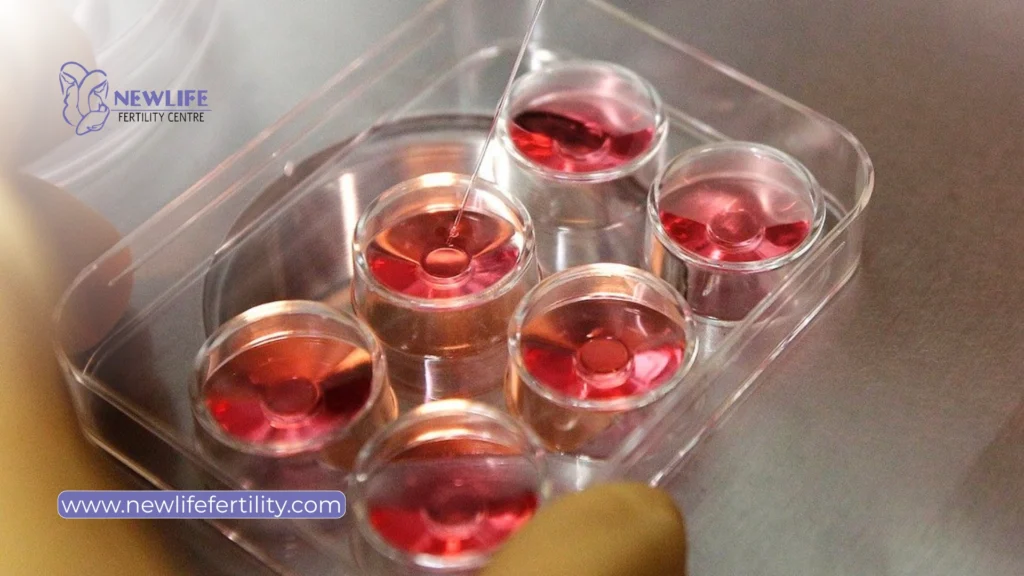
Egg donation is when a woman donates her eggs (ova) to an intended parent or couple who want to conceive.
The donor’s eggs are fertilized with sperm (from a partner or donor) in a lab, creating an embryo.
That embryo is then transferred into the uterus of the person who will carry the pregnancy.
Here’s what this means: The pregnancy is carried by the intended mother (or surrogate), but the genetic material comes from the egg donor.
Why does this matter?
It means your child will have half of the egg donor’s DNA, and half from the sperm provider.
If you’re using your partner’s sperm, your child will have a genetic connection to your partner, just not to you biologically.
Who is egg donation for?

Egg donation is recommended when:
You have ovary or egg issues: Low egg quality, low egg count, or absent ovaries due to surgery, genetic condition, or illness.
You’re of advanced maternal age: Women over 40-45 often have higher rates of chromosomal abnormalities in their eggs. Donor eggs from younger women statistically have better fertilization and implantation rates.
You carry genetic conditions: If you could pass on a serious hereditary condition, using a donor’s eggs reduces that risk.
You’ve had multiple failed IVF cycles: Sometimes it’s not the uterus, it’s the eggs. A fresh start with younger donor eggs can change outcomes.
You’re a same-sex male couple or single intended father: You’ll need both a donor and a surrogate to carry the pregnancy.
You’ve gone through cancer treatment: Chemotherapy or radiation may have damaged your eggs. Egg donation bypasses this.
The emotional weight of this decision is real.
A lot of people feel lost when they first consider egg donation.
That’s completely normal.
You might grieve the genetic connection you won’t have.
And that’s okay.
But here’s what I learned from speaking with Ontario families who’ve done this: many say they felt more connected to their child because they chose this path consciously. They planned it. They prepared emotionally.
That matters.
Who are egg donors?

Before we talk about where to find donors, let’s talk about who they are.
What makes someone a good egg donor?
Egg donors are typically women between 21 and 32 years old.
Why this age range?
Younger eggs have:
- Higher fertilization rates
- Lower risk of chromosomal abnormalities
- Better pregnancy outcomes overall
Donors go through strict screening:
Medical screening: Blood tests, genetic testing, infectious disease screening (HIV, hepatitis, STIs). Full health history reviewed.
Psychological evaluation: A psychologist or counselor talks to the donor about her motivations, understanding of the process, and emotional readiness.
Reproductive health assessment: Ultrasound of ovaries, hormone levels (AMH, FSH), overall reproductive capacity.
Genetic screening: Some donors are screened for genetic conditions like cystic fibrosis, sickle cell disease, and other hereditary disorders.
It’s thorough.
Really thorough.
Anonymous vs. known egg donors

You have two options when it comes to donor identity.
Anonymous donors
You don’t know who she is. She doesn’t know who you are.
| Pros of Anonymous Donors | Cons of Anonymous Donors |
| More privacy for both parties Larger donor pool (more options) Less complex emotionally later Typically faster process | Limited information about donor background Can’t reach out later if questions arise Some families feel they want to know “who” their child’s biological mother is |
Known donors (friend, family, or directed donors)
In this case, you use someone you know, a friend, sister, or relative.
| Pros of Known Donors | Cons of Known Donors |
| You know her well Your child may have contact with biological family Often less expensive | Emotionally complex relationships (can strain friendships)Legal complications if not properly handledWhat happens if the relationship breaks down?Higher chance of emotional attachment issues later |
Here’s my take 👇
Both paths work. But both need serious conversation and legal support first.
If you’re considering a known donor, please get a family lawyer involved early.
I’m not trying to scare you.
I’m trying to save you from heartbreak later.
Egg donor options in Ontario
Okay, so where do you actually get an egg donor in Ontario?
You have three main paths.
Option 1: Fertility clinic donor programs

Most fertility clinics in Ontario have their own donor programs.
How fertility clinic donor programs works
- The clinic recruits and screens egg donors
- You browse through donor profiles (usually anonymously)
- You choose a donor
- The clinic coordinates the entire process
Pros of fertility clinic donor programs
- Everything happens in one place (less coordination stress)
- Clinic handles all medical screening and legal work
- Donors are already vetted and ready to go
- Timeline is often faster
Cons of fertility clinic donor programs
- Limited choice (depends on clinic’s donor pool)
- Can be more expensive
- Less flexibility in donor matching
Cost range: $15,000-$25,000+ for a single egg donor cycle (we’ll break this down more later).
Option 2: Egg donor banks

Egg donor banks (also called “egg donation banks” or “oocyte banks”) are separate facilities that recruit, screen, and store donor eggs.
Think of them like banks, but for eggs instead of money.
How egg donor banks works
Fresh donor eggs
- You match with a donor
- She goes through a hormone stimulation cycle
- Her eggs are retrieved and fertilized fresh with your sperm
- Embryos are created and transferred
Frozen donor eggs
- The egg donation bank has already screened donors and frozen eggs
- You choose a vial of frozen eggs
- They’re thawed and used for fertilization and transfer
- Faster timeline (no waiting for donor cycle)
Pros of donor banks
- Larger selection of donors
- Often more affordable than clinic programs
- Frozen eggs mean immediate availability (no waiting)
- Can use multiple times from same donor (if available)
- More transparent pricing
Cons of donor banks
- Frozen eggs have slightly lower fertilization rates than fresh (still very good, though)
- You need a clinic to work with for the actual transfer
- Some people feel less personal connection to the process
Cost range: $10,000-$20,000 for frozen eggs (varies by egg donation bank and how many vials).
Popular Ontario/Canadian egg banks
| Bank / Distributor | Location Base | Best For… |
| CAN-AM Cryoservices | Hamilton, ON | The largest Canadian distributor; excellent for local support and logistics. |
| Canada Egg Bank | National | A dedicated Canadian database of altruistic donors. |
| MyEggBank | North America | One of the largest networks with diverse donor profiles and high success rates. |
| Aphrodite Egg Bank | International | Known for European/Diverse donor options with delivery to Ontario clinics. |
Option 3: Known or directed egg donors

Using someone you know: friend, sister, relative.
How known or directed egg donors works
- You ask someone you know
- She agrees and goes through screening with your fertility clinic
- The rest of the process is the same (just with someone you know)
Pros of known or directed egg donors
- Often less expensive (no donor compensation or bank fees)
- Personal connection
- Your child could have relationship with donor
Cons of known or directed egg donors
- Relationship risk if something goes wrong
- Emotional complexity
- Screening still takes time
- Legal agreements essential
Important: Even with a known donor, you need legal agreements. Talk to a family lawyer before moving forward.
How egg donation works: Step by step
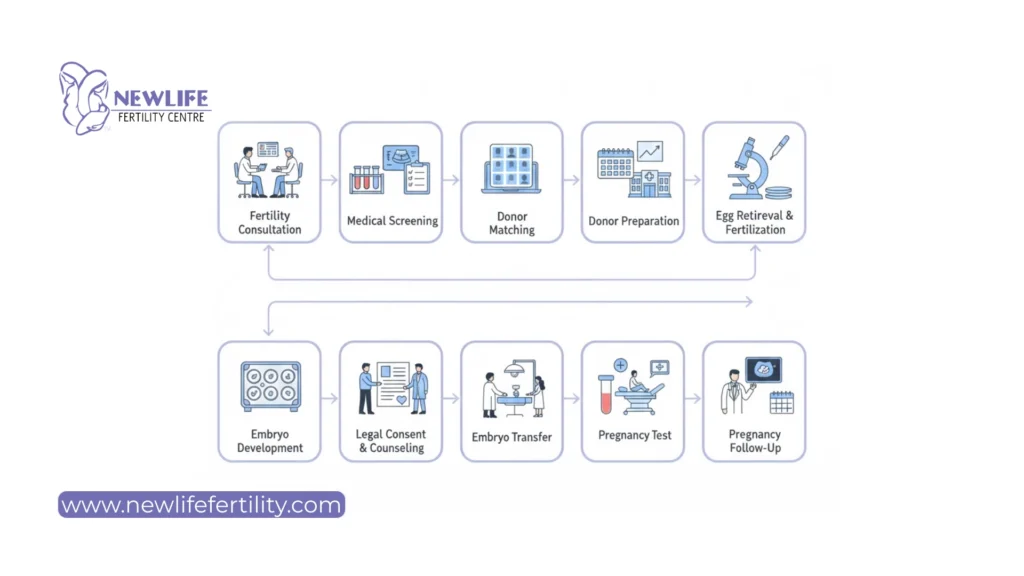
Okay, let’s walk through the actual process.
This is where a lot of confusion happens, so I’m going to break it down.
Step 1: Fertility consultation
You meet with a reproductive endocrinologist (fertility doctor) in Ontario.
They’ll:
- Review your medical history
- Explain why egg donation is recommended for you
- Discuss success rates with donor eggs
- Answer your questions
- Discuss whether fresh or frozen eggs suit your situation
This is a good time to ask everything.
Don’t worry about asking “too many” questions.
A good fertility doctor expects this.
Step 2: Medical screening (you)
You’ll go through tests to prepare for pregnancy:
- Blood tests (hormone levels, infectious diseases)
- Pap smear (if applicable)
- Ultrasound of uterus
- General health assessment
These tests make sure your uterus is healthy and ready to carry a pregnancy.
Step 3: Donor matching
If you’re using a clinic or bank, you’ll look at donor profiles.
Information typically includes:
- Age, height, weight
- Eye color, hair color, ethnicity
- Blood type
- Education level
- Medical history
- Sometimes: personality traits, interests, talents
- Baby photos (sometimes)
- Genetic screening results
You’ll review these profiles and choose.
It’s weird.
I’m not going to pretend it’s not.
You’re literally shopping for genetic material.
But it’s also practical.
Take your time. Discuss with your partner or trusted person.
Step 4: Donor preparation (if fresh eggs)
If using fresh eggs, the donor goes through:
Hormone stimulation (about 10-14 days):
- Daily hormone injections to stimulate multiple eggs to develop
- Regular ultrasounds and blood tests to monitor progress
Egg retrieval:
- Minor surgical procedure (takes 15-20 minutes)
- Done under sedation
- Eggs are extracted from ovaries
The donor recovers quickly and goes home the same day.
(If using frozen eggs, skip this, eggs are already ready.)
Step 5: Fertilization
Your sperm (or donor sperm) is combined with the donor’s eggs in the lab.
The embryologist watches for fertilization.
By next day, you’ll know how many eggs are fertilized.
This is stressful.
Be prepared for possible disappointment.
Not every egg fertilizes. That’s normal biology.
Step 6: Embryo development
The fertilized eggs (now called embryos) develop in the lab for 5-6 days.
On day 5 or 6, the embryos are assessed for quality.
Best quality embryos are selected for transfer.
Step 7: Legal consent & counseling
Before transfer, you’ll sign legal agreements.
Your clinic will require:
- Informed consent documents
- Genetic counseling (usually one session)
- Psychological counseling (sometimes)
- Legal review (especially if known donor)
These aren’t obstacles.
They’re protections.
They protect you, the donor, and your future child.
Step 8: Embryo transfer
This is the big day.
What happens:
- A catheter with the embryo(s) is passed through your cervix
- The embryo is placed in your uterus
- You’re done in 10 minutes
No sedation needed.
You’ll feel some cramping (like a Pap smear).
Then you go home and… wait.
Step 9: Pregnancy test
About 10-12 days after transfer, you’ll get a blood test to check for pregnancy.
Either you’ll be pregnant, or you won’t.
This waiting period is brutal.
Be kind to yourself.
Step 10: If pregnant
You’ll have follow-up ultrasounds and blood tests.
Most fertility clinics follow you for the first 8-10 weeks, then refer you back to your regular OB.
From there, it’s a regular pregnancy.
Egg donor cost in Ontario

Let’s talk about money.
Because this is real, and it matters.
Below is a clear, no-surprises breakdown of what egg donation usually costs in Ontario.
Average egg donor cost breakdown
Donor compensation (if applicable)
| Donor Type | Estimated Cost |
| Fresh donor cycle | $8,000 to $15,000 |
| Frozen egg bank donor | Already included in egg price |
| Known donor (friend or relative) | Usually no payment (legal advice recommended) |
Note: In Canada, donors are not paid directly, but expenses and compensation structures vary. Always confirm with your clinic and lawyer.
Medical procedures
| Medical Step | Estimated Cost |
| Fertility assessment and bloodwork | $500 to $1,500 |
| Ultrasounds and monitoring | $800 to $1,500 |
| Egg retrieval procedure | $2,000 to $4,000 |
| Lab fees (fertilization and embryo development) | $2,000 to $3,500 |
| Embryo transfer | $1,500 to $2,500 |
| Medications (for intended parent) | $500 to $2,000 |
Donor bank fees (if using a bank)
| Fee Type | Estimated Cost |
| Frozen egg vial | $5,000 to $10,000 |
| Storage and handling | $500 to $1,500 |
Legal and counseling costs
| Service | Estimated Cost |
| Legal agreements | $1,000 to $3,000 |
| Counseling or psychological assessment | $500 to $1,500 |
Note: Costs can be higher with known donors due to additional legal protections.
Total egg donor cost range in Ontario
| Egg Donation Option | Typical Total Cost |
| Fresh donor cycle | $18,000 to $35,000+ |
| Frozen donor eggs | $10,000 to $20,000 |
| Known donor | $12,000 to $25,000 |
These are ballpark figures.
Every clinic prices differently.
Every situation is different.
What’s usually included vs. extra
| Usually Included | Often Extra (always confirm) |
| Initial consultation Your medical screening Donor screening and matching Egg retrieval (donor) Fertilization and embryo development One embryo transfer | Additional medications Multiple embryo transfers Genetic testing of embryos (PGT or similar) Long-term donor egg storage Surrogacy coordination, if required |
Is egg donation covered by OHIP or insurance?

No, egg donation in Ontario is not covered by OHIP.
Not partially. Not indirectly.
Zero coverage.
Some private insurance plans may help with:
- Fertility medications
- Certain ultrasounds or blood tests
Coverage is usually limited, often around 20 to 30 percent, and many plans cover nothing at all.
Still, check your benefits. Always.
Many families end up:
- Saving over time
- Using fertility financing
- Or doing a mix of both
It’s not fair.
But this is the current reality in Ontario.
Is egg donation legal in Ontario?

Yes. Egg donation is completely legal in Ontario and across Canada.
What the law says
Egg donation is regulated under the Assisted Human Reproduction Act.
- Donors cannot be paid for their eggs
- Donors can be reimbursed for expenses like lost wages, travel, and medical costs
In practice, this reimbursement usually totals $8,000 to $15,000.
The goal is altruistic donation, not buying eggs.
Rights of intended parents
- Use donor eggs to create embryos
- Carry the pregnancy
- Be listed as the legal parent(s) on the birth certificate
- Maintain confidentiality with anonymous donors
Rights of egg donors
- Health and genetic screening
- No parental responsibility
- Anonymity, if chosen
- Access to counseling
Using a known donor
If the donor is someone you know, a legal agreement is required.
This covers parental rights, future contact, confidentiality, and financial matters.
Legal fees are usually $1,000 to $3,000 and strongly recommended.
It protects everyone.
How to choose the right egg donor or donor bank

You’re going to look at donor profiles.
It’s overwhelming.
There are so many options.
Here’s what to focus on:
What to look for in a donor profile
Medical health
- No major genetic conditions in family
- Clean infectious disease screening
- Good egg quality markers (if listed)
- Non-smoker
Age (ideally)
- Under 32 for best outcomes
- Under 28 is even better
Realistic expectations about appearance
- You might want your child to “look like” you
- But genetics is unpredictable (your brother might look like the donor, not you)
- Focus on health and genetic screening over appearance
Donor motivation
- Read her statement (if provided)
- Good donors are motivated to help, not just earn money
- You want someone who took this seriously
Questions to ask your clinic or bank

Before you commit, ask:
- What’s your live birth rate per embryo transfer with donor eggs?
- What’s your success rate with this specific donor (if available)?
- How long does the entire process take from now?
- What if the donor doesn’t produce enough eggs? (Refund policy?)
- Are there additional costs I haven’t heard about?
- What happens if I’m not happy with the donor match?
- Can I change my mind before transfer?
- What’s your counseling and legal support?
Good clinics will answer all of these clearly.
Bad clinics will rush you or avoid questions.
Red flags to avoid
❌ A clinic that pressures you to decide quickly
❌ Vague pricing (nickel and diming you constantly)
❌ No psychological or genetic counseling offered
❌ Poor communication or staff that seems annoyed
❌ Very low success rates they can’t explain
❌ No legal agreements (if known donor)
❌ Promises of “guaranteed” results (impossible in fertility)
Success rates with donor eggs

Here’s something that might surprise you.
Success rates with donor eggs are often higher than with your own eggs.
Why?
Because donor eggs come from younger women with better egg quality.
The numbers
In Ontario and Canada:
- Live birth rate per transfer with donor eggs: 40-60% (depending on age of intended mother, clinic, quality of sperm)
- Live birth rate per transfer with your own eggs (age 40+): 5-20%
This is huge.
The difference between 5% and 50% is life-changing.
Factors that influence your success
In your control
- Quality of sperm (good sperm increases success)
- Age of intended mother (younger = better outcomes)
- Uterus health (get it checked)
- Overall health (less smoking, better diet, exercise helps)
Not in your control
- Fertilization rate (depends on lab quality and luck)
- Embryo quality (genetic lottery)
- Implantation (why some healthy embryos don’t stick)
- Chromosomal abnormalities (rare with donor eggs from young women, but happens)
Can increase success slightly
- Pre-genetic testing (PGS) of embryos ($2,500-$4,000 extra)
- Uterine prep protocols (some clinics use these)
- Acupuncture (helps with relaxation, maybe helps implantation)
- Mental health support (stress reduction is real)
Setting realistic expectations
Let’s be honest.
Even with donor eggs, success isn’t guaranteed.
You might need multiple transfers.
You might still experience miscarriage.
This is the heartbreaking reality of fertility treatment.
But the odds are significantly better than without donor eggs.
And many Ontario families do succeed.
Is egg donation the right path for you?
Here’s what I’ve learned while researching this deeply and speaking with families in Ontario who have actually walked this road.
Egg donation works.
Not always on the first try.
Not always without disappointment.
But it works.
It gives many people a real chance at becoming parents.
You get to carry the pregnancy.
You get to give birth.
You get to raise the child.
And over time, most parents realise this one simple truth.
The genetic part matters far less than they feared.
What matters is intention.
What matters is love.
What matters is that you chose this child and showed up for them long before they were born.
That’s what makes someone a parent.
At the same time, it’s also okay if egg donation is not right for you.
Some people cannot afford it.
Some are not emotionally comfortable with the idea.
Some choose other paths like adoption, fostering, or living child free.
All of these choices are valid.
But if you are reading this because your doctor mentioned egg donation and something inside you felt a small sense of hope, even if it scared you, that feeling is worth listening to.
You do not have to decide today.
The best next step is simply to speak to a fertility clinic, ask honest questions, and understand your options clearly.
From a personal place, I’ll share this too.
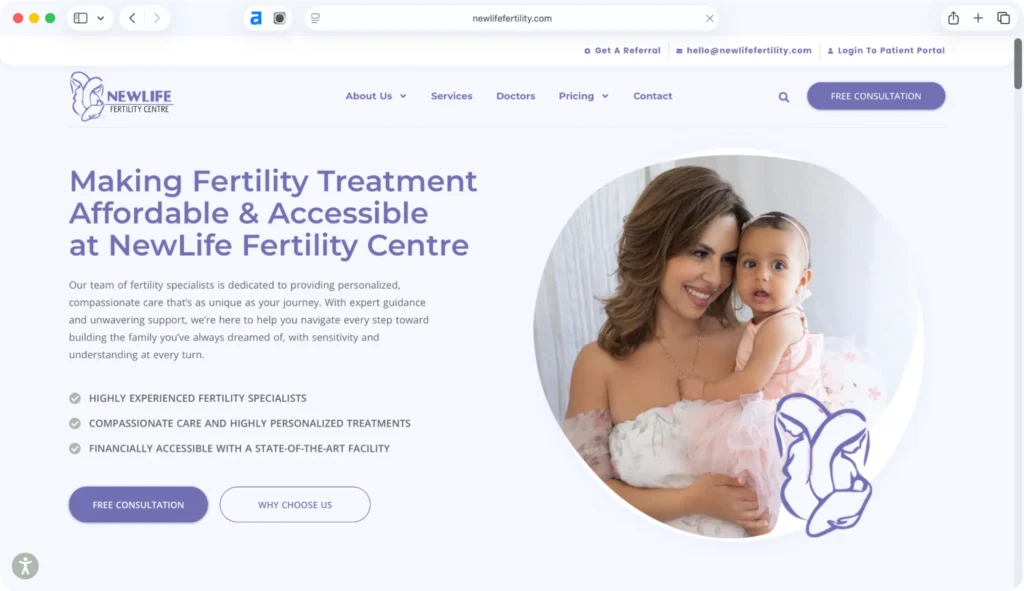
My cousin went through treatment at NewLife Fertility by starting with a free consultation, and their experience there was genuinely positive. They felt supported, informed, and never rushed. Their journey was not easy, but it ended with success, and that matters.
Whether you choose NewLife Fertility or another clinic in Ontario, what matters most is finding a team that listens to you, respects your pace, and explains things clearly.
This is your journey.
Your body.
Your timeline.
Your decision.
You deserve clarity before commitment.
You deserve compassion while deciding.
And you deserve to trust yourself, whatever you choose.
That is exactly why this guide exists.