IVF already asks you to make some big, emotional decisions.
It’s a little like training for a marathon… only nobody hands you a map.
Every few days, there’s another decision. Another appointment. Another thing to worry about.
Stimulation. Egg retrieval. Waiting for fertilization.
And just when you think you’re through the hardest part, your doctor says:
“Let’s do a frozen embryo transfer (FET).”
Now your brain is spinning:
“Is frozen transfer actually better?”
“Are there extra risks?”
“Why not just transfer the fresh embryo right away?”
If that sounds like you, take a breath.
You’re not alone.
And you’re definitely not overthinking it. These are smart, important questions.
Because when you’re going through IVF, every choice feels huge. And naturally, you want to understand what gives you the best possible chance.
This guide will walk you through the real advantages, disadvantages, benefits, and risks of frozen embryo transfer in simple, honest language so you can make decisions with more clarity and a little less anxiety.
What is frozen embryo transfer (FET)?
In IVF, your eggs are collected, fertilized with sperm, and allowed to grow into embryos inside the lab.
In a fresh embryo transfer, one embryo is transferred back into the uterus just a few days after egg retrieval, during the same treatment cycle.
A frozen embryo transfer (FET) works a little differently.
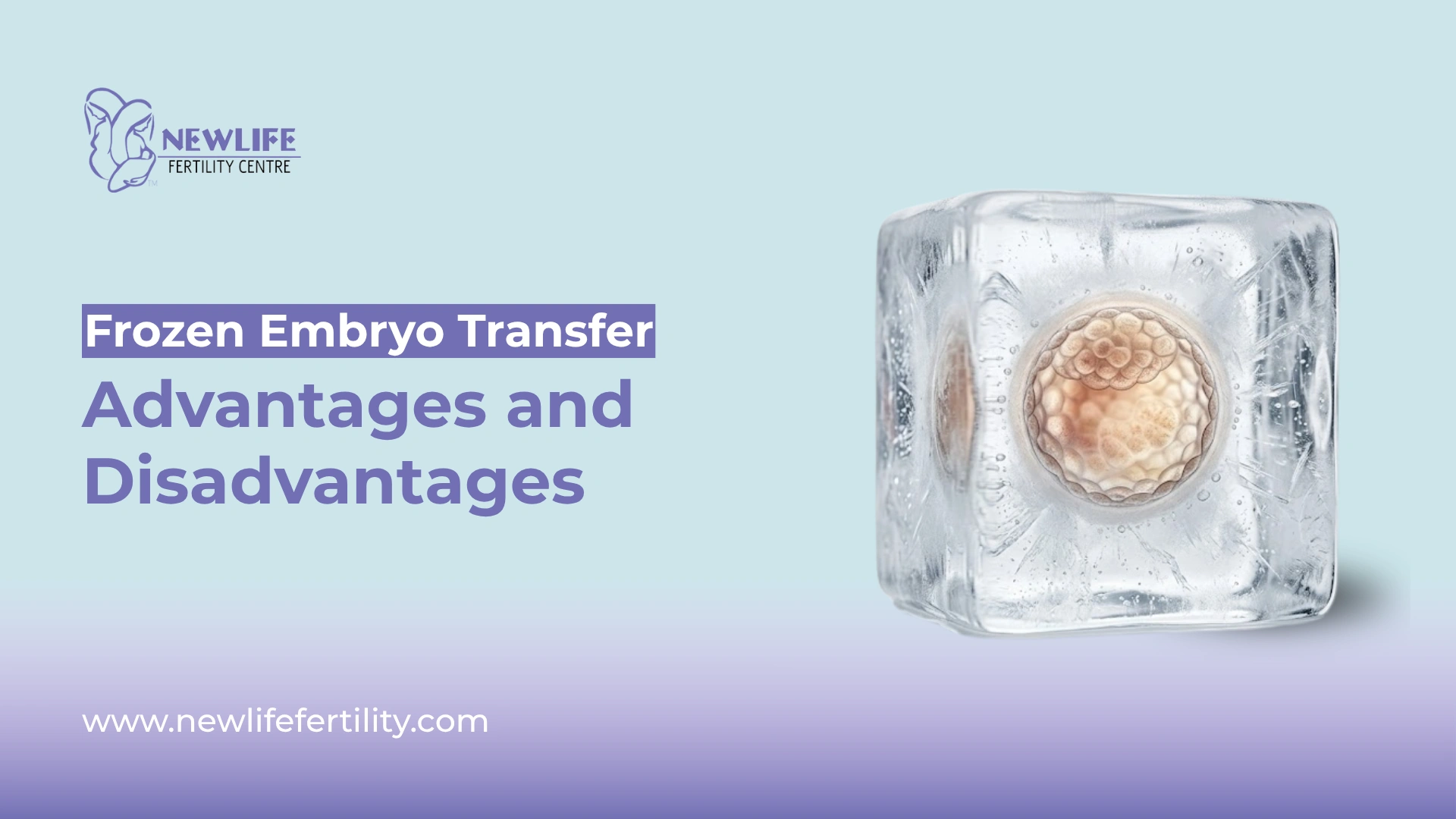
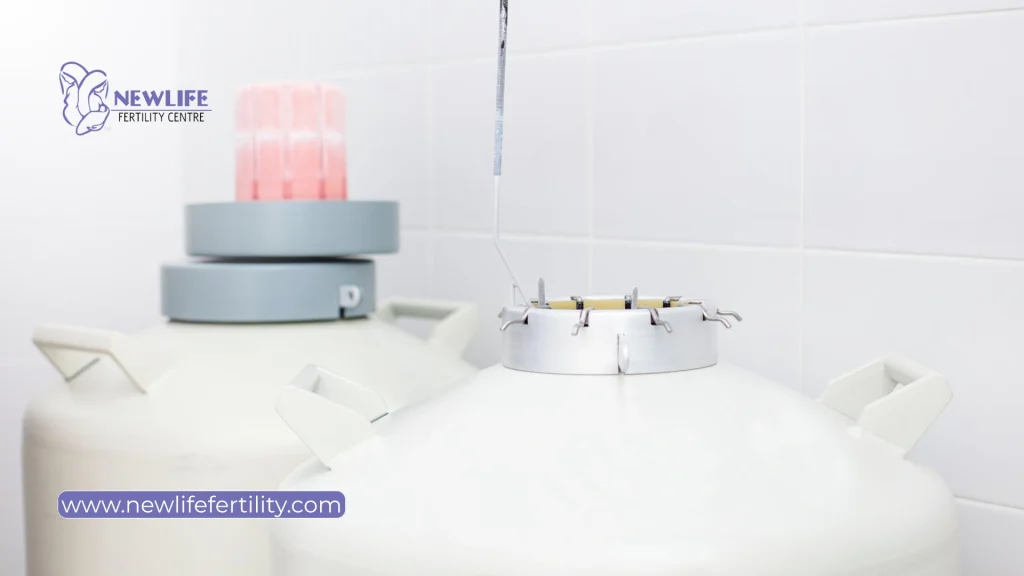
Instead of transferring the embryo immediately, the embryos are frozen using a rapid freezing technique called vitrification and safely stored for later use.
The embryo is then thawed and transferred in a future cycle when your uterus has had time to recover and can be prepared under more stable, controlled hormonal conditions.
And that timing matters.
Because modern vitrification technology gives very high embryo survival rates after thawing, and because doctors can better prepare the uterine lining before transfer, frozen embryo transfer has become increasingly common in modern IVF treatment.
Why do doctors recommend frozen embryo transfer?
If a fresh transfer already exists, why are so many clinics recommending a frozen embryo transfer instead?
Usually, it’s not about trends. It’s about strategy.
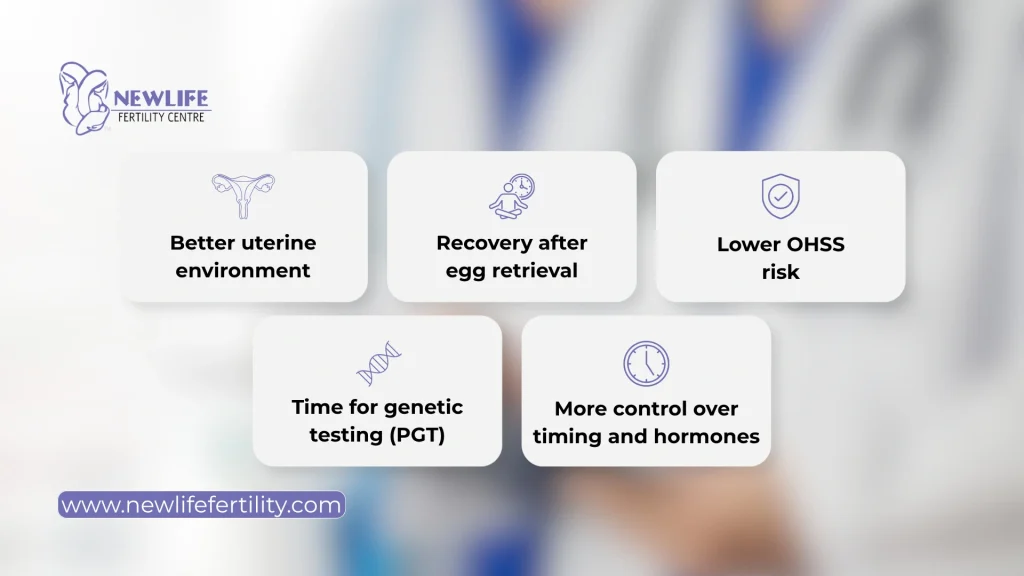
Doctors often recommend FET because it allows more control, safer timing, and better preparation before transfer.
Better uterine environment
During a fresh IVF cycle, your body is exposed to very high hormone levels from stimulation medications. In some women, this can affect how receptive the uterine lining is.
With FET, the transfer happens later in a more stable cycle, often closer to the body’s natural hormonal state.
Recovery after egg retrieval
Egg retrieval is still a medical procedure, and your body needs time to recover afterward.
FET gives your body space to heal before focusing on implantation and early pregnancy.
Lower risk of Ovarian Hyperstimulation Syndrome
For women at higher risk of OHSS, a freeze-all cycle followed by FET is often considered safer.
Because pregnancy does not begin immediately after retrieval, the body avoids additional hormonal stress during recovery.
Time for genetic testing (PGT)
Frozen transfer also allows embryos to be tested for chromosomal abnormalities before transfer.
This can help doctors select embryos with the best chance of implantation in certain IVF cases.
More control over timing and hormones
With FET, doctors can carefully prepare the uterine lining, monitor hormone levels, and schedule the transfer at the most suitable time.
Instead of working within the narrow timing window of egg retrieval week, they can optimize the conditions more precisely.
Advantages of frozen embryo transfer
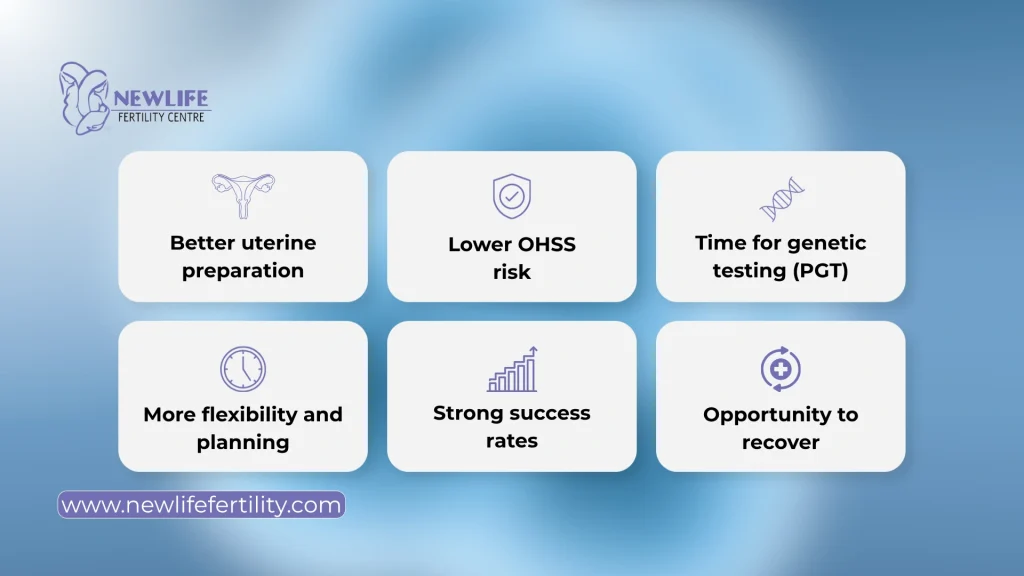
Better uterine preparation
With frozen embryo transfer, your uterus does not have to handle peak stimulation hormones, egg retrieval recovery, and implantation all at once.
Instead, your doctor can prepare the uterine lining in a calmer and more controlled environment.
This helps:
- build the lining more gradually
- avoid extreme hormone spikes
- improve endometrial receptivity in some patients
For many women, this means the uterus is genuinely more prepared when the embryo is finally transferred.
Lower risk of Ovarian Hyperstimulation Syndrome
Some women respond very strongly to IVF stimulation medications, especially patients with conditions like PCOS.
In these situations, doctors may worry about OHSS, a potentially serious complication caused by overstimulated ovaries.
Doing a fresh transfer immediately after retrieval can sometimes worsen symptoms because pregnancy hormones increase the hormonal load even further.
A freeze-all approach followed by FET allows your body to recover first, making the process safer and reducing the risk of severe OHSS complications.
Time for genetic testing (PGT)
If your treatment plan includes PGT (preimplantation genetic testing), frozen embryo transfer is usually part of the process.
Here’s why:
The embryos first need to be biopsied and tested in the lab for chromosomal abnormalities. That process takes time.
Instead of rushing into transfer, the embryos are frozen while testing is completed. Once results are available, the healthiest embryo can be selected for transfer later.
For certain patients, this may help improve implantation and live birth outcomes.
More flexibility and planning
One underrated advantage of frozen embryo transfer is flexibility.
IVF often feels like everything is happening on a strict medical timeline. FET gives some control back to you and your doctor.
You may be able to:
- choose a transfer month that feels better physically or emotionally
- avoid major work or travel conflicts
- take time to mentally prepare before transfer
And honestly, that flexibility can make a huge emotional difference during IVF treatment.
Frozen embryos can still have excellent success rates
A lot of patients worry that frozen embryos are somehow weaker or less effective than fresh ones.
Modern research tells a very different story.
Thanks to vitrification, most embryos survive the thawing process very successfully. In many clinics, frozen embryo transfers now show equal or even higher success rates compared to fresh transfers.
Success rates still depend on many factors like age, embryo quality, diagnosis, and clinic expertise. But freezing itself is no longer considered a disadvantage in modern IVF.
Opportunity to recover emotionally and physically
IVF is not just physically exhausting. It can be emotionally overwhelming too.
Frozen embryo transfer creates a pause between retrieval and transfer, allowing your body and mind time to recover.
That recovery period can help you:
- heal from injections and retrieval discomfort
- process test results and next steps
- feel more emotionally prepared for transfer day
For many patients, that pause makes the process feel calmer, more intentional, and a little less overwhelming overall.
Disadvantages of frozen embryo transfer
Now let’s talk honestly about the other side of frozen embryo transfer.
Because while FET has many advantages, it also comes with some emotional, physical, and financial challenges that patients should understand clearly.
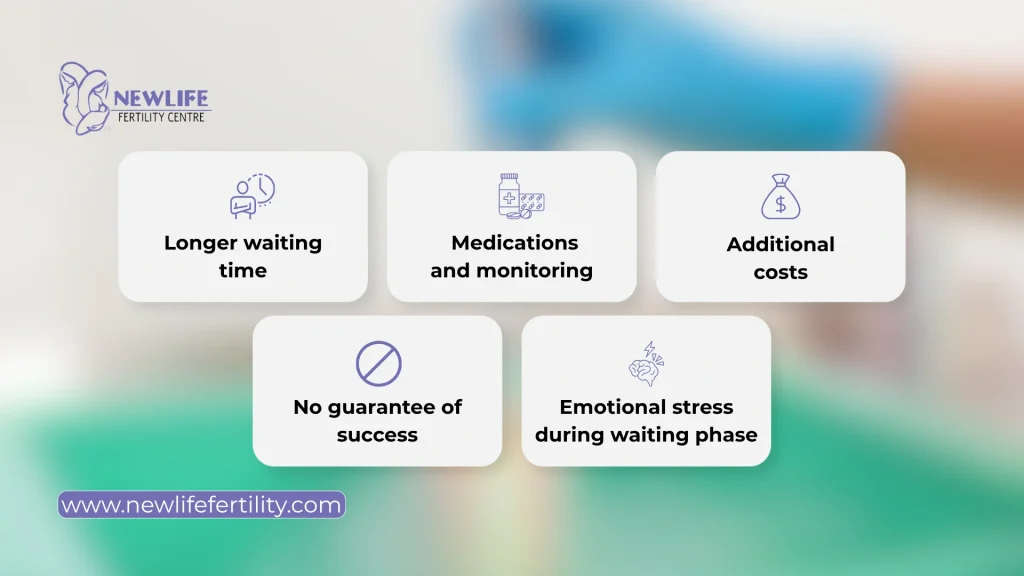
Longer waiting time
With frozen embryo transfer, there is usually more waiting involved.
First, embryos need to be frozen.
Then your body needs time to recover.
Then comes the next cycle and uterine lining preparation before transfer can finally happen.
And if you’ve already been trying to conceive for months or years, even a few extra weeks can feel emotionally exhausting.
For many patients, the uncertainty and waiting become one of the hardest parts of the process.
More medications and monitoring
Most FET cycles still involve treatment and preparation.
Depending on your protocol, this may include:
- hormone tablets or patches
- progesterone medications
- injections in some cases
- ultrasounds and blood tests to monitor the uterine lining and hormone levels
It’s manageable for most women, but it can still feel physically and emotionally tiring.
Especially if you were hoping egg retrieval would be followed by a short “break.”
Additional costs
Frozen embryo transfer can sometimes involve extra costs compared to a fresh transfer cycle.
These may include:
- embryo freezing fees
- storage fees
- medication costs
- monitoring appointments
- the FET procedure itself
The exact cost depends on your clinic, location, and insurance or funding support.
That’s why it’s important to ask for a clear cost breakdown early in the process so there are no surprises later.
No guarantee of success
This is probably the most important thing to understand.
Frozen embryo transfer can improve conditions for implantation, but it cannot guarantee pregnancy.
Even when:
- the embryo quality looks excellent
- the uterine lining appears ideal
- medications and timing are carefully managed
A cycle may still not implant.
And that reality can feel incredibly frustrating.
But failed implantation does not automatically mean your body failed or that something was done wrong. IVF outcomes are influenced by many microscopic biological factors that doctors still cannot fully control.
Emotional stress during the waiting phase
Sometimes, more time also means more overthinking.
You may start asking yourself:
- “What if the embryo doesn’t survive thawing?”
- “What if this cycle fails too?”
- “What if I’m losing time?”
Those thoughts are common. And they’re valid.
The emotional side of IVF is real, especially during the waiting periods between retrieval, preparation, and transfer.
Having emotional support, whether from your clinic, a counsellor, your partner, or someone you trust, can make this phase much easier to handle.
Risks of frozen embryo transfer
Now let’s talk about actual medical risks, not just inconveniences or emotional challenges.
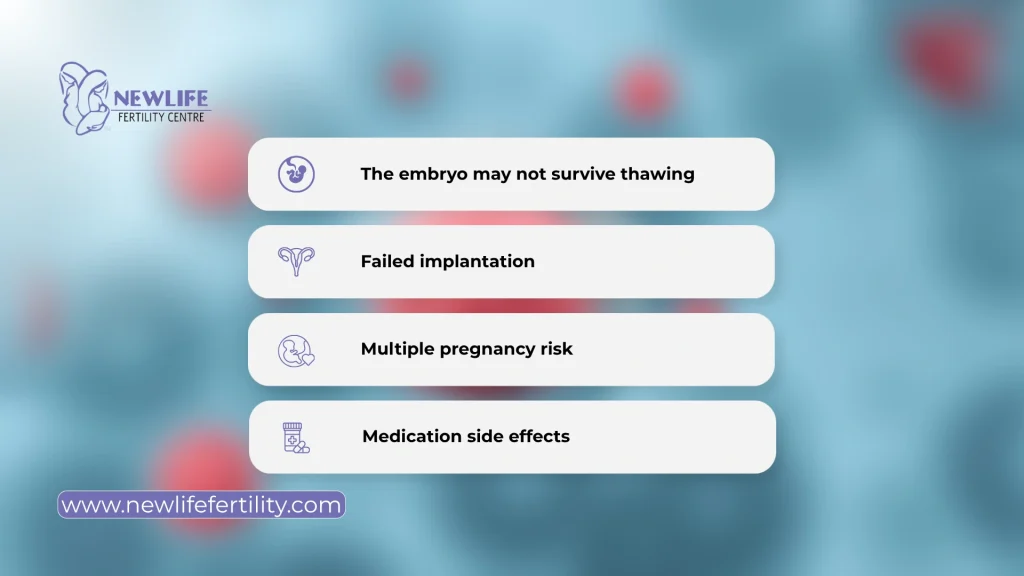
The embryo may not survive thawing
Modern vitrification technology has dramatically improved embryo survival rates after thawing, often above 90%.
But very high does not mean 100%.
In rare situations, an embryo may not survive the thawing process or may not continue developing as expected afterward.
Your clinic will usually discuss backup plans and how many embryos may be thawed during your cycle.
Failed implantation
Even when:
- the embryo looks healthy
- the uterine lining appears ready
- timing is carefully planned
Implantation can still fail.
This can happen in both fresh and frozen embryo transfers.
And emotionally, it can be one of the hardest parts of IVF.
But failed implantation usually does not mean your body “failed.” Often, it simply means a very complex biological process did not align in that specific cycle.
Multiple pregnancy risk
If more than one embryo is transferred, the chance of twins or higher-order multiples increases.
While that may initially sound positive, multiple pregnancies also carry higher medical risks for both the mother and babies.
That’s one reason many fertility clinics now encourage single embryo transfer whenever appropriate.
Medication side effects
The medications used during FET preparation can sometimes cause side effects such as:
- bloating
- headaches
- breast tenderness
- fatigue
- mood swings or irritability
Most side effects are temporary and manageable, but they can still affect day-to-day life.
If anything feels severe, unusual, or emotionally overwhelming, it’s always worth discussing with your doctor.
Is frozen embryo transfer better than fresh transfer?
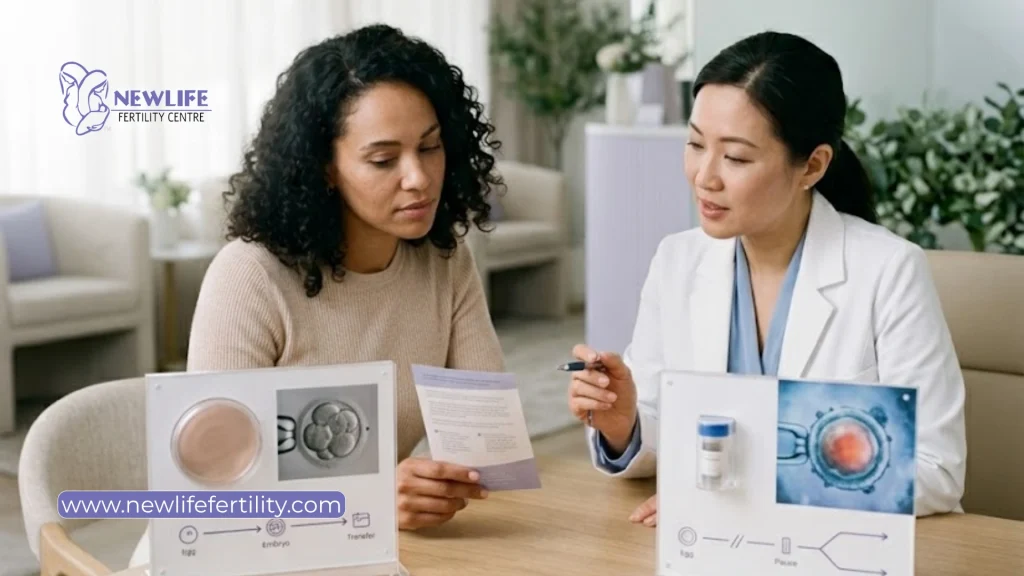
The honest answer?
Sometimes yes. Sometimes not.
It really depends on your body, your IVF response, and your overall treatment plan.
Many studies and clinic experiences now show that frozen embryo transfer can offer equal or even higher success rates compared to fresh transfer, especially when the uterus benefits from a calmer hormonal environment and embryos are carefully selected.
But that does not automatically mean frozen transfer is always the better option for everyone.
In some cases, especially for certain low-risk or low-prognosis patients, a fresh transfer may still make complete sense.
So instead of saying:
“FET is always better.”
A more accurate statement would be:
Many clinics now prefer frozen embryo transfer because it offers more control, safer timing, and better preparation in many IVF cases. But the best option should always be personalized based on your hormones, age, diagnosis, embryo quality, and overall fertility picture.
Who may benefit most from frozen embryo transfer?
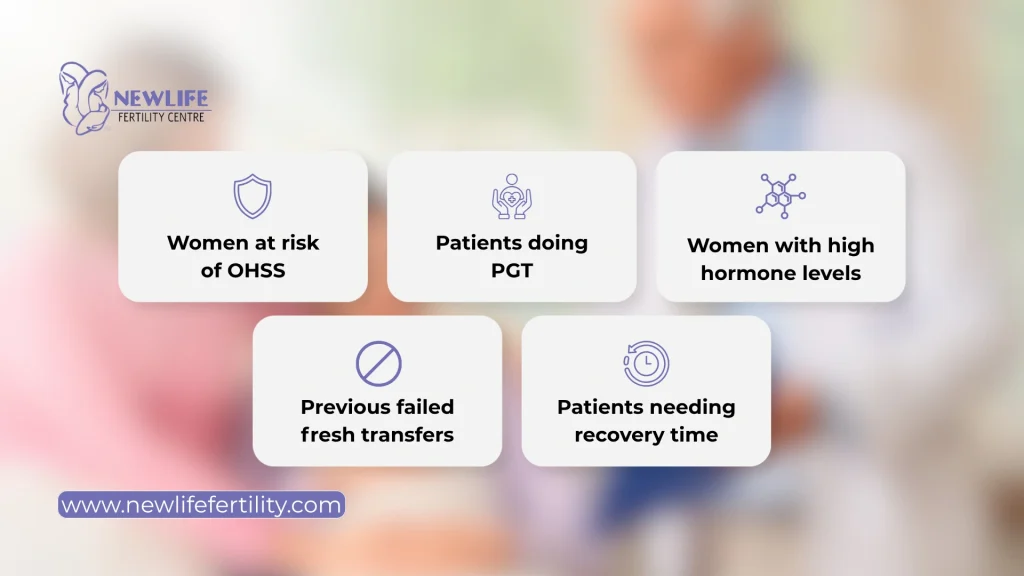
Frozen embryo transfer is often especially helpful for certain groups of IVF patients.
Women at risk of Ovarian Hyperstimulation Syndrome
Women with PCOS or a very strong response to stimulation medications are often advised to avoid fresh transfers.
A freeze-all approach followed by FET gives the body time to recover and significantly lowers the risk of OHSS complications.
Patients doing PGT
If embryos are being genetically tested, frozen transfer is usually part of the process.
Freezing gives the lab enough time to test embryos properly and allows doctors to transfer embryos with normal chromosomal results later.
Women with very high hormone levels during IVF
Sometimes estrogen levels become extremely high during stimulation, or the uterine lining does not look ideal during the fresh cycle.
In these situations, freezing embryos and transferring later may improve implantation conditions.
Women with previous failed fresh transfers
If a good-quality embryo fails during a fresh cycle, doctors may recommend trying again in a more stable FET cycle.
The calmer hormonal environment may offer better implantation conditions in some patients.
Patients who need more recovery time
Not everyone feels physically or emotionally ready for transfer immediately after retrieval.
Some women genuinely benefit from taking time to recover, process everything, and approach transfer feeling more prepared overall.
Who may not need frozen embryo transfer?

Frozen transfer is not automatically necessary for every IVF patient.
Some women may still do very well with fresh embryo transfer, especially if:
- hormone levels remain stable
- the uterine lining looks healthy
- there is little or no OHSS risk
- embryo quality looks strong
In these situations, going straight into fresh transfer may:
- shorten the overall IVF timeline
- avoid extra freezing and thawing steps
- reduce additional costs
And for some patients, that may be the right decision.
The goal is not to follow trends.
It’s to choose the approach that best fits your specific situation.
How successful is frozen embryo transfer?

On a broader population level, frozen embryo transfer often shows very strong success rates and, in many clinics, performs similarly to or better than fresh transfer.
But your personal chances depend on several important factors, including:
- your age at the time eggs were retrieved
- embryo quality
- whether PGT testing was used
- uterine lining health
- hormone balance
- underlying fertility conditions like PCOS, endometriosis, or male-factor infertility
That’s why generic internet statistics can only tell you so much.
Your clinic can give you a more meaningful estimate based on patients with situations similar to yours.
What should you ask your doctor before choosing FET?

Before deciding on frozen embryo transfer, it helps to walk into your appointment with clear questions prepared.
You may want to ask:
- Why are you recommending FET instead of fresh transfer in my case?
- What are my estimated success chances with each option?
- How long will the waiting period be?
- What medications will I need during the FET cycle?
- What side effects should I expect?
- What are the total costs, including freezing and storage?
- How many embryos would you recommend transferring?
- If this transfer fails, what would the next step look like?
And remember:
Good fertility doctors expect these questions.
You are not being difficult or negative by asking them.
You’re being informed, thoughtful, and involved in your own treatment decisions.
So, are the advantages of frozen embryo transfer worth it for your IVF journey?
Frozen embryo transfer is not automatically “good” or “bad.”
It’s a medical strategy. One that fertility specialists use to create the best possible conditions for implantation, pregnancy, and overall safety based on your unique situation.
For many patients, the advantages of frozen embryo transfer can be significant:
- better uterine preparation
- lower risk of Ovarian Hyperstimulation Syndrome in some cases
- time for genetic testing
- improved flexibility and planning
- strong success rates with modern freezing technology
At the same time, it’s important to acknowledge the disadvantages too. The waiting period can feel emotionally exhausting. There may be additional medications, monitoring appointments, and extra costs. And like every IVF treatment, frozen embryo transfer still comes with uncertainty.
That’s why there is no one-size-fits-all answer here.
The right decision depends on your body, your hormone levels, your embryo quality, your medical history, and honestly, what feels manageable for you emotionally as well.
If all of this feels overwhelming right now, that’s completely understandable.
You do not have to figure it out alone.
At NewLife Fertility, our team helps patients understand their options clearly, honestly, and without pressure. Whether you’re deciding between fresh vs frozen transfer or trying to understand what gives you the best chance moving forward, we’re here to guide you through it step by step.
If you’d like personalized guidance for your IVF journey, you can book your free consultation with our fertility specialists and get answers tailored to your situation.
Frequently asked questions about advantages and disadvantages of frozen embryo transfer (FET)
Frozen embryo transfer can offer several benefits, including better uterine preparation, lower risk of Ovarian Hyperstimulation Syndrome in high responders, time for genetic testing, and more flexibility in scheduling treatment. Modern FET cycles also show strong success rates in many clinics, with pregnancy outcomes that are often comparable to or sometimes higher than fresh embryo transfers.
The disadvantages of frozen embryo transfer may include a longer waiting period between egg retrieval and transfer, additional medications and monitoring appointments, and extra costs related to freezing and storage. Some patients also find the emotional side of waiting and uncertainty difficult, especially since IVF treatment still comes with no guaranteed outcome.
For women with high hormone levels or increased risk of OHSS, frozen embryo transfer is often considered the safer option because it allows the body time to recover before pregnancy begins. In other situations, both fresh and frozen transfer can be safe, and the right approach depends on your individual fertility profile and medical history.
Frozen embryo transfer risks include a small chance that embryos may not survive thawing, failed implantation despite good embryo quality, and the possibility of multiple pregnancy if more than one embryo is transferred. Some women may also experience medication side effects such as bloating, headaches, fatigue, or mood changes during the preparation phase.
With modern vitrification technology, frozen embryos generally do not have lower success rates. In fact, many studies now show similar or even higher pregnancy and live birth rates with frozen embryo transfer in certain patient groups. Success still depends on factors like age, embryo quality, uterine health, and overall fertility diagnosis.
Doctors often recommend frozen embryo transfer because it allows better control over hormone levels and uterine lining preparation. It can also reduce OHSS risk, provide time for genetic testing, and create a more stable environment for implantation. In many IVF cases, this extra preparation can improve overall treatment planning and outcomes.