If you’re reading this, you may have been dreaming of a baby for months, or even years, and wondering, “How can I afford this?” You are not alone. The journey to grow your family can be full of emotions, stress, and uncertainty, but financial worries shouldn’t be a roadblock.
This is where the Ontario Fertility Program (OFP) comes in. It helps people in Ontario get financial support for IVF (In Vitro Fertilization) so you can focus on your journey without the constant worry of high costs.
In this blog, I will guide you through everything you need to know to apply for IVF funding in Ontario, including eligibility, the step-by-step process, what the funding covers, and important 2026 updates such as the new Ontario Fertility Treatment Tax Credit.
What is Ontario Fertility Program?
The Ontario Fertility Program (OFP) is a government-funded program designed to support people who need IVF to have a baby. It is intended to reduce the financial burden of fertility treatments and make IVF more accessible for those who need it.
The program covers one full IVF cycle per person, including:
- Physician/nurse assessments and counselling
- Up to two attempts at cycle monitoring
- Certain blood and urine tests
- Certain ultrasounds
- One attempt at egg retrieval
- Sperm collection or, if required, one attempt at surgical sperm retrieval using certain techniques
- Fertilization and embryology services, including intra-cytoplasmic sperm injection (ICSI), assisted hatching, and blastocyst culture
- One-at-a-time transfer of all embryos (fresh/frozen)
- Embryo freezing, thawing, and culture
However, the program does not cover all costs. Fertility medications, donor eggs or sperm (purchase, shipping, and storage), embryo storage, and genetic testing are usually not included, though some of these costs can be offset by the new 2026 Ontario Fertility Treatment Tax Credit.
If a donor or surrogate has a valid OHIP card, their related clinical services may be funded under OFP even though the purchase or storage cost is not.
The OFP is a crucial support system for anyone struggling with infertility, whether you are a single parent, part of a same-sex couple, or a traditional couple. It ensures that access to IVF support is determined by medical need, not by financial ability.
Those who have acted or are acting as surrogates may be eligible for one additional funded IVF cycle per lifetime.
Who can apply for IVF funding in Ontario?

Not everyone can get funding, so it’s good to check your eligibility before applying. Here’s what you need to know:
Residency
You must live in Ontario and have a valid OHIP card. OHIP stands for Ontario Health Insurance Plan, which allows you to access health services in the province.
Age limit
You must be under 43 years old to be eligible for the funded IVF cycle.
Medical requirement
IVF must be medically necessary. This could include low-quality eggs or sperm, blocked fallopian tubes, or other fertility challenges that prevent natural conception.
Family structure
It doesn’t matter if you are single, married, or in a same-sex relationship. Anyone who faces difficulty having a baby can apply.
The best part about the program is, it ensures fair access for all residents who qualify.
With this, many people in Ontario can take one big worry off their shoulders: the cost!
Step-by-step: How to apply for IVF funding in Ontario
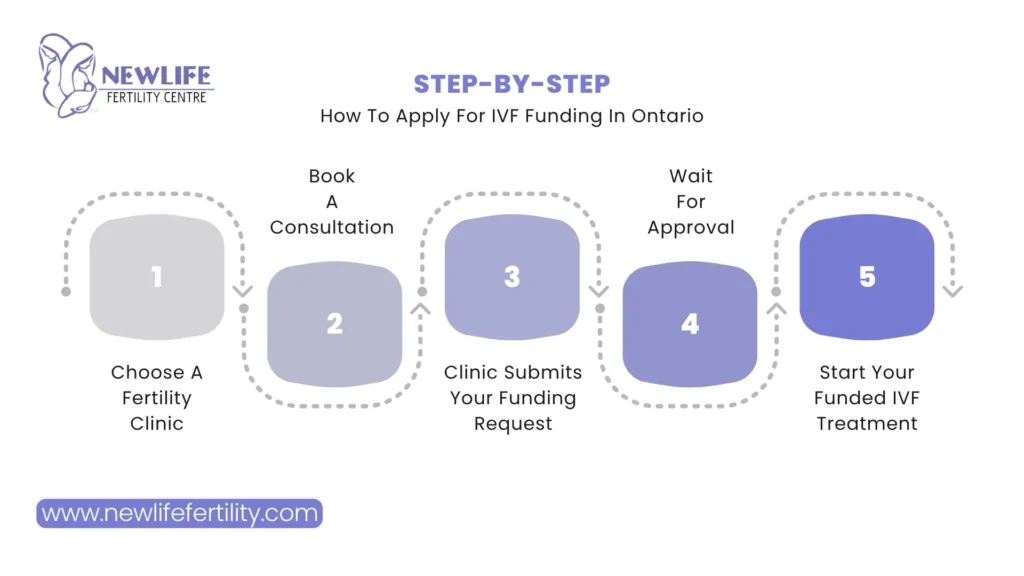
Applying for IVF funding may feel complicated, but it is straightforward when you follow the right steps. Here’s a clear, detailed guide:
Step 1: Choose a fertility clinic
Select a clinic that participates in the OFP. Only clinics approved by the program can offer government-funded IVF. For example, NewLife Fertility Centre is a trusted and experienced clinic in Ontario.
Step 2: Book a consultation
Schedule an appointment to meet with the doctor. They will assess your health, review your fertility history, and confirm whether IVF is the right option for you.
Step 3: Clinic submits your funding request
Once you are approved by the doctor, the clinic will submit your funding application to the government on your behalf.
Step 4: Wait for approval
Funding approval can take several weeks. Use this time to prepare emotionally, gather information, and ask any remaining questions.
Step 5: Start your funded IVF treatment
Once approved, the clinic will guide you through the IVF process. A funded IVF cycle officially begins at egg retrieval or embryo thaw and ends once all viable embryos have been used or certain clinical conditions are met.
What the funding covers (and what It doesn’t)
Now, this part is important. The Ontario Fertility Program helps a lot, but it doesn’t pay for everything. Let’s see what’s included and what’s not.
| OFP Coverage | ✅ Included | ❌ Not Included (Patient Cost) |
|---|---|---|
| IVF Cycle Fee (Lab Work, Retrieval, Transfer) | ✓ One full cycle per person per lifetime | × |
| Fertility Medications (Hormones) | × | ✓ Often covered by insurance or 2026 Tax Credit |
| Donor Eggs or Sperm | ✓ Clinical services for OHIP-holding donors | ✓ Purchase, shipping, and storage costs |
| Embryo Storage / Genetic Testing (e.g., PGT-A) | × | ✓ |
| Cycle Monitoring, Physician & Nurse Counselling, ICSI, Assisted Hatching, Blastocyst Culture, Embryo Freezing/Thawing | ✓ Covered where medically necessary | × |
| Psychologist/Social Worker Counselling, Optional Tests, Services for Non-OHIP Participants | × | ✓ |
It’s also worth noting that the Ontario Fertility Program funds additional fertility services such as Artificial Insemination (AI/IUI) and Fertility Preservation (FP), which may help those pursuing other fertility pathways.
New for 2026: Ontario Fertility Treatment Tax Credit
Ontario now offers a refundable tax credit to help with IVF-related costs. This is especially helpful for expenses that the OFP does not cover.
- Amount: 25% of eligible fertility expenses, up to $5,000 per year (based on $20,000 in expenses)
- Covers: Medications, embryo storage, genetic testing, and other IVF-related costs not funded by the OFP
Example scenario:
Let’s imagine Sara, who is trying IVF in Ontario. The OFP covers her main IVF procedure, but she still needs to pay for:
- Fertility medications: $4,000
- Embryo storage: $1,500
- Genetic testing: $2,500
Total extra expenses: $8,000
With the 2026 Ontario Fertility Treatment Tax Credit, Sara can claim 25% back on these expenses:
25% of $8,000 = $2,000
✅ Sara gets $2,000 refunded, which reduces her out-of-pocket cost from $8,000 to $6,000.
This way, even though the OFP doesn’t cover everything, the tax credit helps families like Sara save money, making IVF more affordable and less stressful.
IVF funding Ontario: When hope turns into life
For many families, IVF funding is not just about money, it’s a chance to make their dream come true. Every cycle, every test, and every visit to the doctor brings them one step closer to holding their baby in their arms.
The Ontario Fertility Program plays a huge role in turning that dream into reality. It supports couples, single parents, and LGBTQ+ families who once thought IVF was out of reach, helping them get closer to hearing that first, magical cry in their home.
At first, the funding might seem small, but when you see how many families it helps every year, you’ll understand just how significant a difference it makes.
With the right guidance from NewLife Fertility Centre, patients can move through every step with confidence and care. Because IVF is not just about science, it’s about love, patience, and the hope that finally turns into life.
Finding the right clinic gives you comfort, confidence, and support. And while finding and deciding all these I just wanted to let you remember, the first step isn’t a medical procedure; it’s a conversation. You don’t need to have all the answers now. You just need to decide to start.
Ready to turn hope into action? Explore all your options, including eligibility for OFP funding and the 2026 Ontario Fertility Treatment Tax Credit.
Grab your free consultation today at NewLife Fertility Centre. Science with empathy.
FAQs about IVF funding Ontario & Ontario Fertility Program
No, IVF is not completely free. The OFP covers one full IVF cycle for eligible residents, including lab work, egg retrieval, and embryo transfer. However, medications, donor eggs or sperm, embryo storage, and genetic testing are not included.
To qualify for the OFP, you must:
Be a resident of Ontario with a valid OHIP card
Be under 43 years old
Need IVF for medical reasons (e.g., low-quality eggs/sperm, blocked tubes, or other infertility issues)
The program is inclusive of single parents and LGBTQ+ families.
Funding approval usually takes a few weeks after your clinic submits your application. The timing may vary depending on the number of applications being processed. Your fertility clinic will keep you updated.
Under the OFP, each person is eligible for one funded IVF cycle per lifetime. However, if you have acted or are acting as a surrogate, you may be eligible for an additional funded cycle. Always discuss your specific situation with your fertility clinic.
The tax credit covers 25% of eligible IVF-related expenses up to $5,000 per year. This includes:
Fertility medications
Embryo storage
Genetic testing
Other IVF-related costs not funded by the OFP
Yes! Many families use a combination of OFP funding, the 2026 tax credit, and private insurance to cover IVF-related expenses, reducing out-of-pocket costs significantly.
Only clinics registered under the OFP can provide government-funded IVF. You can check the clinic’s website or ask them directly. Choosing a trusted clinic like NewLife Fertility ensures smooth application and guidance throughout the process.
The OFP does not cover donor eggs or sperm, but these costs may be partially offset using the 2026 tax credit or private insurance. Your fertility clinic can help you plan for these expenses.