“Is IUI painful?”
“Will it work for us?”
“How is intrauterine insemination different from IVF?”
I hear these questions all the time from couples like you who’ve been trying to conceive but hitting a wall.
And honestly?
The confusion around fertility treatments is real.
Google gives you medical jargon. Fertility clinics throw fancy terms at you. Doctors explain it too fast. And somewhere in between, you’re left wondering: “What the hell is IUI, anyway?”
That’s why I’m writing this.
I’ve worked with hundreds of couples exploring fertility options. And I’ve seen the same confusion happen over and over again.
Here’s what I know for sure:
IUI (intrauterine insemination) is often the first thing your fertility doctor will recommend. It’s simpler than you think. Less invasive than you fear. And way more straightforward than the internet makes it sound.
Let me break it down for you.
In plain English.
Without the B.S.
What is intrauterine insemination?
Okay, here’s the simplest way to think about it.
Your body is trying to make a baby naturally. The sperm swims up. The egg comes down. They meet. Baby happens.
Sounds simple, right?
But sometimes, that “meeting” isn’t happening.
The sperm can’t make the journey. The timing is off. Cervical mucus is blocking the way. Or something else is getting in the way.
That’s where intrauterine insemination comes in.
What is IUI?
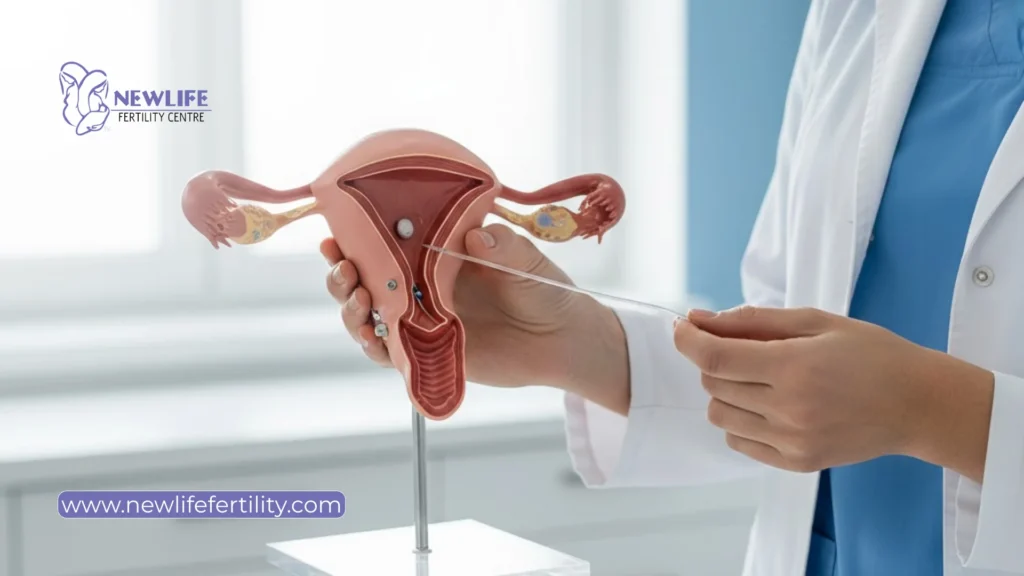
IUI is a procedure where we take sperm and place it directly inside your uterus, close to the egg.
That’s the basic IUI definition.
No big mystery. No complex science.
Instead of waiting for sperm to swim all the way from your cervix through your uterus and then somehow find the egg somewhere in your fallopian tubes, we’re shortcutting the journey.
We’re saying: “Here’s the sperm. Here’s where the egg is. Now you two figure it out.”
It’s not making a baby for you. It’s just making insemination easier by helping the sperm reach the egg more directly.
Think of it like removing roadblocks so the sperm can actually do its job.
You might hear this procedure called artificial insemination in some contexts, though intrauterine insemination is the precise medical term for this specific procedure.
What is an IUI procedure? Who is it for?
Women and couples who are trying to conceive but something is getting in the way of that natural meeting between sperm and egg.
You’ll see the term “IUI treatment” thrown around a lot. Really, it’s just this one procedure. Simple. Direct. Designed to help nature along.
That’s the whole thing.
How does intrauterine insemination work? (IUI process step-by-step)
Alright, let’s walk through what actually happens.
This isn’t scary. It’s straightforward.
Understanding the IUI treatment process helps remove anxiety about what’s coming.
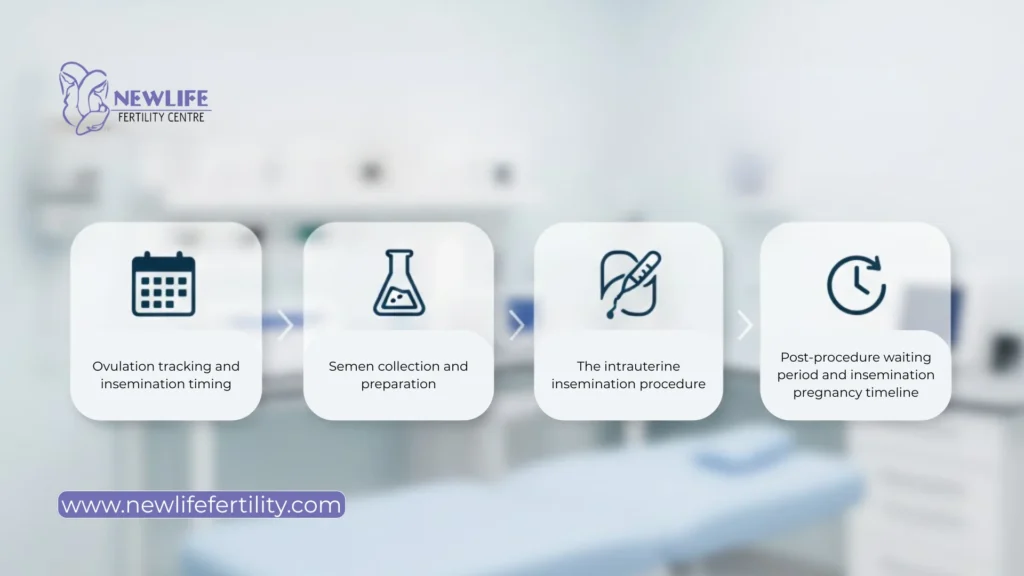
Step 1: Ovulation tracking and insemination timing
First, your doctor needs to know exactly when you’re ovulating.
Some clinics monitor your natural cycle using ultrasounds and blood tests. They’re watching to see when your egg is about to release.
This is critical timing because insemination works best when it happens close to ovulation. When does insemination occur? Right around the time your body releases the egg.
Other clinics give you mild fertility medications (like Clomid) to stimulate your ovaries slightly. This helps them predict ovulation more accurately.
Either way, the goal is the same: Know when the egg is coming.
Step 2: Semen collection and preparation
The guy (your partner or a donor) provides a semen sample on the day of the procedure.
Here’s where it gets interesting.
The sample doesn’t go straight into the uterus.
First, the lab “washes” it. This sounds weird, but it’s smart. They separate the healthy, fast-moving sperm from the rest. They’re basically creating a super-concentrated batch of the best swimmers.
This takes about an hour.
Step 3: The intrauterine insemination procedure
This is the moment everyone worries about.
You lie back. Similar to a Pap smear. The doctor uses a thin catheter (a tiny tube) to place the prepared sperm directly into your uterus.
Does intrauterine insemination hurt?
For most women: No. Maybe mild cramping. Nothing you can’t handle.
The whole insemination procedure takes about 5-10 minutes.
Step 4: Post-procedure waiting period and insemination pregnancy timeline
After the insemination, you rest for a few minutes.
Then you go home.
And then… you wait.
The sperm is now inside your uterus, positioned close to where the egg should be.
The fertilization either happens naturally over the next few hours, or it doesn’t.
You’ll take a pregnancy test about 12-14 days later to see if an insemination pregnancy occurred.
That’s the IUI treatment process. Start to finish.
Who is intrauterine insemination recommended for?

Here’s the thing: intrauterine insemination isn’t a one-size-fits-all treatment.
Your fertility doctor recommends it when there’s a specific reason it’ll help.
Unexplained infertility
You’ve been trying for months, tests show everything looks normal, but conception still isn’t happening. IUI treatment gives sperm a better shot.
Mild male factor infertility
The sperm count is low, or motility is weak. IUI’s “washing” process concentrates the healthy swimmers, making their job easier.
Ovulation issues
You’re not ovulating regularly, or your ovulation timing is unpredictable. Once we stabilize your cycle with mild medication, insemination therapy works well.
Cervical mucus problems
Sometimes cervical mucus is too thick or acidic, blocking sperm. Intrauterine insemination bypasses this completely.
Single women or same-sex couples
Using donor sperm? Intrauterine insemination is often the most straightforward, affordable option.
Couples trying for a second child
If you got pregnant naturally once but now you’re struggling, IUI and pregnancy can happen through this treatment.
If you fit one of these categories, intrauterine insemination might be your doctor’s first recommendation.
And honestly?
That’s usually a good sign. It means they think you have a solid chance without going through something more complex.
Is IUI surgery? Is intrauterine insemination painful or safe?

Let’s address the elephant in the room.
The biggest fear I hear: “Is intrauterine insemination painful?”
I get it. You’re nervous.
But here’s the truth.
The insemination itself? Most women describe it as uncomfortable at worst, not painful. Similar to a Pap smear. Maybe some mild cramping. Some women feel nothing.
A few report sharper cramping if their cervix is positioned differently, but even that is rare.
The procedure lasts 5-10 minutes.
You can absolutely handle 5-10 minutes.
Is IUI safe? Is intrauterine insemination surgery?
Let me be clear: intrauterine insemination is not surgery. It’s a simple procedure that takes minutes.
Yes. 100% safe.
It’s a low-risk procedure. Infection risk is minimal because we’re using sterile equipment and it’s a quick procedure. Bleeding is rare. Perforation of the uterus (the scariest thing people worry about)? Happens in less than 1 in 1,000 cases.
That’s essentially non-existent.
The biggest “side effect” you might experience?
Mild cramping for a few hours afterward. Maybe spotting. That’s genuinely it.
Want to know the contrast?
IVF involves a needle going into your ovaries. Egg retrieval. Days of hormonal side effects. Bloating. Bruising.
Intrauterine insemination is the gentle option.
It’s literally the gentler cousin of fertility treatments.
Simple. Quick. Safe. Done.
What is the success rate of intrauterine insemination?

Here’s where I’m going to be honest with you.
IUI success rates vary. A lot.
General success rate range: 10% to 20% per cycle. The success rate of intrauterine insemination depends on many factors.
I know that doesn’t sound great. But here’s the context.
Your natural, unassisted success rate each month (if you’re under 35)? About 20-25%.
IUI treatment slightly improves or matches those odds, depending on your situation.
What affects your success with intrauterine insemination?
- Your age: Women under 30: higher success. Women over 40: lower success. This is just biology.
- The reason for infertility: If it’s male factor infertility, success rates are higher (because washing sperm helps a lot). If it’s unexplained, rates are moderate. If it’s egg quality issues, rates are lower.
- Use of fertility medications: Mild medications slightly boost success. More medications don’t always mean more success.
- Number of cycles: Success compounds. First cycle success is moderate. By cycle 3, cumulative success is much higher.
Here’s what your doctor won’t always say clearly:
IUI works best for specific problems. If your problem is male factor infertility or cervical mucus issues, success rates are genuinely good (20-30% per cycle). If your problem is something else, success rates might be average.
That’s why your doctor will assess your situation and tell you: “Intrauterine insemination treatment is worth trying” or “I think we should consider IVF.”
Trust that guidance. They’ve seen thousands of cases.
Intrauterine insemination vs IVF: what’s the difference?

Here’s the comparison a lot of people need.
You’re confused between intrauterine insemination and IVF. Your doctor mentions both. And you’re wondering: “Which one do I actually need?”
| Factor | IUI (Intrauterine Insemination) | IVF |
| What it does | Places sperm close to egg naturally | Fertilizes egg in lab, implants embryo |
| Procedure complexity | Simple, 5-10 minutes | Complex, requires multiple steps |
| Invasiveness | Mild catheter into uterus | Needle into ovaries for egg retrieval |
| Cost | INR 15,000-30,000 per cycle | INR 1,50,000-3,00,000+ per cycle |
| Success rate | 10-20% per cycle | 30-50% per cycle (varies by age) |
| Time commitment | 1-2 visits per cycle | 10-15 visits over 3-4 weeks |
| Side effects | Mild cramping, maybe spotting | Hormonal side effects, bruising, OHSS risk |
| Who gets it first | Couples with specific male factor, cervical, or unexplained infertility | Couples with blocked tubes, low egg quality, or failed intrauterine insemination |
The key difference:
IUI (intrauterine insemination) lets nature do the fertilizing. IVF does the fertilizing for you.
When doctors recommend each:
- Try intrauterine insemination first if: You have mild male factor, cervical issues, ovulation issues, or unexplained infertility. You want to keep costs down. You want less invasiveness.
- Skip to IVF if: Your tubes are blocked. Your egg quality is a concern. You’re over 40. Intrauterine insemination has failed multiple times.
Think of it like this.
IUI is the training wheels option. It helps you get where you need to go, but you’re still pedaling yourself.
IVF is the motorized option. Someone else is doing the heavy lifting.
Most couples start with intrauterine insemination treatment because it’s simpler, cheaper, and effective for the right situations.
How many IUI cycles are usually tried?

Here’s what your doctor will probably tell you:
“Let’s try 2 to 3 cycles of intrauterine insemination.”
Why 2-3?
Because intrauterine insemination doesn’t work the first time for everyone.
Success compounds with multiple cycles. By cycle 3, your cumulative success chance is actually decent.
But here’s the reframe:
If intrauterine insemination hasn’t worked after 3 cycles, it’s probably not the right treatment for your situation.
That doesn’t mean you’re broken. It means: “IUI worked best for other problems. Your problem needs something different.”
At that point, your doctor will say:
“Let’s reassess. Maybe we try IVF. Maybe we investigate further. Maybe we try a different approach.”
But usually by cycle 3, you have good data.
You know if intrauterine insemination is working for you or not.
Some couples conceive in cycle 1. Some in cycle 3. Some realize after cycle 2 that they need a different path.
All of that is normal.
Common questions about intrauterine insemination (FAQ)

What is intrauterine insemination in simple terms?
It’s a procedure where sperm is placed directly into your uterus near your egg, making it easier for fertilization to happen naturally.
How long does the IUI treatment process take from start to finish?
From your first visit to when you take the pregnancy test? About 4-5 weeks. The actual insemination procedure? 5-10 minutes.
Can I resume normal activities after intrauterine insemination?
Yes. Immediately. Walk out and go about your day. Some doctors suggest taking it easy for a few hours (rest), but there’s no “strict bed rest” requirement. That’s an old myth.
When can I take a pregnancy test after intrauterine insemination?
Wait 12-14 days. Taking it earlier will give you a false negative (because hCG levels are still too low). Those early tests are just heartbreak waiting to happen. Wait for reliable results.
Is intrauterine insemination treatment better with or without medications?
Depends on your situation. Mild medications like Clomid can help with timing and improving egg quality. But natural cycle intrauterine insemination (without meds) can work too, especially if you have regular ovulation. Your doctor will recommend what’s best for you.
Will intrauterine insemination hurt my chances of natural conception later?
No. IUI doesn’t damage anything. If you skip intrauterine insemination and keep trying naturally, you still have the same chances as before.
Is intrauterine insemination only for couples?
No. Single women use intrauterine insemination with donor sperm. Same-sex couples use IUI. You don’t need a male partner.
How soon after intrauterine insemination should I feel pregnancy symptoms?
Pregnancy symptoms appear 1-2 weeks after conception, not right after intrauterine insemination. Most people feel nothing right after the procedure, which is normal.
When should you talk to a fertility specialist about intrauterine insemination?

Here’s something important.
You don’t have to wait until you’ve been trying for 2 years to talk to a fertility doctor.
I know the old guideline is “12 months of trying, then see a specialist.”
But that’s outdated.
That guideline made sense in 1995. Not anymore.
Consider talking to a fertility specialist about intrauterine insemination if:
- You’re over 35 and have been trying for 6 months without success
- You’re under 35 and have been trying for 12 months without success
- You have irregular periods or know you have ovulation issues
- You have a history of pelvic inflammatory disease, endometriosis, or blocked tubes
- Your partner has low sperm count or motility issues
- You just want to understand your fertility options without any pressure to decide
Here’s the thing I want you to understand:
Getting evaluated early doesn’t mean you have to start intrauterine insemination treatment immediately.
It means you get clarity.
You understand what’s actually going on. You know if IUI is an option or if something else makes more sense. You know what your chances are. You know the timeline.
And honestly?
That clarity is worth a lot.
It removes the guesswork. It stops you from spending another year wondering “what if.” It gives you control back.
Understanding IUI with NewLife Fertility Clinic
So what is IUI, really, when you look beyond the medical terms and endless Google searches? It’s a simple, guided nudge that helps sperm meet the egg, reduces guesswork, and gives you a structured, science-backed chance at pregnancy, without jumping straight into IVF.
If you feel stuck, overwhelmed, or just tired of trying to figure it all out alone, you don’t have to. At NewLife Fertility Clinic, our specialists walk you through whether intrauterine insemination makes sense for your unique situation, explain the numbers honestly, and support you at every step: emotionally and medically.
If you’re even a little curious whether IUI might be right for you, now is a good time to talk, ask questions, and get clarity. Book your free consultation.
We’d genuinely love to know where you are in your fertility journey. Because everyone’s path is different.