Before heading toward the key differences between IUI and IVF, let’s first understand what these treatments mean and how they help in starting a family.
At NewLife Fertility Centre, we know that choosing betweenintrauterine insemination (IUI) andin vitro fertilization (IVF) can be confusing.
Both treatments are designed to help people who are facing trouble conceiving naturally. The main difference lies in how and where fertilization happens, either inside the body or in a lab.
Many couples start with IUI because it’s simpler and less costly. Others may choose IVF for better success chances, especially when IUI hasn’t worked.
No matter which path you take, it’s always good to begin withfertility testing. It helps doctors understand what’s stopping pregnancy and guides them toward the best treatment.
This blog will help you learn what makes IUI and IVF different, how each process works, their success rates, and how to choose the right one for you.
What is IUI (intrauterine insemination)?
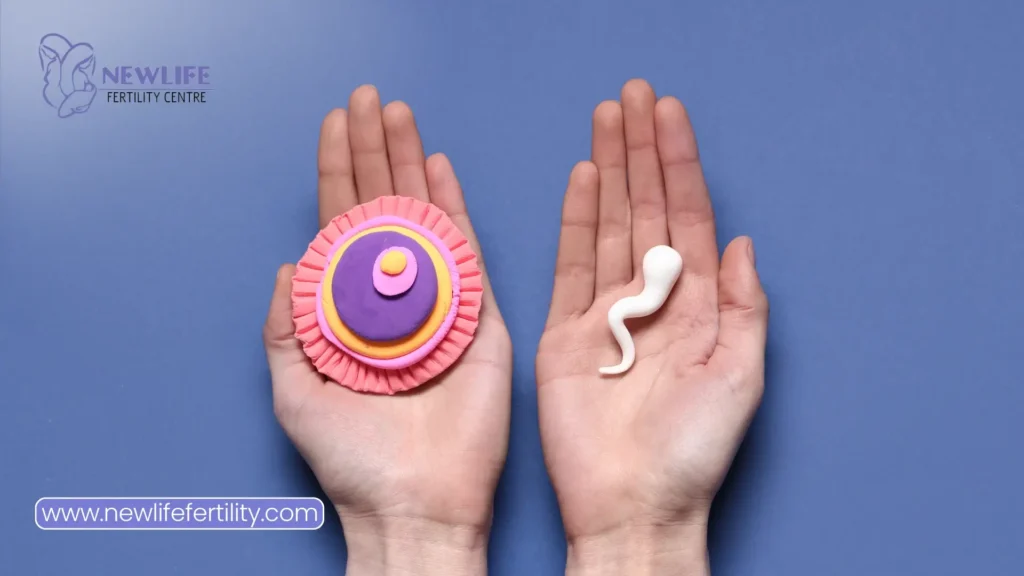
IUI, or intrauterine insemination, is one of the simplest fertility treatments. It helps sperm get closer to the egg inside a woman’s body to increase the chance of pregnancy.
In this process, the doctor places specially washed sperm directly into the uterus during ovulation. This makes it easier for the sperm to meet the egg naturally.
IUI is often used when couples face mild fertility issues, such as low sperm count or trouble with timing. It’s also helpful for single women or same-sex couples using donor sperm.
The goal of IUI is to give sperm a “shortcut” so fertilization can happen more easily. It’s quick, almost painless, and usually takes only a few minutes to complete.
Step-by-step process of IUI

Step 1: Ovulation tracking
The doctor tracks the woman’s ovulation using ultrasound or blood tests. This helps find the best day for insemination.
Step 2: Sperm collection and washing
A sperm sample is collected from the partner or donor. It is then “washed” in the lab to remove weak or slow sperm, keeping only the healthy ones.
Step 3: Insemination procedure
The doctor gently places the prepared sperm into the uterus using a thin, flexible tube. The process is quick and usually painless.
Step 4: Rest and recovery
After insemination, the patient rests for a short while before going home. Normal activities can be continued on the same day.
Step 5: Pregnancy testing
Around two weeks later, a pregnancy test will be done to see if the IUI was successful.
IUI success rate and influencing factors
The success of IUI can change from person to person, depending on age, health, and the cause of infertility.
According to the National Library of Medicine, a study of 758 couples found that the average IUI success rate per cycle is around 10.9%, and the overall pregnancy rate after multiple cycles reaches 19.4%.
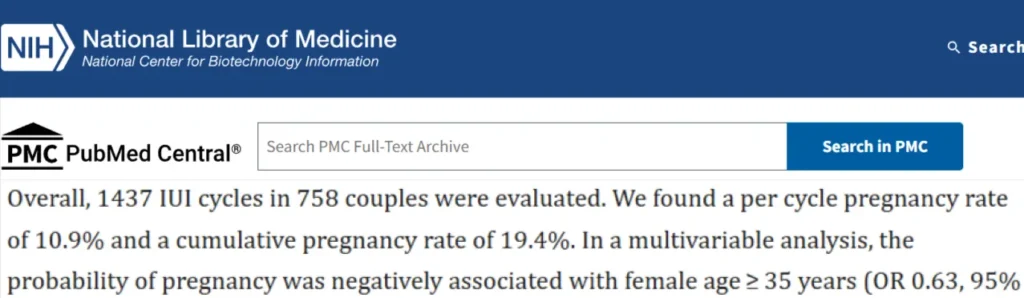
Women under 35 usually have higher chances of success, while the rate tends to drop with age.
A healthy sperm count, proper ovulation, and right timing during insemination also increase the chance of pregnancy.
Following a healthy lifestyle, eating balanced meals, and managing stress can help improve IUI results over time.
Even though the success rate may seem modest, IUI is often the simplest and most natural step to start the fertility journey.
What is IVF (in vitro fertilization)?
IVF, or in vitro fertilization, is one of the most advanced fertility treatments used to help people get pregnant.
In the IVF process, a woman’s eggs are collected and combined with sperm in a lab to form embryos.
Once healthy embryos are created, usually one embryo is carefully placed inside the uterus to help start a pregnancy.
In some cases, doctors may transfer more than one embryo, which can increase the chances of pregnancy but also the possibility of twins or multiples.
IVF is often chosen when other fertility treatments like IUI have not worked or when there are more complex fertility issues.
It gives doctors more control over fertilization and embryo selection, which improves the chances of success.
This treatment is especially helpful for blocked fallopian tubes, low sperm count, or unexplained infertility.
Step-by-step process of IVF
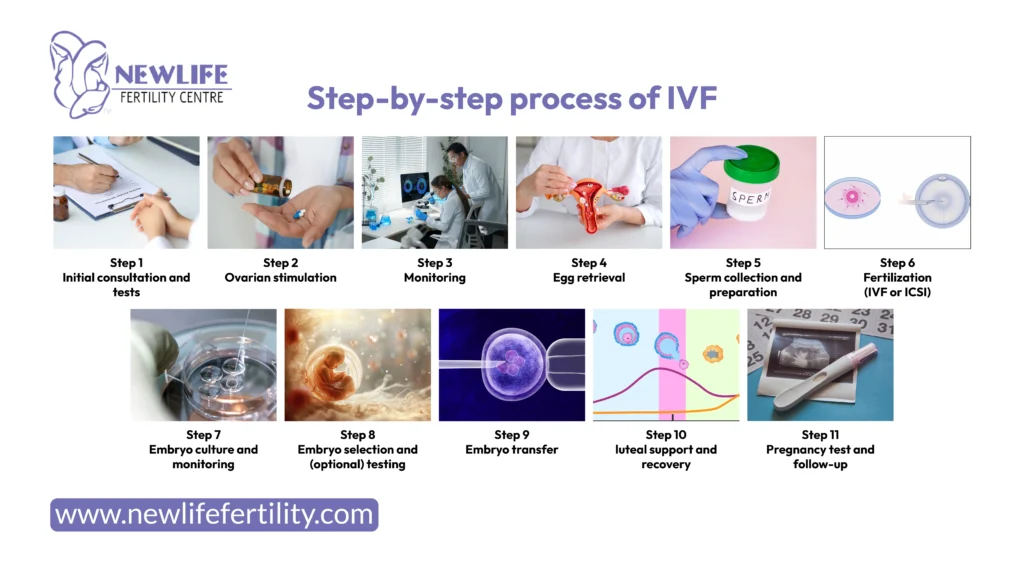
Step 1: Initial consultation and tests
- You meet the doctor to talk about your health and history.
- Doctors suggest tests for eggs, sperm, and the womb to plan the right treatment.
Step 2: Ovarian stimulation
- The woman takes medicines to help the ovaries make many eggs.
- These medicines are given as injections and are watched closely by the doctor.
Step 3: Monitoring
- Doctors check egg growth using blood tests and ultrasound scans.
- This helps pick the best day to collect the eggs.
Step 4: Egg retrieval
- A small procedure takes the eggs out from the ovaries using a needle.
- It is a short procedure, and the care team works to keep the patient comfortable.
Step 5: Sperm collection and preparation
- A sperm sample is collected from the partner or donor on the same day.
- Lab staff clean and prepare the sperm so only the best swimmers are used.
Step 6: Fertilization (IVF or ICSI)
- The eggs and sperm are put together in the lab to start fertilization.
- If needed, a single sperm may be injected into an egg (ICSI) to help it fertilize.
Step 7: Embryo culture and monitoring
- Fertilized eggs become embryos and grow in the lab for a few days.
- Embryologists watch how the embryos develop and pick the healthiest ones.
Step 8: Embryo selection and (optional) testing
- Doctors choose the best embryo(s) to transfer to the womb.
- Some people may choose genetic testing of embryos before transfer.
Step 9: Embryo transfer
- A doctor places the chosen embryo into the uterus using a thin tube.
- This step is usually quick and does not need surgery.
Step 10: luteal support and recovery
- After transfer, hormone medicines help the womb stay ready for pregnancy.
- Patients can rest and resume light activities as advised by the clinic.
Step 11: Pregnancy test and follow-up
- About two weeks after transfer, a blood test checks if pregnancy happened.
- If positive, doctors continue care and plan the next steps for the pregnancy.
IVF success rate and influencing factors

According to the Canadian Fertility & Andrology Society(CFAS), IVF success rates in Canada depend strongly on a woman’s age.
Women under 35 can expect about a 41% live birth rate per embryo transfer. Between ages 35 and 37, this rate falls to 34%, and between 38 and 40, it drops to 24%.
For women aged 41-42, the success rate goes down to 11%, and after 43, it’s around 6%. These numbers have stayed mostly the same in recent years.
The good news is that the IVF success rate in Canada is improving in terms of safety and outcomes. The rate of multiple pregnancies from IVF has dropped by 23% in recent years, even as more IVF cycles were performed.
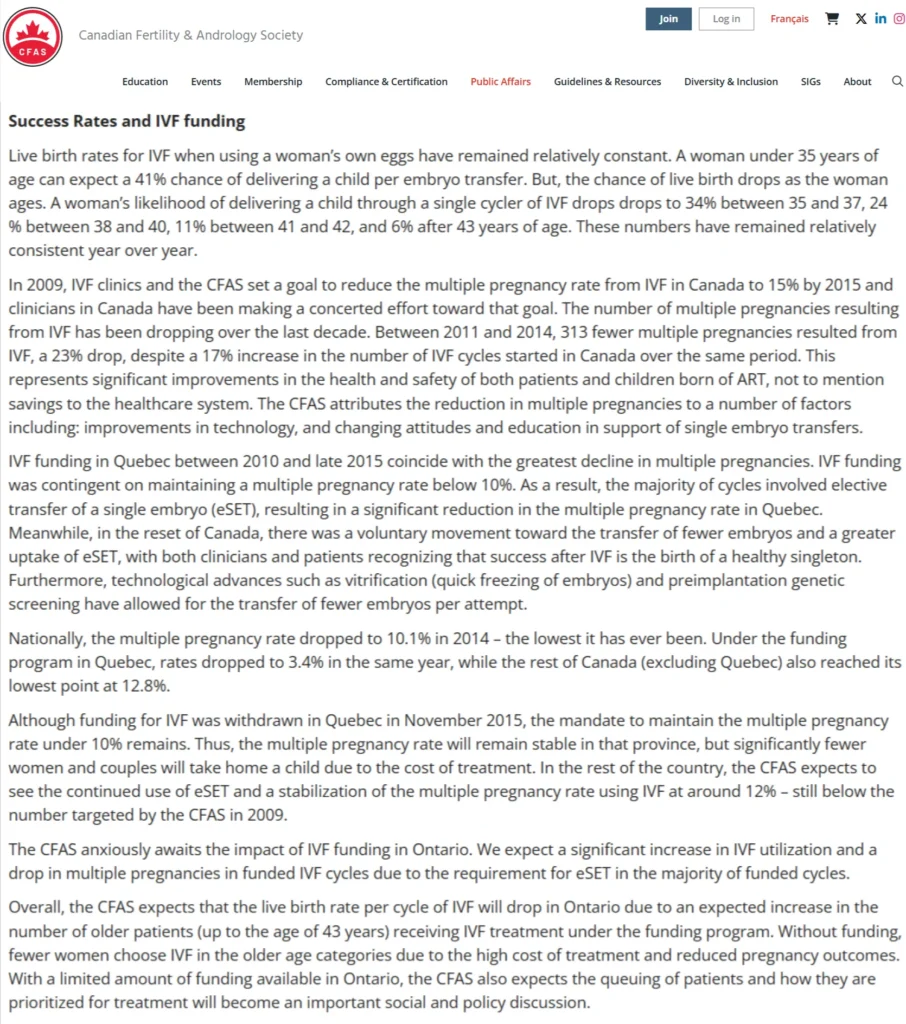
This improvement comes from better technology and a focus on single embryo transfers (eSET), helping reduce health risks for both mothers and babies.
CFAS notes that Ontario’s IVF funding program and the rise of genetic testing and embryo freezing have also improved the success and safety of treatments nationwide.
IUI vs. IVF: Key differences in fertility treatments
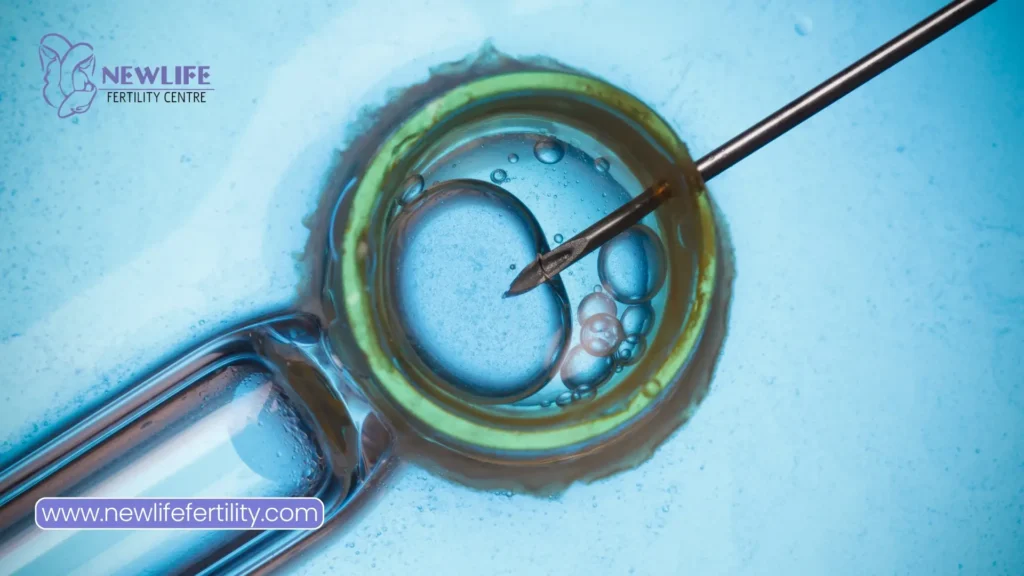
IUI is often the first step for couples with mild fertility issues or unexplained infertility because it’s simple, low-cost, and less invasive. IVF, on the other hand, is chosen when IUI fails or in cases like blocked tubes, advanced age, or severe sperm problems, offering a higher chance of pregnancy through advanced lab technology.
| Aspect | IUI (Intrauterine Insemination) | IVF (In Vitro Fertilization) |
|---|---|---|
| How it works | Sperm is placed directly inside the uterus to meet the egg naturally. | Eggs are taken from the ovaries, fertilized in a lab, and then an embryo is placed in the uterus. |
| Where fertilization happens | Inside the body (in the fallopian tube). | Outside the body (in a lab). |
| Procedure type | Simple and less invasive. | More advanced and involves medical procedures. |
| Use of medication | Often uses mild fertility drugs to trigger ovulation. | Requires stronger medications for egg stimulation. |
| Time taken per cycle | Usually 2–3 weeks. | Usually 4–6 weeks. |
| Success rate (per cycle) | About 10%–20%, depending on age and health. | About 41% for women under 35, and lower as age increases. |
| Best suited for | Couples with mild male infertility, cervical issues, or unexplained infertility. | Couples with blocked tubes, severe sperm issues, or failed IUI attempts. |
| Cost in Canada (average) | $1,000–$1,500 per cycle. | $10,000–$15,000 per cycle. |
| Invasiveness | Minimal or no surgery needed. | More invasive procedures include egg retrieval and embryo transfer. |
| Chances of twins | Low. | Higher if multiple embryos are transferred. |
| Emotional demand | Easier to manage physically and emotionally. | More emotionally and physically demanding. |
| Overall approach | A natural, first-step treatment. | A medically assisted, advanced treatment. |
IUI vs. IVF: Cost comparison in Canada
| Category | IUI (Intrauterine Insemination) | IVF (In Vitro Fertilization) |
| Average base cost per cycle | $1,000–$2,500 | $10,000–$15,000 |
| Medication cost | $50–$200 (Clomid/Letrozole) or $1,500–$5,000 (injectables) | $3,000–$7,000 (fertility stimulation) |
| Cycle monitoring (bloodwork, ultrasounds) | $500–$2,000 | Usually included in base package |
| Sperm preparation or donor sample (if needed) | $500–$1,500 per vial | $1,000–$3,000 (if donor sperm is used) |
| Additional lab procedures | Not required | ICSI: $1,500–$3,000 (if needed) |
| Embryo freezing & storage | Not applicable | $500–$1,200 per year |
| Frozen embryo transfer (FET) | Not applicable | $3,000–$5,000 |
| Preimplantation Genetic Testing (PGT) | Not applicable | $4,000–$8,000 |
| Third-party options (if needed) | Donor sperm IUI: $1,000–$3,000+ | Donor egg IVF: $15,000–$30,000+ |
| Provincial funding | Usually private pay | Ontario covers one IVF cycle under OHIP (excluding meds & extras); Quebec offers partial reimbursement |
| Total estimated cost (one full cycle) | $1,000–$3,500+ | $13,000–$25,000+ depending on medications and add-ons |
| Emotional & physical demand | Mild and short-term | Higher due to longer process and medical procedures |
Note:
- The exact cost of your fertility treatment may vary depending on your personalized plan, medications, and diagnostic results.
- Your final estimate will be provided after a detailed consultation with our fertility experts.
- To know your precise treatment cost and explore available options, register your free consultationwith our fertility specialists.
IUI or IVF: Which fertility treatment is suitable for you?

Choosing between IUI and IVF depends on several personal, medical, and financial factors. While both treatments aim to help you achieve pregnancy, they work differently and are suitable for different fertility challenges.
In general:
IUI is often recommended for couples with mild fertility issues, or unexplained infertility, or when the male partner has slightly low sperm count or motility.
IVF is usually suggested for women with blocked fallopian tubes, severe endometriosis, advanced maternal age, or after several failed IUI attempts.
And here are some of the reasons….
Why consulting a fertility specialist matters

A fertility specialist can help identify the root cause of infertility, whether hormonal, structural, or related to sperm quality, and guide you toward the most effective solution.
Their expertise ensures that:
- Your fertility evaluation covers all essential diagnostics.
- You receive a personalized treatment plan (IUI, IVF, or other assisted reproductive technologies).
- You are aware of the success rates, risks, and timelines before beginning treatment.
- Your emotional well-being is supported through every phase of the process.
At the consultation stage, our fertility experts can also provide an accurate cost estimate, so you can make an informed decision with confidence. And if you still find yourself in a confusing situation, here I have mentioned some of the….
Factors to consider before deciding
Before choosing between IUI and IVF, it’s important to evaluate the following:
| Factors | IUI | IVF |
| Female partner’s age | Best results under 35 | Can be effective up to 43 (with own eggs) |
| Duration of infertility | Suitable for <3 years | Recommended for >3 years or failed IUIs |
| Fallopian tube condition | At least one open tube required | Works even if both tubes are blocked |
| Male factor infertility | Mild cases only | Suitable for mild to severe cases |
| Treatment invasiveness | Minimally invasive | Involves ovarian stimulation and egg retrieval |
| Success rate per cycle | Around 10–20% | Around 40–50% (under 35 years) |
| Cost | Lower | Higher, but more effective per attempt |
Note: Each patient’s fertility journey is unique. What works for one couple may not be ideal for another hence, a customized evaluation is the most reliable way to decide.
Step from IUI to IVF with confidence
We had never given up on you, so how can you?
We understand that the journey to becoming a parent isn’t always easy. Sometimes, IUI doesn’t bring the results you hoped for, and that can feel discouraging. But remember there’s always another way forward.
If you’ve already tried three to six IUI cycles without success, or if you’re over 35, facing blocked tubes, male infertility, or unexplained infertility, it might be time to consider IVF. This treatment offers higher success rates and new hope for many couples.
Hold on to the dream of the moment when tiny hands wrap around your finger and little feet crawl toward you. That dream is still waiting for you. 🌸
✨ Take your next step with confidence.
Book a free consultation with our fertility experts to find the best treatment that feels right for you and understand whether IUI or IVF is right for you.
Frequently asked questions about IUI vs. IVF in Canada
IUI places washed sperm directly into the uterus during ovulation, while IVF combines eggs and sperm in a lab before transferring an embryo to the uterus. IVF is usually more advanced and has higher success rates.
IUI is much more affordable, usually costing between $1,000 – $2,500 per cycle, while IVF can range from $10,000 – $15,000 or more depending on the clinic and medications.
Most fertility experts recommend three to six IUI cycles before switching to IVF, especially if you haven’t conceived or have other fertility challenges.
No, IVF success depends on factors like age, egg quality, and health conditions. Women under 35 have a higher success rate (around 40% per cycle), but it decreases with age.
Both treatments are mostly painless. You may feel mild discomfort during egg retrieval in IVF or slight cramping during IUI, but it’s short-lived and easily managed.
Yes, but success with IUI lowers as age increases. IVF is often recommended for women over 35 because it offers a better chance of pregnancy.
The best way is to consult a fertility specialist who can review your test results, health history, and goals to suggest whether IUI or IVF is more suitable for you.
In Ontario, one IVF cycle is covered under OHIP for eligible patients. Other provinces may offer partial or private coverage depending on the clinic and insurance plan.