There’s something magical about building a family. It’s more than just a scientific procedure. For me, it’s about love, connection, and the desire to share life with someone little who calls you “mom.”
And in my view, every parent deserves that chance, no matter their situation or the challenges they’re facing.
For many couples in the LGBTQIA+ community, starting a family once felt like a faraway dream. But today, with modern fertility treatments and scientific advancements, that dream is closer than ever, especially with guidance and care from the fertility clinics in Canada, where inclusive family-building options like reciprocal IVF are widely supported. And one of the most beautiful paths to making it real is called reciprocal IVF.
Some of you may already know a bit about it, and some might be hearing it for the first time.
No worries at all.
In this guide, we’ll walk through everything you need to know about reciprocal in vitro fertilization:
- What is reciprocal IVF
- How it works for LGBTQIA+ couples
- Step-by-step process
- Success rates
- What to expect
- And how it helps two hearts grow one family
Let’s begin with the basics.
What is reciprocal IVF?

Reciprocal IVF is a fertility treatment designed mainly for same-sex female couples who want to share the journey of having a baby together.
One partner provides the eggs, which makes her the genetic mother.
The other partner carries the pregnancy, which makes her the birth mother.
The eggs are fertilized with donor sperm in a lab. A healthy embryo is then gently placed into the uterus of the partner who will carry the pregnancy.
It is a beautiful way for both partners to participate in creating new life. One creates the beginning. The other carries the growth. Together, they share one family story.
How reciprocal in vitro fertilization supports LGBTQIA+ families

Love makes a family. And today, fertility treatments make it possible for everyone to experience that joy.
Here’s how reciprocal IVF and modern fertility care support different individuals in the LGBTQIA+ community:
Lesbian couples

Reciprocal IVF is one of the most loved options.
One partner donates the eggs, the other carries the baby. Donor sperm fertilizes the egg in the lab.
Both partners share a unique bond: one through genetics and one through pregnancy.
Gay couples

Gestational surrogacy is the usual path.
Typically, one partner provides sperm, donor eggs are used, and a gestational surrogate carries the baby.
This means one partner becomes the biological father of that specific child.
Some couples choose to create embryos using sperm from each partner so that both can become biological fathers, either for different embryos or future children.
Bisexual individuals

Bisexual individuals may choose IVF, IUI, or reciprocal IVF depending on their partner and fertility needs.
Fertility care is flexible and focuses on personal goals.
Transgender individuals

For transgender individuals, fertility care can include:
- Egg or sperm freezing before hormone therapy or surgery, to preserve future family options.
- IVF or surrogacy, if one partner cannot carry or produce eggs/sperm.
This ensures they can still have biological children if they choose to in the future. The goal is simple: to preserve and support future family-building options.
Queer or questioning individuals

For those who are still discovering themselves, clinics provide judgment-free counselling and fertility guidance.
You don’t need to have all the answers right away. Also, fertility experts help you explore safe, supportive ways to plan for a family when the time feels right.
Intersex individuals

Intersex individuals may have both male and female biological traits, and their fertility options can vary widely.
With careful medical guidance, treatments like IVF, ICSI, or surrogacy can help and make parenthood possible.
I know every case is unique, but with compassion and modern medicine, there are many paths to bringing a baby into your life.
Asexual or Allies

Some asexual individuals may still wish to have children through donor programs or surrogacy, even if they don’t experience traditional attraction.
And allies are those who support LGBTQIA+ rights and play a huge part in helping create awareness and inclusivity around fertility care for everyone.
Step-by-step guide for reciprocal IVF
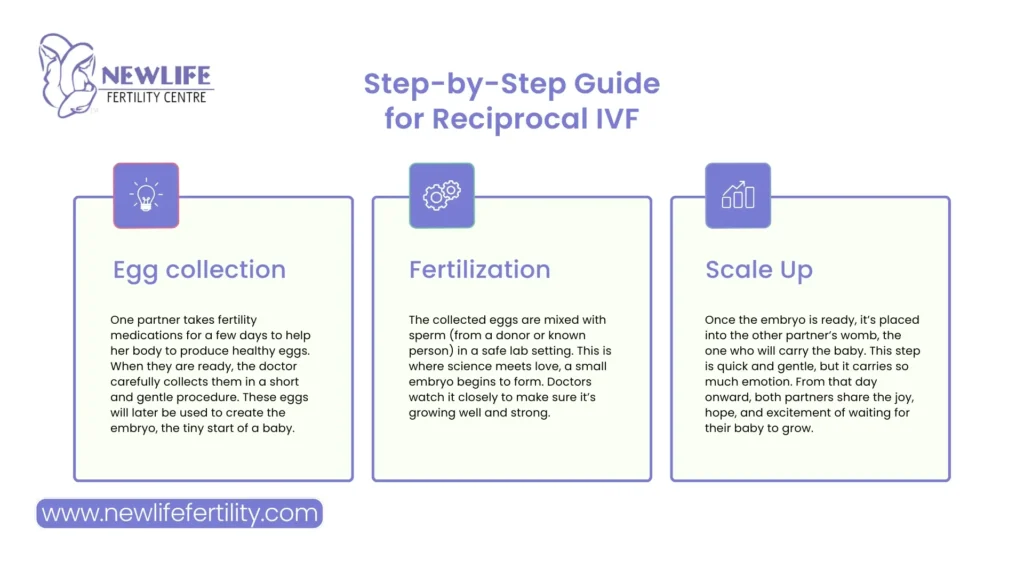
Reciprocal IVF is like teamwork, where both partners play an important role in bringing new life into the world. Let’s see the steps.
Step 1: Egg collection
One partner takes fertility medications for a few days to help her body to produce healthy eggs. When they are ready, the doctor carefully collects them in a short and gentle procedure. These eggs will later be used to create the embryo, the tiny start of a baby.
Step 2: Fertilization
The collected eggs are mixed with sperm (from a donor or known person) in a safe lab setting. This is where science meets love, a small embryo begins to form. Doctors watch it closely to make sure it’s growing well and strong.
Step 3: Embryo transfer
Once the embryo is ready, it’s placed into the other partner’s womb, the one who will carry the baby. This step is quick and gentle, but it carries so much emotion. From that day onward, both partners share the joy, hope, and excitement of waiting for their baby to grow.
Reciprocal IVF: Who gives the eggs, and who carries the baby?

Every couple chooses differently.
Some decide based on medical reasons.
For example, the partner with stronger ovarian health may provide eggs while the other partner carries the pregnancy.
Others decide based on personal wishes.
Maybe one partner has always dreamed of experiencing pregnancy while the other prefers giving the eggs.
Doctors help guide the decision, but the final choice always belongs to the couple.
There is no right or wrong.
One partner creates life at the cellular level.
The other gives that life a safe place to grow.
Both roles are equally beautiful.
Basically, reciprocal in vitro fertilization is a beautiful way of saying, “We made this life together.”
How successful is reciprocal IVF?

Reciprocal IVF success rate depends on factors like:
- The age and health of the partner providing the eggs
- Quality of donor sperm
- Clinic expertise
According to the Human Fertilisation & Embryology Authority (HFEA), female same-sex couples and single women show a birth rate of around 40 percent per embryo transferred, compared to 35 percent for opposite-sex couples.
One key reason is that many same-sex couples use IVF for family-building, not infertility, which often leads to stronger reproductive health and higher success.
Still, IVF is a journey.
It may take more than one attempt, but each step brings you closer to a heartbeat and a dream turning real.
How much does reciprocal IVF cost in Canada?

Reciprocal IVF is a meaningful journey, but understanding the cost is important.
In Canada, the average cost usually starts around $12,000 to $20,000 CAD, depending on factors like:
- Fertility medications (approx. $4,000–$6,000 for retrieval + $2,000–$3,000 for transfer)
- Lab procedures like ICSI or PGT
- Donor sperm (anonymous or known)
- Clinic care, monitoring, freezing, and storage
Some provinces, such as Ontario, offer financial support programs or subsidized IVF cycles for eligible patients.
Always check with your clinic and insurance provider for coverage.
While the investment may feel big, many couples say the moment they hold their baby makes every step worth it.
Things to consider before starting reciprocal IVF

Before starting reciprocal IVF, it’s good to take a moment to think about a few important things, not just with your head, but with your heart too. Here are some gentle reminders:
🧠 Emotional side
Reciprocal IVF can be exciting but also a little stressful. There might be days full of hope and some that feel heavy. Talking openly with your partner and supporting each other makes a big difference.
💪 Physical side
Both partners may take medicines or go through procedures. Eating healthy, staying active, and resting well can help your body prepare for this journey.
💸 Money side
The reciprocal in vitro fertilization process can be costly. So plan your finances early, check for insurance options, or ask your clinic about payment plans.
🤝 Support system
Family, friends, or a counsellor can help you stay grounded during the journey.
Remember, this journey is not just about science. It’s about love, patience, and teamwork. Every couple’s story is unique, and there’s no “right” way to feel.
How to choose the right fertility clinic for reciprocal in vitro fertilization treatment

Finding the right clinic is like finding the right place for your dream to grow. It’s not just about the machines or success rates, it’s about how the place makes you feel.
Here are a few things to keep in mind:
- 💬 Comfort matters: Choose a clinic where you feel safe, seen, and respected no matter who you are or who you love.
- 🧑⚕️ Ask questions: Talk to the doctors and nurses. Ask how they support LGBTQIA+ couples and what their experience is with reciprocal IVF.
- 📈 Success and care: Look for clinics that combine good success rates with real emotional care. A kind, understanding team can make the journey much smoother.
- 💰 Transparency: A good clinic will be open about the costs and steps involved, no hidden surprises.
When you walk into the right clinic, you’ll feel the warmth, the welcome, and the hope that says, “You belong here.”
Final boarding call for your most beautiful journey with reciprocal IVF
Life moves quickly. Between work, responsibilities, and everything we juggle every day, it is easy to keep postponing thoughts about family building. But learning about your fertility is not pressure. It is simply a way to understand your body better and explore your options with confidence.
Knowing where you stand helps you plan your future calmly and clearly. It gives you space to make choices that feel right for you and your partner, at a pace that feels comfortable.
And if you ever need guidance, support, or someone to explain everything in a friendly and caring way, NewLife Fertility Centre is here to help.
If you are wondering whether now is the right time to start, or if you just want answers to a few questions, you can book a free consultation today.
So take your first easy step with a team that truly cares.
Frequently asked questions about reciprocal IVF
Yes, reciprocal IVF is completely legal in Canada. Same-sex female couples can both participate as the egg provider and the birth parent.
Yes. In most Canadian provinces, both partners can be listed as legal parents. Your clinic will guide you on any forms or legal steps needed.
The process is generally well tolerated. Egg retrieval feels like mild cramping for most people, and embryo transfer is usually quick and gentle.
Yes. Some couples choose to switch roles. One partner may give eggs in the first cycle and carry the pregnancy in the next.
Yes. Reciprocal IVF requires donor sperm from either an anonymous or known donor. Your clinic will help you explore options.
A full cycle usually takes six to eight weeks, which includes ovarian stimulation, egg retrieval, fertilization, and embryo transfer.
There is no strict limit, but egg quality naturally decreases with age. Many clinics recommend treatment before the age of 40 for the best results.
Yes. If one partner has frozen her eggs earlier, they can be used in a reciprocal IVF cycle.
Coverage varies. Some private plans may cover medications or diagnostic tests. Ontario also offers funded IVF cycles for eligible patients.
Yes. It is a well-established fertility treatment with strong success rates and low risk when managed by an experienced clinic.
Most clinics recommend transferring a single embryo to reduce the chance of multiples and ensure a safer pregnancy.
It is completely normal. Many couples need more than one transfer. Your doctor will guide you through the next steps with care.