“Is surrogacy actually legal in Canada?”
“How do I even find someone to carry my baby?”
“I’m overwhelmed by the paperwork. Where do I start?”
If you’ve asked yourself these questions recently, take a deep breath. You are not alone.
Every day, hundreds of hopeful Canadians type things like “surrogacy process” or “what is a surrogate” or even search frantically with typos like “surrogacy” or “surrogate,” just trying to find a clear answer.
The internet is full of scary medical jargon and 50-page legal documents.
But building a family shouldn’t feel like a law exam.
It should be clear. It should be safe. And it should be exciting.
So, tag along.
Let me demystify the entire Canadian surrogacy journey for you, from the first definition to bringing your baby home.
Let’s dive in.
What is surrogacy?

In simple terms?
Surrogacy is an arrangement where a woman (the surrogate) agrees to carry a pregnancy and give birth to a baby for another person or couple (the intended parents).
Think of it like a garden.
The intended parents provide the seed (the embryo), and the surrogate provides the safe, nurturing garden for it to grow.
But here is the golden rule for Canada:
Surrogacy in Canada is “altruistic.”
“What does that mean?”
It means that unlike in some other countries, commercial surrogacy is illegal here.
You cannot pay a surrogate a salary, wage, or fee for carrying your child. It is a crime to “buy” this service.
However, you can (and should) reimburse her for the expenses related to the pregnancy, like vitamins, maternity clothes, travel to the clinic, and lost wages if she has to miss work for appointments.
So, whether you spell it surrogacy, surrocacy, or sourgate in your search bar, the core principle in Canada remains the same:
It is a partnership based on generosity, not a business transaction.
Types of surrogacy
You will often hear two main terms thrown around. It is crucial to know the difference before you start.
Traditional surrogacy

In this method, the surrogate is genetically related to the baby.
She uses her own egg, which is fertilized by the intended father’s sperm (usually via artificial insemination).
This is much rarer today and legally riskier because the surrogate has a biological link to the child.
Gestational surrogacy

When you ask, “What is a surrogate’s role in most clinics?” this is the answer.
In gestational surrogacy, the surrogate has no genetic link to the baby.
How?
Doctors use in vitro fertilization (IVF) to create an embryo using the intended parents’ egg and sperm (or donors). That embryo is then transferred into the surrogate’s uterus.
She is carrying your genetic child.
What does gestational surrogacy mean for you?
It means the legal and emotional boundaries are often clearer. This is the path most Canadian fertility clinics recommend.
Why should you choose surrogacy?

“Is this right for us?”
It’s a big decision. But for many, it is the only path to a biological child.
You might choose the surrogacy procedure if:
- You struggle with infertility: Issues with the uterus or previous pregnancy risks.
- You are a same-sex male couple: You need an egg donor and a surrogate to build your family.
- You are a single man: You want to be a father with a genetic connection.
- Medical safety: Pregnancy might be physically dangerous for the intended mother.
The main benefit?
You get to be fully involved in the pregnancy journey attending ultrasounds and feeling kicks, without carrying the physical risks yourself.
What’s the surrogacy process or surrogacy procedure in Canada?
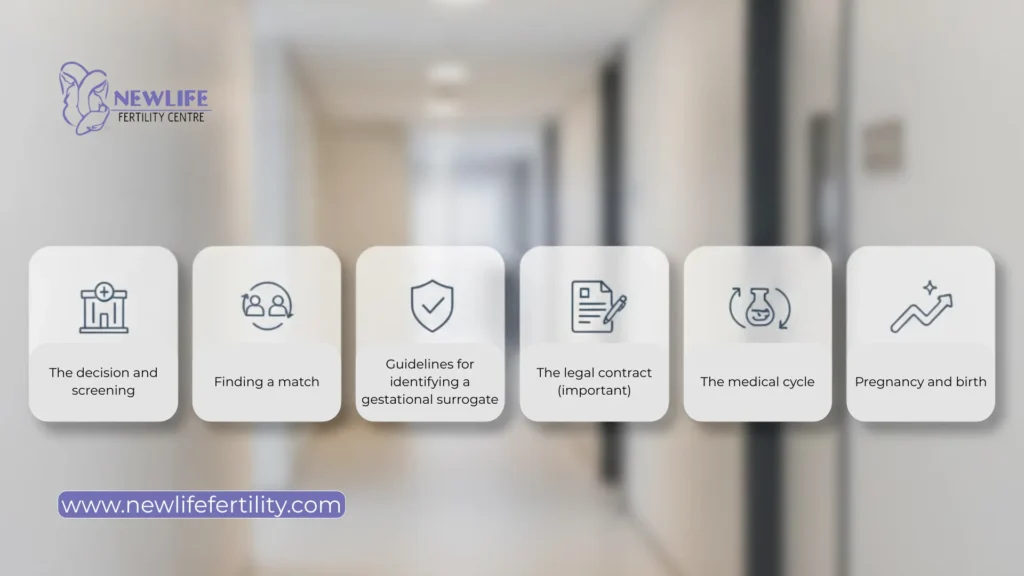
Okay, so how does the roadmap of surrogacy process look?
Well, it’s not an overnight trip. It’s a journey. But we can break it down into manageable steps.
Here is the flow:
Step 1: The decision and screening
Before you find a match, you need to be “medically ready.” This means creating embryos via IVF at a fertility clinic.
Step 2: Finding a match
How do you find surrogacy partners? In Canada, you have two main routes:
Fertility clinic: They help match you with a pre-screened surrogate.
Independent: You find a surrogate through online support groups or friends/family.
Step 3: Guidelines for identifying a gestational surrogate
Whether you use a clinic or go solo, look for these “green flags” in a surrogate:
- She has carried a healthy pregnancy before.
- She has completed her own family (usually recommended).
- She is financially stable (remember, she isn’t doing this for income).
- She has a strong support system at home.
Step 4: Medical screening
Your surrogate will undergo physical and psychological testing at your clinic to ensure she is healthy and ready for the journey.
Step 5: The legal contract (important)
We will cover this in detail below, but do not skip this. No contract = No embryo transfer.
Step 6: The medical cycle
The surrogate takes medication to prepare her uterus lining, and the embryo is transferred.
Step 7: Pregnancy and birth
You wait for that positive test! Then, you support her through the pregnancy until the big day.
Legal process for gestational surrogacy

I was planning to write about the legal part at the end of the blog, but I don’t want to stretch this enough.
So here is the thing I’d like to recommend: Do not DIY the legal part.
Canada has the Assisted Human Reproduction Act (AHR Act), and it is strict.
Here is what the legal side looks like:
Independent legal advice
You cannot share a lawyer.
Meaning, the intended parents need one lawyer, and the surrogate needs her own separate lawyer.
Why? To ensure no one is being coerced and everyone understands their rights.
The surrogacy agreement
This massive document covers everything from expense reimbursements to “What happens if there are twins?” It must be signed before any medical procedures (embryo transfer) take place.
Post-birth parentage
In Canada, how you become the legal parents depends on the province of birth.
In some provinces, the surrogate is initially the parent on paper, and your lawyer gets a ‘Declaration of Parentage’ from a court to list your names instead.
In others, like Ontario and BC, an administrative process lets you go straight onto the birth certificate without a judge.
Either way, a good fertility lawyer makes it a routine, behind-the-scenes paperwork process.
Key surrogacy terms you should know
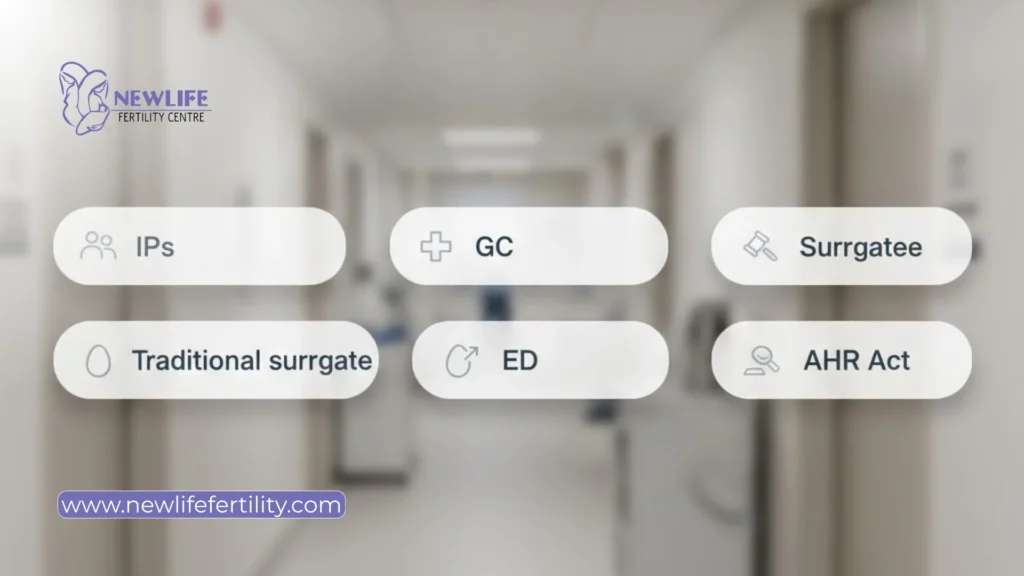
Below are some frequently used surrogacy terms (acronyms) that you will hear a lot. So, keep this cheat sheet handy:
- IPs (Intended parents): That’s you! The people who will raise the child.
- GC (gestational carrier): The medical term for the surrogate.
- Traditional surrogate: A surrogate who uses her own egg.
- ED (egg donor): If you are using a donor egg alongside a surrogate.
- AHR Act: The federal law governing surrogacy partners and processes in Canada.
- Surrogatee: (A common typo, but usually people just mean “surrogate”!).
Ready to take the next step on your surrogacy journey?
You’ve got the knowledge. You know what surrogacy means, how the process works, and what the legal landscape looks like in Canada.
But the truth is having knowledge about this is half the battle.
The other half is having the right team in your corner.
And that’s exactly why you need a fertility partner who gets it.
Someone who has walked hundreds of families through this exact journey. Someone who knows Canadian law inside and out. Someone who treats your dreams like their own mission.
That’s where NewLife Fertility Centre comes in.
We are not just a clinic. We are your surrogacy compass.
Over the years, we have helped countless intended parents, surrogate partners, and families navigate the entire surrogacy process in Canada, from that first uncertain Google search (what is a surrogate’s role?) all the way to holding your baby in your arms.
Here’s what sets us apart:
We handle the complexity for you
You don’t have to become a legal expert or medical jargon translator. Our team coordinates everything. Bit it medical screening, legal guidance, and surrogate matching. You just show up and focus on building your family.
We know Canadian law
The AHR Act, provincial variations, and post-birth parentage orders, we have done this hundreds of times. While many fertility clinics hand you off to lawyers, we walk beside you through every step.
We believe in genuine partnerships
We screen surrogates carefully, ensure clear communication between all parties, and create an environment where this beautiful arrangement is built on trust, not transactions.
We support the whole journey
From your first consultation to your baby’s first photo, and beyond, we are here. Ultrasounds, counselling, legal paperwork, and emotional support. We provide all sorts of packages.
So, here’s the thing.
You didn’t read all this just to “know about surrogacy.”
You read it because you are serious about building your family.
And if that’s true, the next step is simple.
Book your free fertility consultation call with NewLife Fertility Centre today.
And in 30 minutes, you will know if surrogacy is right for you and what your unique path might look like.
Because your family is waiting.
And we would love to help you bring them home.
To your future family. 🤞