“I’m ready to start IUI, but what exactly happens?”
“Will it hurt?”
“How long will the whole thing take?”
I hear these questions all the time from couples stepping into their fertility journey. And honestly? It’s completely normal to feel this way.
You’re about to undergo a procedure that might change your life. So naturally, you want to know exactly what happens.
Let me walk you through it.
This blog isn’t about definitions or “what is IUI.” If you’re looking for that, I’ve already covered what is IUI and how intrauterine insemination actually works in another detailed piece.
This one? This is about the real process. The step-by-step journey from day one of your cycle to the moment you take that pregnancy test.
Because understanding exactly what happens removes fear. And when fear goes away, clarity takes its place.
Let’s go.
The IUI process: A timeline overview

Before I break down each step, let me give you the big picture.
The IUI process isn’t random. It’s structured, timed, and predictable.
Below is the general flow:
- Day 1 to day 5: Your cycle starts. Cycle monitoring begins.
- Day 5 to day 12: Medication (if needed) and ultrasound tracking to monitor follicle growth.
- Day 12 to day 14: Ovulation trigger injection given.
- Day 13 to day 16: IUI procedure performed, usually 24-36 hours after the trigger.
- Day 16 to day 30: Two-week wait period.
- Day 28 to day 32: Pregnancy test done.
That’s the skeleton. Now let’s add the flesh to it.
The entire process? Usually takes about one month per cycle.
Not years. Not months waiting. One cycle = one month.
That clarity itself brings relief, doesn’t it?
Step 1: Cycle monitoring and ovulation tracking

The thing about IUI is, it’s not just about inseminating sperm randomly into your uterus.
Timing is everything.
That’s why the first phase is monitoring.
Natural cycle vs. medicated cycle
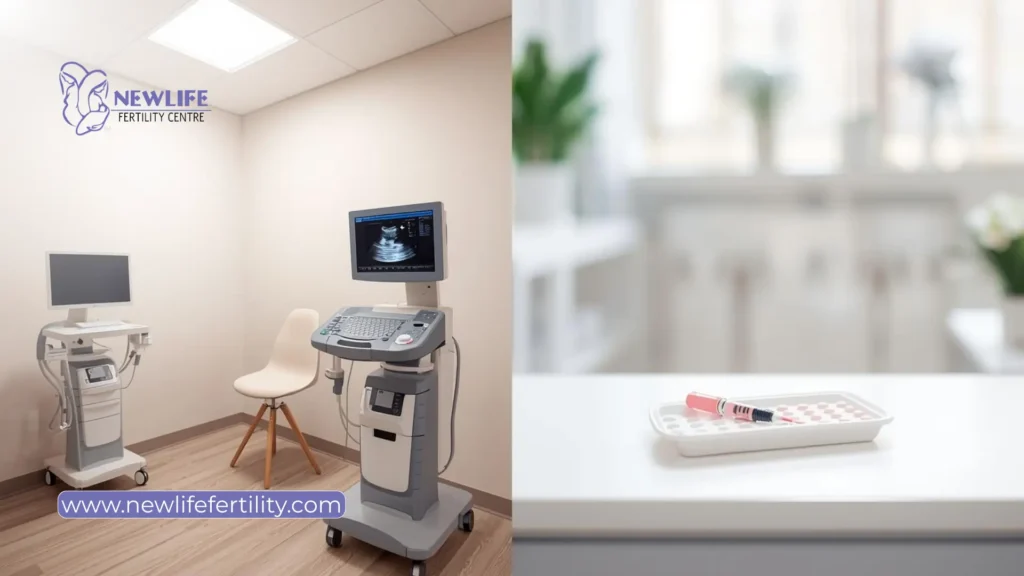
Some clinics use your natural cycle. Others use medication to stimulate multiple eggs.
Natural cycle approach
You’re not on any fertility medication. Your body naturally releases one egg during your cycle. Your doctor tracks when this happens using ultrasounds and blood tests.
Why choose this? Less medication, lower cost, and if you respond well naturally, it works just fine.
Medicated cycle approach
You’re given hormonal injections or pills (usually starting around day 3 of your cycle). These stimulate your ovaries to produce multiple eggs instead of just one.
Why do this? More eggs = more chances of fertilization. If one cycle fails, you’ve got backup.
Most clinics recommend medicated cycles for better success rates.
How the monitoring actually happens
You’ll visit the clinic for transvaginal ultrasounds.
Yup, that’s the one where the ultrasound probe goes inside your vagina.
But here’s what’s important to know: It doesn’t hurt. Feels a bit uncomfortable? Maybe. Painful? No.
Your doctor is looking at your ovaries on the screen, counting follicles (little sacs containing eggs), and measuring their growth.
A mature egg typically sits in a follicle that’s around 18-25mm in size.
Along with ultrasounds, you’ll get blood tests to check hormone levels specifically estrogen and progesterone. These hormones signal that ovulation is approaching.
You’ll probably visit the clinic 2-4 times during this monitoring phase.
Each visit takes about 15-20 minutes.
Step 2: Semen collection and preparation

Now, let’s talk about sperm.
Because here’s something most people don’t know: the sperm used in IUI isn’t just raw semen.
It’s been washed, concentrated, and prepared.
How semen is collected
Simple. Your partner provides a semen sample at the clinic, usually in a private collection room.
Some couples prefer to collect it at home and bring it to the clinic (usually must arrive within an hour).
The sample needs to be kept at body temperature during transport. Sounds fancy, but it’s just keeping it warm.
That’s it. No pain. No stress.
The sperm washing and preparation process
Here’s where science happens.
Raw semen contains:
- Sperm cells (what you need)
- Seminal fluid (what you don’t)
- Dead cells, bacteria, and other debris
The lab technician washes the sample using special solutions and centrifugation. This separates the healthy, motile sperm from everything else.
Why does this matter?
Because if you put raw semen directly into the uterus, it can trigger inflammation and cramping. The uterus doesn’t like foreign proteins.
But concentrated, washed sperm? Your uterus welcomes it.
After washing, the best sperm are concentrated into a small volume—usually about 0.5ml containing millions of motile sperm.
The entire preparation takes about 1-2 hours.
So if your IUI is scheduled for 2 PM, your partner’s sample is collected around noon. By the time you’re ready, the sperm is ready.
Step 3: The intrauterine insemination procedure

This is the main event.
And here’s what’s wild: it’s actually simpler than most people imagine.
What actually happens during IUI
You’ll lie down on an examination table, similar to a pap smear position.
Your doctor inserts a speculum into your vagina (same as a pap smear, remember?).
The cervix is visualized.
A thin catheter (basically a soft plastic tube) is gently passed through your cervix into your uterus.
The washed sperm sample is loaded into the catheter.
The sperm is slowly injected into your uterus.
The catheter is removed.
You rest for 10-15 minutes.
Done.
How long does it take?
The entire procedure? 5 to 10 minutes.
Yes, that’s it.
The actual insemination takes literally 1-2 minutes.
The rest is positioning, setup, and making sure everything is done correctly.
What you’ll feel
Most women describe it as mildly uncomfortable, not painful.
Some describe it as “nothing at all.”
A few describe cramping, usually mild.
Why the variation? Because everyone’s anatomy is different. Some women’s cervixes are angled differently. Some are more sensitive.
But “painful”? Genuinely rare.
The discomfort, if any, is brief.
Many clinics give you a painkiller 30 minutes before (ibuprofen or something similar). Your doctor might recommend it based on your individual situation.
Bring a heating pad if you think you’ll need it after. Some women find comfort in warmth.
Step 4: After the IUI procedure what you do next

The procedure is done. Now what?
Immediately after
Most clinics ask you to rest for 10-15 minutes after the insemination.
Don’t jump up immediately. Lie there. Let your body settle.
This isn’t because the sperm will fall out (it won’t, it’s already where it needs to be). It’s more psychological comfort and allows any slight cramping to ease.
Rest and activity
Here’s where a lot of misinformation floats around.
You don’t need to be on bed rest for days. That’s not evidence-based, and it’s not recommended by major fertility organizations.
What you should do
- Take it easy for the rest of the day. No intense exercise.
- Avoid heavy lifting.
- No swimming or soaking in hot water for 24 hours (chlorine and heat aren’t great for sperm).
- Normal walking, light activities are fine.
- Return to work if your job isn’t physically demanding.
What you can do after 24 hours
- Normal exercise (though some doctors recommend lighter exercise until pregnancy test).
- Regular activities.
- Sexual intercourse (though most doctors recommend waiting 24-48 hours just to be safe).
Honestly? Your body doesn’t need you to be immobilized. It’s handling a naturally occurring process. Your job is to not stress about it and let biology do its thing.
Medications after IUI
Most clinics prescribe progesterone after IUI.
This can be:
- Oral pills (progesterone tablets)
- Vaginal suppositories or gels
- Intramuscular injections (less common now)
Why? Progesterone supports the uterine lining and helps with implantation if fertilization happens.
You’ll typically start progesterone the day after IUI and continue until your pregnancy test. If you’re pregnant, you might continue it longer. If not, you stop.
Some clinics also recommend prenatal vitamins if you’re not already taking them.
How does intrauterine insemination actually work inside your body?
Now let’s talk about what happens inside after the sperm is deposited.
What happens to the sperm

The sperm you just had inseminated? They’re now in your uterus.
They start swimming immediately, moving toward your fallopian tubes where your egg is waiting (or about to arrive).
Think of it like this: You’ve essentially skipped the cervical barrier and the lower part of the vagina. The sperm doesn’t have to travel through hostile environments. It goes straight to where it needs to be.
This is why IUI helps with:
- Cervical factor infertility (thick mucus that blocks sperm)
- Male factor infertility (low count or mobility issues)
- Unexplained infertility
The sperm swim up through your uterus into your fallopian tube.
Your egg is released from your ovary (ovulation) usually 24-36 hours after the trigger injection.
The egg moves into the fallopian tube.
If sperm is there, fertilization happens in the tube.
Fertilization and early embryo journey
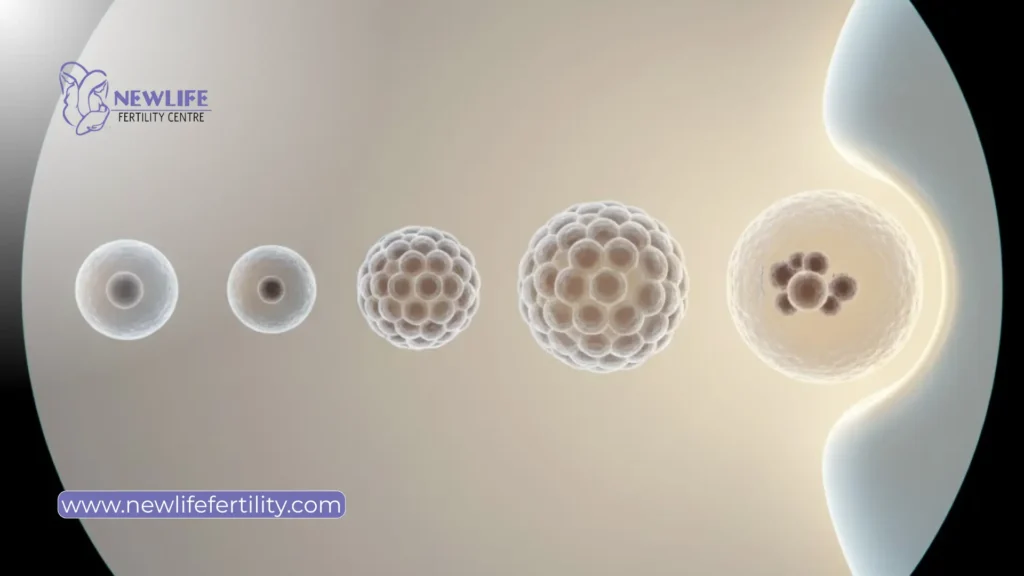
After fertilization, the embryo (now a single cell that will divide) starts moving down the fallopian tube.
It’s dividing: 2 cells, 4 cells, 8 cells, 16 cells.
Over the next 5-6 days, it becomes a blastocyst (a ball of 100+ cells).
This blastocyst reaches your uterus and “hatches” from its outer shell.
It then implants into your uterine lining.
Once implanted, hormones are released that tell your body “Hey, you’re pregnant.”
Your pregnancy test detects these hormones (hCG) in your blood.
Why IUI has lower success rates than IVF (the biological truth)
Here’s something most people don’t realize:
Even with inseminated sperm, fertilization isn’t guaranteed.
The sperm has to find the egg. The egg has to be mature. The sperm has to be healthy enough to penetrate the egg’s outer shell.
After fertilization, the embryo has to develop properly. It has to reach the uterus. It has to implant.
Any of these steps can fail for various reasons.
That’s why IUI success rates are lower than IVF (where fertilization is confirmed in a lab before transfer).
But that also means IUI is more “natural” in how it works.
Nature takes its course, with a helping hand at the insemination step.
Results after IUI: what happens next

Okay, the procedure is done. Now begins the infamous “two-week wait.”
The two-week wait (2ww)
Days 1-5: Usually nothing. You might have mild cramping or spotting (totally normal).
Days 6-10: You might feel… fine. Or you might feel symptoms. Or nothing.
This is the part where everyone goes a bit crazy. Symptom spotting begins.
Possible symptoms (and why they might mean nothing):
- Breast tenderness (could be progesterone, could be pre-period)
- Mild cramping (could be implantation, could be gas)
- Nausea (could be progesterone, could be something you ate)
- Fatigue (could be hormones, could be stress)
- Mood swings (yup, progesterone again)
The reality? Progesterone causes these symptoms whether you’re pregnant or not.
My honest suggestion
Don’t drive yourself crazy symptom spotting. The pregnancy test will tell you the truth. Symptoms won’t.
Pregnancy testing timeline
Most clinics ask you to come in for a blood test 12-14 days after IUI.
Why a blood test and not a home urine test?
Blood tests are more accurate and detect hCG (pregnancy hormone) earlier, usually 8-10 days after IUI.
Home urine tests are less sensitive and work better from day 14 onwards.
If you want to test at home before your clinic appointment, wait until at least day 12. Testing too early gives false negatives.
The Results: what happens next
If the test is positive:
Congratulations! You’ll likely repeat the blood test 2-3 days later to confirm rising hCG levels. Then your doctor will schedule an ultrasound around day 21 to confirm a developing pregnancy.
If the test is negative:
Stop your progesterone supplements. Your period will likely start within a few days. This is heartbreaking, I know. But it also means you can start planning your next cycle if you choose to.
Success rates and factors affecting IUI results
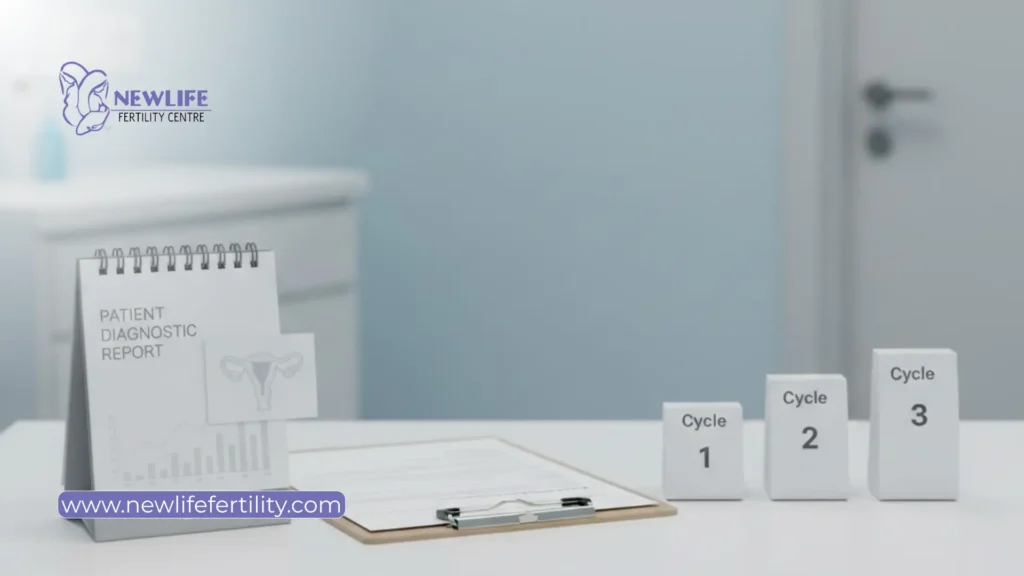
Let’s talk about real numbers.
General success rates
Per-cycle IUI success rate: 10-20%
This means for every 100 IUI cycles done, roughly 10-20 result in pregnancy.
This sounds low compared to IVF (success rates around 40-50% depending on age), but IUI is also less invasive, cheaper, and doesn’t require egg retrieval.
Factors that dramatically affect your results
Age (This matters more than you think)
- Under 30: ~15-20% success per cycle
- 30-35: ~12-15% success per cycle
- 35-40: ~8-12% success per cycle
- Over 40: ~3-8% success per cycle
Why? Egg quality decreases with age. It’s biology, not fair.
Cause of infertility
- Unexplained infertility: Better IUI success (because nothing’s obviously wrong)
- Male factor (low count/motility): Much better with IUI (because you’re bypassing the cervical barrier)
- PCOS: Good response to IUI if ovulation is triggered correctly
- Fallopian tube blockage: IUI won’t work (you need IVF)
- Endometriosis: Moderate success with IUI
Number of cycles
Cumulative success improves with multiple cycles.
- After 1 cycle: ~15% cumulative success
- After 3 cycles: ~35-40% cumulative success
- After 6 cycles: ~50-60% cumulative success
This is why doctors typically recommend 3-6 cycles before considering alternatives like IVF.
How many IUI cycles are usually recommended?

Here’s where many couples ask: “Is one cycle enough?”
Short answer: Usually not.
Typical IUI cycle recommendation
Most fertility specialists recommend starting with 3-6 IUI cycles before reassessing.
Why 3-6?
Because after 3 cycles, you have enough data to see if the treatment is working for your specific situation.
Some couples get pregnant in cycle 1. Others in cycle 3. Some need all 6.
After 6 unsuccessful cycles, success rates plateau. Continuing beyond 6 shows diminishing returns.
When your doctor might recommend reassessment
After 3 cycles
Your doctor checks: Is the protocol working? Should we adjust medication doses? Are there other factors we missed?
After 6 cycles
If still unsuccessful, your doctor usually recommends either:
- Switching to IVF (if male factor or egg quality issues)
- Additional testing (if we haven’t found the cause)
- Taking a break (sometimes stress reduction helps)
- Exploring other options (adoption, donor sperm/egg, etc.)
Time between cycles
Most clinics wait one full cycle between IUI attempts.
So if your IUI is in January and fails, you’d typically do the next one in March.
Why wait? To give your body a break and gather more data about your cycle patterns.
Some clinics allow back-to-back cycles, but it’s less common.
Common questions about the IUI procedure
Let me address the stuff everyone’s actually wondering about.
Is the IUI procedure painful?
Honest answer: For most women, no. Uncomfortable? Maybe. Painful? Rarely.
The most common discomfort is mild cramping, similar to period cramps.
If you have a history of painful procedures or severe period cramps, mention it to your doctor. They can give you pain management options.
How long does the IUI process take? (the whole thing)
One cycle = About 2-4 weeks
Monitoring phase: 7-10 days
Procedure day: About 1 hour at the clinic
Two-week wait: 12-14 days
Total: 1 cycle per month
Can you continue normal life during the IUI process?
Yes, absolutely.
- Work: Yes (unless it’s physically demanding)
- Exercise: Yes (light to moderate until pregnancy test)
- Travel: Ideally not during monitoring phase (you need frequent clinic visits)
- Intimacy: Avoid 24-48 hours after procedure
- Stress: Do what helps you manage it
The process isn’t a medical emergency. It’s a structured treatment.
Is one IUI cycle really enough?
Statistically: Probably not.
Success per cycle is 10-20%. So one cycle has an 80-90% chance of not resulting in pregnancy.
But that doesn’t mean it won’t happen. Some couples do get pregnant in cycle 1.
However, most doctors recommend 3-6 cycles before considering alternatives.
When to talk to a fertility specialist
You might be reading this thinking, “Okay, but is IUI right for me?”
Great question.
IUI might be right for you if
- You have unexplained infertility
- Male factor infertility (low sperm count or motility)
- Cervical factor infertility (cervical mucus issues)
- You’re ovulating normally (or can with medication)
- Your fallopian tubes are open
- You want a less invasive option than IVF
IUI probably won’t work if
- Both fallopian tubes are blocked (sperm can’t reach egg)
- Severe male factor (too few sperm or too low motility to reach egg even with washing)
- Poor egg quality (age-related or genetic)
- Certain uterine abnormalities
- You have a history of ectopic pregnancy
Why you need personalized guidance
IUI works differently for different people based on
- Your complete medical history
- Your partner’s semen analysis results
- Your ovulation patterns
- Your specific cause of infertility
- Your age and egg quality
A fertility specialist will review all this and recommend whether IUI makes sense for you.
Don’t guess. Ask.
So, how does IUI really work for you?
You now know how the IUI process unfolds, from day one to that two‑week wait. It’s structured, it’s simple, and it’s designed to give your body the best possible chance, without the complexity of big procedures.
If you’re wondering whether this is the right next step for your journey, we get it. It’s not just about science; it’s about hope, clarity, and knowing you’re not alone.
At NewLife Fertility Centre, we walk with couples like yours, one cycle at a time. If you’d like to talk through your situation in a relaxed, no‑pressure way, we’d love to hear from you.
Book your free fertility call with us → and let’s see if IUI is the right fit for your story.