If your doctor has mentioned a “frozen embryo transfer” and your mind instantly went, “Wait… what exactly happens now?” You’re not alone.
Hearing terms like “FET,” “cryopreservation,” and “protocol” when all you want is a healthy pregnancy can feel overwhelming.
You might be wondering:
- Are my embryos really safe in a freezer?
- What actually happens during the transfer?
- Is this better or worse than a fresh transfer?
Let’s walk through this in simple, clear language so you understand what FET is, where it fits in IVF, and what to broadly expect.
No heavy medical jargon. No confusing explanations. Just honest, easy-to-understand answers.
And the fact that you’re here, trying to understand your options, already says a lot about your strength.
Let’s start. 💛
What is frozen embryo transfer (FET)?
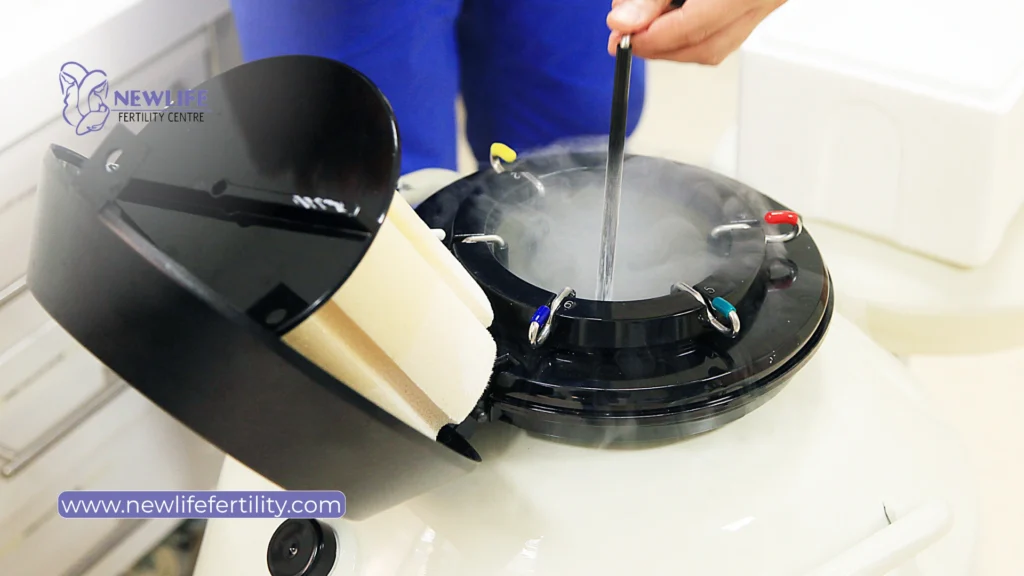
A Frozen Embryo Transfer, or FET, is a procedure where a previously frozen embryo is thawed and transferred into your uterus.
That’s it at its core.
“But where did the frozen embryo come from?”
Great question.
During an IVF cycle, doctors typically retrieve multiple eggs, fertilize them, and create embryos. Not all of them are transferred right away. The remaining ones are frozen and stored safely, sometimes for months, sometimes for years.
FET is when you come back to use those stored embryos.
Think of it like this.
Your embryos are kept in a kind of pause mode. When the time is right, when your body is ready, when you are ready, those embryos are carefully thawed and given a new chance.
That’s the beauty of FET.
How does frozen embryo transfer work?
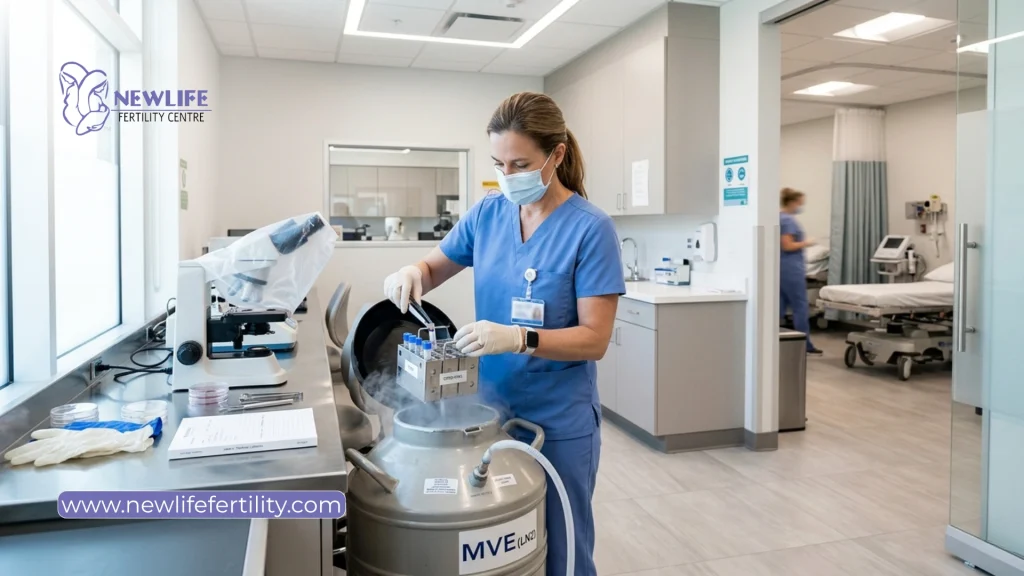
An embryo is created during a previous IVF cycle. It is then frozen using a process called vitrification, which means it is rapidly frozen at a very low temperature to preserve it safely.
When you are ready for the transfer, the embryo is carefully thawed in the lab.
At the same time, your uterus is prepared to receive it.
Then, the embryo is gently placed inside your uterus, where it may implant and grow into a pregnancy.
“That’s it?”
Well, there are a few more steps involved in the full process.
But yes, the core idea really is that simple.
Step-by-step frozen embryo transfer process (quick overview)
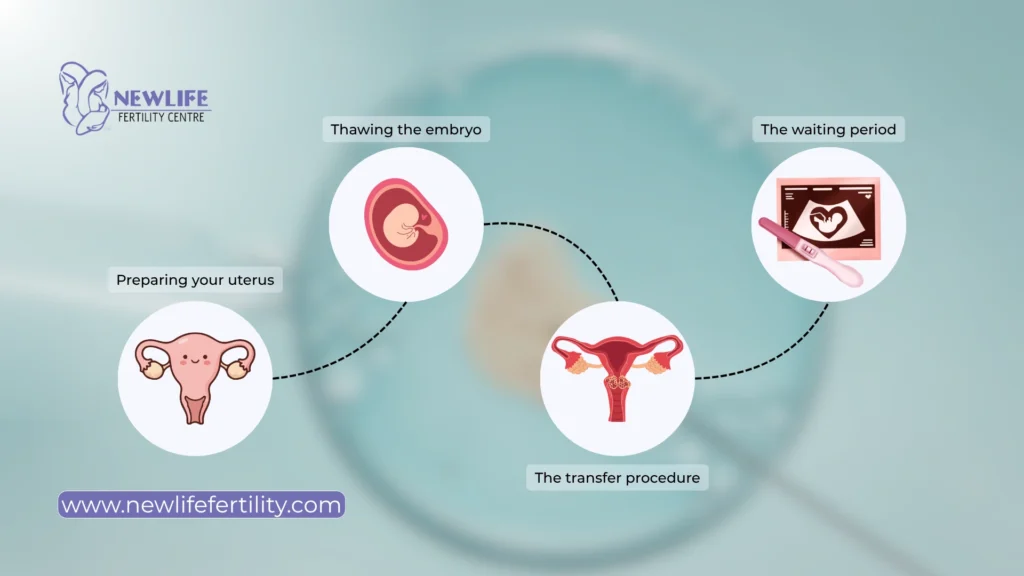
Every clinic has its own protocol, but the general flow usually looks like this:
Preparing your uterus
Your doctor times your cycle, natural or medicated, so the uterine lining is ready to receive an embryo. This may involve scans, blood tests, and sometimes estrogen or progesterone medications.
Thawing the embryo
Once your lining is ready, the lab carefully thaws one or more frozen embryos using controlled steps to keep them healthy.
The transfer procedure
A thin catheter is gently passed through your cervix to place the embryo into your uterus. This is usually an outpatient procedure, often without anesthesia, and is typically described as mildly uncomfortable rather than painful.
The waiting period
After the transfer, you can go home the same day and wait for the pregnancy test date given by your clinic.
The FET cycle: What does it even mean?

You’ll often hear the phrase “FET cycle.”
What does that actually mean?
A cycle simply refers to the full timeline from when you start preparing for the transfer to when you take the pregnancy test.
In most cases, an FET cycle lasts a few weeks.
It usually includes:
- Initial consultation and baseline tests
- Uterine preparation, either through hormones or your natural cycle
- Monitoring appointments
- Embryo transfer day
- The two week wait, often the most emotionally intense part, and that’s completely normal
- Pregnancy test
“How long does the whole thing take?”
Usually around 3 to 6 weeks, depending on your protocol.
Types of FET: Which one applies to you?

Not all FET cycles are the same.
There are two main types, and your doctor will recommend one based on your body and overall health.
Natural cycle FET
This follows your natural menstrual cycle. Your body’s own hormones prepare the uterus with little or no medication. It is often a good option for women with regular cycles.
Medicated (programmed) cycle FET
In this approach, hormones like estrogen and progesterone are used to prepare the uterine lining. It allows better control over timing and is often recommended for women with irregular cycles or specific medical needs.
So “Which one is better?”
Well, neither is universally better. Because the better approach will totally depend on your body, your medical history, and your doctor’s recommendation.
What happens after the embryo transfer?

You’ve had the transfer.
Now what?
After the procedure, most fertility clinics in Canada advise resting for the remainder of the day, although many women return to light activities the next day.
Your embryo will then attempt to implant into the lining of your uterus. This process is called implantation and usually happens within 1 to 5 days after the transfer.
During this time, you might notice:
- Mild cramping
- Light spotting
- Bloating
- Or nothing at all
“Is feeling nothing a bad sign?”
Not at all.
Every body responds differently. Some women feel several symptoms, while others feel nothing and still have a successful outcome.
Around 10 to 14 days after the transfer, a blood test called beta hCG is done to confirm whether implantation was successful.
Frozen vs. fresh transfer: What’s the difference?
A lot of people ask this.
So here’s a quick comparison:
| Factor | Fresh Transfer | Frozen Transfer (FET) |
| Timing | Happens right after egg retrieval in the same IVF cycle | Happens in a separate cycle, weeks or months later |
| Body’s state | Body is still recovering from stimulation | Body has had time to rest and recover |
| Embryo | Fresh, never frozen | Frozen and then thawed |
| Flexibility | Less flexible timing | More flexible, can be planned around your schedule |
Both can be equally effective. In fact, many studies suggest that FET can lead to better outcomes for some women, mainly because the uterus has time to recover after hormonal stimulation.
Who should consider FET?
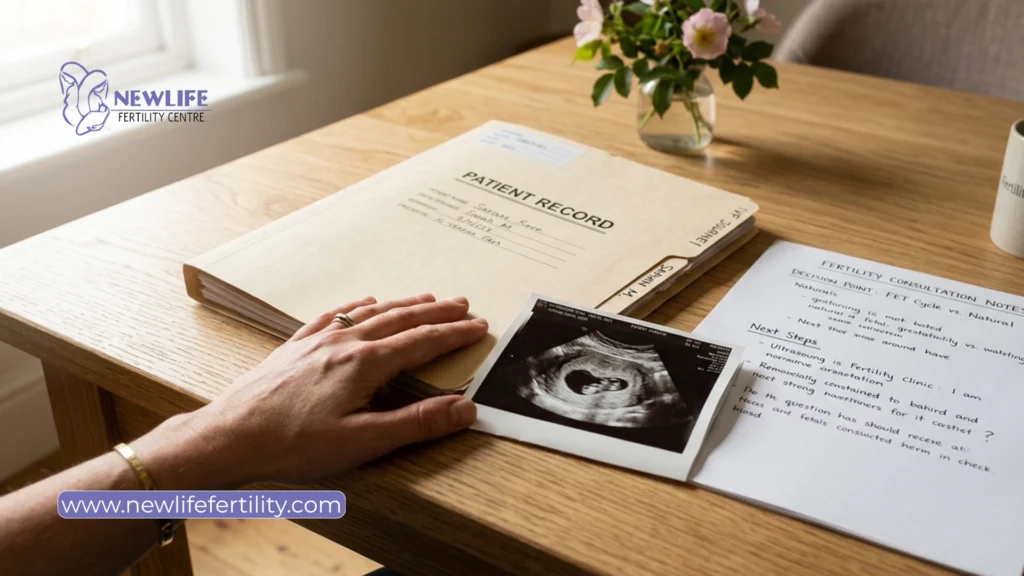
FET can be a good option in several situations.
“Does this apply to me?”
Maybe.
Here are some of the most common scenarios:
- You have completed an IVF cycle and have frozen embryos remaining
- A fresh transfer did not work, and you still have stored embryos
- Your doctor recommended freezing all embryos before transfer, often called a “freeze-all” approach
- You needed to delay the transfer due to health, timing, or personal reasons
- You chose egg or embryo freezing for fertility preservation
If any of these sound like your situation, FET may be the next step your doctor recommends.
And having frozen embryos waiting is not a setback. For many people, it is actually a hopeful next step.
Success rates of frozen embryo transfer

It’s natural to want one number, “What are the chances this will work?” but success with FET depends on many factors like
- Your age
- The quality and grade of the embryo
- The health of your uterine lining
- Your overall medical history
- Whether the embryo is a Day 3 or Day 5 (blastocyst)
On average, FET success rates are comparable to, and sometimes even better than, fresh transfers.
But this is not a one-size-fits-all answer.
“So what should you do?”
Talk to your doctor. They understand your embryo quality, your history, and your body and can guide you best.
What does frozen embryo transfer mean for you going forward?
If you’ve reached the point where frozen embryo transfer is being discussed, you’ve already taken some meaningful steps forward.
It’s completely normal to feel a mix of hope, confusion, and questions. What matters is that you now understand what FET is and what to expect.
This process is not just medical, it’s personal. And having the right guidance can make all the difference.
At NewLife Fertility, we focus on keeping things simple, supportive, and customized to you, so you feel informed at every step, not overwhelmed.
If you’re thinking about your next step with FET or have questions about your frozen embryos, you can speak with our team anytime.
👉 Book a free consultation with us and get clear, personalized guidance for your next step.
FAQs about frozen embryo transfer (FET)
FET involves preparing your uterus, thawing the embryo, and gently transferring it into your uterus. It is usually a short and mostly painless procedure.
The transfer itself takes about 15 to 30 minutes. The full FET cycle, from preparation to pregnancy test, usually takes around 3 to 6 weeks.
After the transfer, the embryo attempts to implant. You may notice mild symptoms or none at all. A pregnancy test is typically done 10 to 14 days later.
Yes, FET can be successful. Outcomes depend on factors like age, embryo quality, and uterine health.
Most women describe it as mild discomfort, similar to a pap smear. Many do not feel anything at all.