You got the number. Maybe you stared at it for ten minutes straight. Maybe you typed it into three different forums at midnight. Maybe you screenshot it and send it to your partner with a string of question marks.
“Is this normal? Is this good? Why is mine lower than that woman’s on Reddit?”
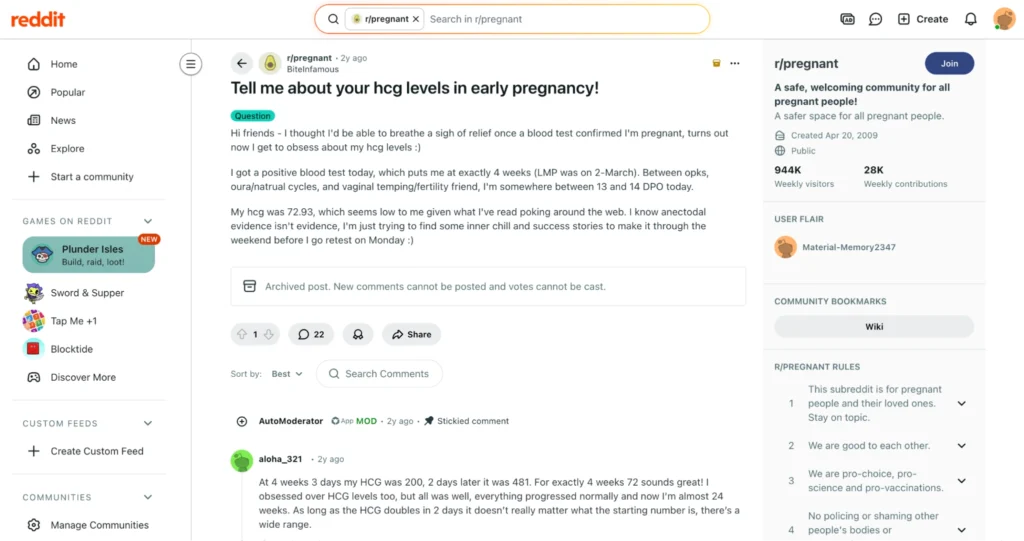
Reddit user shares early pregnancy hcg results after frozen embryo transfer seeking reassurance on normal level ranges. (Source: Reddit)
If that sounds like you right now, this guide is written exactly for you.
After a frozen embryo transfer, waiting for beta hCG results is one of the most emotionally loaded moments in the entire IVF journey. The number can feel like a verdict.
But here is what most labs and clinics do not explain clearly enough.
One number rarely tells the full story.
This guide will walk you through what hCG actually is, what levels are expected day by day, what low or slow rising really means, and most importantly, when you need to be concerned and when you can take a breath and give your body more time.
Let’s break it all down, calmly and clearly.
What is hCG and why does it matter after FET?

hCG stands for human chorionic gonadotropin. It is a hormone produced by the cells that eventually form the placenta, and it only appears in your body after an embryo has implanted and started developing.
Think of it as your body’s earliest signal that something is happening.
After a frozen embryo transfer, your doctor tracks hCG for a simple reason. It helps confirm implantation and gives early insight into how the pregnancy is progressing.
Rising hCG levels usually mean the embryo is settling in and growing. A number that stalls or drops can sometimes indicate a concern, but not always and not immediately.
There is one important thing to understand here.
hCG does not appear the moment your embryo is transferred. The embryo first needs to implant into the uterine lining. Only after that do the placental cells begin producing hCG.
And that process takes a few days.
Which is exactly why your clinic asks you to wait before testing.
When is hCG tested after a frozen embryo transfer?
Most clinics schedule the first beta hCG blood test between Day 9 and Day 14 after your transfer. The exact timing can vary depending on whether a Day 3 embryo or a Day 5 blastocyst was transferred.
Here is a simple way to understand the timeline:
| Day 1 to 5 | The embryo is implanting. It is too early to test meaningfully. |
| Day 7 to 8 | hCG may just start to become detectable, but levels are still very low. |
| Day 9 to 10 | This is when many clinics do the first beta test. |
| Day 12 to 14 | A second test is done to check if the levels are rising as expected. |
| Day 16 and beyond | Further monitoring may be done if needed. |
So why does timing matter so much?
Because testing too early can create unnecessary confusion.
If you test around Day 5 or 6, you might see a very low number or a faint line. That does not mean something is wrong. It often just means your body has not had enough time to build up hCG yet.
It is completely natural to feel tempted to test early.
But early results without the right context can lead to a lot of unnecessary anxiety.
Frozen embryo transfer hCG levels by day
This is the section most people are looking for, so let’s get into it.
But first, one important thing to keep in mind.
These are ranges, not rules. Your number does not have to match these exactly to be okay.
hCG levels can vary widely from person to person, from clinic to clinic, and even from one pregnancy to another in the same woman. The values below are general reference points based on typical frozen embryo transfer cycles with a Day 5 blastocyst.
| Days After FET (Day 5 Blastocyst) | Typical hCG Range (mIU/mL) |
| Day 5 | 0 – 5 (usually undetectable) |
| Day 7 | 2 – 50 |
| Day 9 | 10 – 100 |
| Day 10 | 20 – 150 |
| Day 12 | 50 – 300 |
| Day 14 | 100 – 600+ |
| Day 16 | 200 – 1,500+ |
Note: For Day 3 embryo transfers, you can add about 2 days to this timeline.
Now here is the most important takeaway from this chart.
Two people can have very different numbers on the same day and still go on to have completely healthy pregnancies.
For example, someone with an hCG of 18 on Day 9 and someone with 95 on the same day can both have normal outcomes.
What matters far more than the starting number is what happens next.
What is a normal hCG level after frozen embryo transfer?
Here’s the honest answer.
There is no single “normal” number.
What doctors actually focus on is not a specific value on Day 10 or Day 12. What matters more is how your hCG levels change over time.
In early pregnancy, hCG is expected to roughly double every 48 to 72 hours.
So for example, if your Day 9 beta is 30, your Day 11 or Day 12 result would ideally be around 60 to 90 or higher.
That rise tells your doctor far more than the starting number ever could.
A lower starting value that increases steadily is often more reassuring than a higher number that does not rise properly.
If there is one thing to hold onto during this phase, it is this.
One number is just a snapshot. The trend is what tells the real story.
Low hCG levels after FET: Should you worry?

This is the question many people search for late at night, and it deserves a clear and honest answer.
A low hCG level does not automatically mean the pregnancy has failed.
There are a few common reasons why your first number might be on the lower side.
- Implantation may have happened a little later, so hCG started rising later
- Natural variation in how different bodies produce hCG
- Testing earlier in the timeline, like Day 9 instead of Day 12
- Differences in embryo quality or early development
So when does low hCG become more concerning?
- When the number rises very slowly or barely changes
- When it plateaus instead of increasing
- When it starts to decline in the early weeks
Even then, your doctor is the best person to interpret your results in context.
What matters most is this.
A lower starting number that rises well can still be a positive sign.
Give your body a little time to show its pattern before jumping to conclusions.
Slow rising or falling hCG: What it could mean

This is often where anxiety starts to peak.
When the numbers are rising, but not as expected. Or when they stop rising altogether.
If your hCG is increasing but not doubling within 48 to 72 hours, it can mean a few different things.
- The pregnancy may still be progressing, just more slowly than average
- Implantation may have happened later or differently than expected
- In some cases, it can be an early sign that the pregnancy may not continue
If hCG levels plateau and stop increasing, it is usually taken more seriously, and your clinic will monitor you more closely.
If hCG starts to decline after an initial rise, it can point to a couple of possibilities.
- A chemical pregnancy, where implantation occurred but development did not continue. This is difficult to go through, and it is more common than many people realize. It is not caused by anything you did.
- An ectopic pregnancy, where implantation happens outside the uterus. This is rare with frozen embryo transfer, but your clinic will check for it carefully and guide you if needed.
If you are seeing falling or unclear numbers, your medical team is the best place to turn.
They understand your full situation, your protocol, and your history.
And you deserve guidance that is specific to you, not based on comparisons or online charts.
The doubling rule: What your doctor is actually looking for
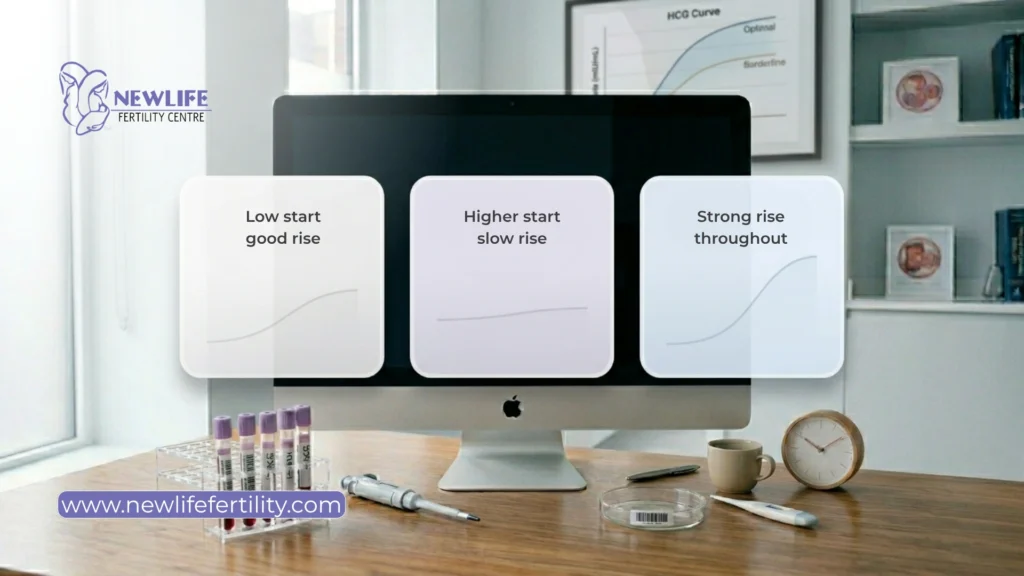
Let’s make this more concrete with a few simple examples. It helps to see how this actually plays out in real situations.
Scenario A: Low start, good rise
Day 10 beta: 25 mIU/mL
Day 12 beta: 62 mIU/mL
This has more than doubled in 48 hours. Even with a low starting number, this is a reassuring trend.
Scenario B: Higher start, slow rise
Day 10 beta: 120 mIU/mL
Day 12 beta: 145 mIU/mL
This is only a small increase. Your clinic would likely monitor this more closel
Scenario C: Strong rise throughout
Day 10 beta: 80 mIU/mL
Day 12 beta: 210 mIU/mL
This has more than doubled and is considered a strong and encouraging pattern.
Here is the key message.
Doctors care more about how fast your hCG is rising than the number itself. A single value on its own does not tell much.
The change between two tests is where the real insight comes from.
Most fertility clinics in Canada will wait for at least two beta results before making any conclusions. If you have only had one test so far, give it a little time before reading too much into it.
hCG injections and hCG wash: What are they?
Some women going through frozen embryo transfer cycles come across terms like hCG injections or hCG wash and wonder what they actually mean.
Let’s break it down simply.
hCG trigger shot before transfer
In some protocols, an hCG injection is given before egg retrieval or before a frozen transfer. It helps trigger ovulation or prepare the uterine lining so the timing of the cycle is precise.
There is one important thing to keep in mind.
If you received an hCG trigger shot, it can temporarily affect your blood or urine hCG levels. This means testing too early can show a false positive because your body is still clearing the injected hormone.
Your clinic will guide you on when it is safe to test.
Intrauterine hCG wash before transfer
An hCG wash, also called intrauterine hCG infusion, involves placing a small amount of hCG directly into the uterus before the embryo transfer.
The idea is to support the uterine lining and possibly improve implantation.
Research on this is still evolving. Some studies suggest a small benefit, while others show no clear difference.
It is not part of every protocol, and whether it is right for you depends on your medical history and your clinic’s approach.
If this has been suggested to you, it is always a good idea to ask your clinic how it fits into your specific plan.
Common mistakes women make when tracking hCG

You are not doing anything wrong by researching or trying to understand your numbers.
But some patterns can make this phase more stressful than it needs to be.
Comparing your numbers to someone else’s
Every person’s body is different. Every embryo is different. Every protocol is different. The woman on the forum with a Day 10 beta of 500 is not a benchmark for your pregnancy. Her numbers tell her story. Yours will tell yours.
Testing too early at home
Home pregnancy tests are qualitative, they tell you positive or negative, not the actual level. Testing at Day 5 or Day 6 post-transfer often gives confusing results that spiral into anxiety when your official beta, taken at the right time, would have been completely reassuring.
Treating one number as a final answer
One beta result is one data point. It is not a diagnosis. It is not a prediction. It is the beginning of a story, not the end.
Focusing on the number instead of the trend
The question isn’t, “Is 45 a good number?” The question is, “Did 45 become 110 two days later?” That’s the real question.
Getting lost in late-night searches
We know. We really know. But the forums will terrify you, the charts will confuse you, and the anecdotes will pull you in every direction. If you’re going to read anything at 2 a.m., let it be something that reminds you that uncertainty is temporary and that your doctor is the right person to interpret your specific numbers.
Your frozen embryo transfer hCG levels are just the beginning of the story
If you have read this far, you are probably sitting with a number in your hand and a heart full of hope and fear at the same time.
That is one of the hardest places to sit. And we want you to know that what you are feeling is not weakness. It is not overthinking. It is what happens when you care deeply about something that matters more than almost anything else.
The beta testing phase after frozen embryo transfer is genuinely one of the most emotionally intense parts of this entire journey. And no chart, no forum, and no number can fully carry you through it.
What we hope you take away from this guide is simple.
One number is not a verdict. The trend is what tells the real story. A low start can still rise beautifully. A single test is just the first sentence of something still being written.
Give your body a little more time before you draw conclusions. And give yourself permission to not have all the answers yet.

Your frozen embryo transfer hCG levels are just the beginning of the story, and NewLife Fertility Centre provides expert care and personalised support for every step ahead.
At NewLife Fertility, we understand that the days between your transfer and your beta results are not just medical. They are deeply personal. Our team is here not just to monitor your numbers, but to help you understand them, support you through the uncertainty, and walk alongside you at every step of your fertility journey.
You do not have to figure this out alone.
If you have questions about your hCG levels, your FET cycle, or what comes next, book your free consultation with the NewLife team. We are here to give you clarity, not just answers.
Frequently asked questions about hCG after frozen embryo transfer
Anywhere from 20 to 200+ mIU/mL can be within range on Day 10, depending on when implantation occurred and your individual body. What matters most is how it rises from there, not where it starts.
Most women see hCG somewhere between 10 and 100 mIU/mL on Day 9 after a Day 5 blastocyst transfer. That is a wide range on purpose. A number on the lower end of that window is not automatically a cause for concern as long as it continues to rise steadily.
By Day 12, many clinics expect to see hCG somewhere between 50 and 300 mIU/mL, and by Day 14, 100 to 600+ mIU/mL. These are general ranges. What your clinic pays closest attention to is whether the number has doubled appropriately from your previous test.
Yes, absolutely. Many women with first betas under 50 go on to have completely healthy pregnancies. A low starting number that rises consistently is far more meaningful than a single low value taken in isolation.
Slow rising hCG means your levels are increasing but not quite doubling within the expected 48 to 72 hours. This can happen due to late implantation, natural variation, or sometimes an early signal that the pregnancy needs closer monitoring. It does not automatically mean the worst. Your clinic will typically ask you to retest and track the pattern before drawing any conclusions.
Declining hCG after an initial rise usually indicates either a chemical pregnancy, where implantation occurred but development did not continue, or less commonly, an ectopic pregnancy. If your levels are falling, contact your clinic directly. They will guide you through what comes next with the full context of your cycle.
Unusually high hCG can sometimes point to a multiple pregnancy or, in rare cases, a molar pregnancy. Your clinic will monitor closely. High hCG with strong doubling is generally considered a positive sign.
An hCG injection before transfer, often called a trigger shot, is used to time ovulation precisely or prepare the uterine lining. In some protocols, an hCG booster injection may also be given after transfer to support early implantation and progesterone production. Whether this is part of your protocol depends on your clinic’s approach and your individual history.
An hCG booster is a low-dose hCG injection given in the days following your transfer. The goal is to support the luteal phase and potentially improve implantation conditions. It is not standard in every protocol, and the research on its benefit is still developing. If your clinic has recommended it, ask them how it fits your specific plan.
An hCG wash, also called an intrauterine hCG infusion, involves placing a small amount of hCG solution into the uterus before the embryo is transferred. It is intended to prepare the endometrium and may improve receptivity. Evidence on its effectiveness is mixed, and it is not used in all clinics or all cycles.
Rising hCG is what drives many early pregnancy symptoms like nausea, breast tenderness, and fatigue. However, symptoms vary enormously between individuals, and the presence or absence of symptoms at this stage does not reliably tell you whether your hCG is rising well. Some women with strong betas have no symptoms at all, and vice versa.
A negative beta on Day 9 does not always mean the cycle has completely failed, particularly if you were tested on the earlier side. Your clinic may recommend retesting in a few days. A negative result at Day 14, however, is generally more conclusive.
If your second beta does not show a meaningful rise, or if your levels start to decline, that is when your clinic will want to look more closely. One number on its own is rarely enough to make a call. If you are unsure, reach out to your clinic directly. They are the right people to interpret your specific results.