This might feel like a small question. But if you’re going through IVF, you already know nothing feels small right now.
Every decision, every choice, every “should I or shouldn’t I” carries weight you never expected it to. And somewhere between your doctor’s appointment, a late-night Google search, and a fertility forum thread with 47 conflicting opinions, you ended up here, wondering about something that feels almost embarrassing to ask out from others.
Can I have sex before or after my frozen embryo transfer?
You’re not alone. Thousands of couples ask this exact question every single day, and the frustrating part is that the answers are often vague, inconsistent, or buried under so much medical language that they leave you more confused than before.
So let’s do this differently. Let’s break it down clearly, before the transfer, after the transfer, and everything in between, so by the end of this, you know exactly what’s safe, what to avoid, and why it even matters in the first place.
Can you have sex before frozen embryo transfer?
Let’s start here because this is where most of the confusion begins.
Is it safe to have intercourse before frozen embryo transfer?

The short answer is: yes, in most cases, but with conditions.
For the majority of the FET cycle, having sex is not automatically off the table. Your body is still your body. But as you get closer to the transfer date, things change, and your clinic’s specific instructions take priority over any general advice, including this blog.
The reason it’s usually okay in the earlier part of your cycle is straightforward. The embryo has not been transferred yet, so there is no implantation happening that could be disrupted. However, the closer you get to transfer day, the more cautious you need to be.
When to stop having sex before frozen embryo transfer

Most clinics recommend avoiding intercourse somewhere between 2 to 5 days before the embryo transfer, though this window varies depending on your clinic’s protocol and your individual treatment plan.
Why such a specific window? Two main reasons.
First, sexual activity, particularly orgasm, can trigger mild uterine contractions. While these are completely normal in everyday life, in the days just before a transfer, you want the uterus to be as calm and receptive as possible. Think of it as preparing a quiet, settled environment for something very important that is about to happen.
Second, there is a small but real risk of infection from intercourse in this phase of the cycle. Your cervix is being monitored, manipulated, and prepared for transfer, so introducing any outside variables right before that is not ideal.
The most important takeaway here is simple. Always follow what your specific clinic tells you. General guidelines give you a framework, but your doctor’s protocol is what you should actually follow.
Can you have unprotected sex before frozen embryo transfer?

This one needs a balanced, honest answer, not a scary one.
In some cases, clinics allow unprotected sex during parts of the FET cycle. In others, they specifically advise against it. The reason is not just infection risk. In rare situations, a natural conception could theoretically overlap with the transfer cycle, which creates a complicated scenario that your medical team would need to manage.
It is not a common occurrence, and this is not something to panic about. But it is a real enough possibility that many clinics include guidance around it in their pre-transfer instructions.
If your clinic has not mentioned it, this is a great question to ask at your next appointment. A simple, “Are there any restrictions on unprotected sex during this cycle?” will give you a clear, situation-specific answer.
Is sex the night before frozen embryo transfer okay?

Here, the answer becomes much clearer. Most doctors advise against it.
The night before your transfer is not the time to take chances, even if the risk is relatively small. Everything up to that point has been preparation, the medications, the monitoring, the timing, and the goal in those final hours is to keep your uterus as relaxed and undisturbed as possible.
Sex can trigger uterine contractions, even mild ones. And the night before transfer, that is simply a variable most clinics prefer to eliminate.
It is just one night. The peace of mind is worth it.
Can you have sex after frozen embryo transfer?
Now we get to the part that most people are searching for, because this is when the real anxiety kicks in. The embryo is inside you or your partner’s body. Every sensation, every movement, every decision suddenly feels loaded with consequence.
Why do doctors advise no sex after FET?

Your doctor recommends avoiding sex after transfer primarily because of what is happening inside your body during the implantation window.
After the embryo is transferred, it needs to travel a short distance, settle into the uterine lining, and begin the process of implantation. This window, roughly the first 10 to 14 days after transfer, is when the embryo is at its most vulnerable stage of this journey.
Orgasm causes uterine contractions. These are natural and harmless under normal circumstances, but during the implantation phase, there is concern that contractions could potentially interfere with this delicate process. The embryo is not fixed in place instantly. Implantation takes time, and the uterus needs to remain as calm as possible during that period.
There is also the same infection risk to consider. After transfer, the cervix has been recently accessed, and the uterine environment is being carefully supported with medications. Introducing any additional variables, including bacteria that can naturally be introduced through intercourse, is something most clinics prefer to avoid during this critical window.
How long after frozen embryo transfer can you have intercourse?

The standard recommendation most clinics give is to wait until after your pregnancy test, which typically happens 10 to 14 days after transfer.
If the pregnancy test is negative, your doctor will guide you on next steps, including when it is safe to resume normal activity. If it is positive, many doctors will ask you to wait even longer, sometimes until the first ultrasound confirms a heartbeat, which is usually around 6 to 8 weeks.
Why the extended wait if it is positive? Because early pregnancy, particularly one achieved through IVF, is considered a higher-risk period. Your clinic wants to give the pregnancy the best possible chance to stabilize before introducing anything that could cause uterine contractions.
As always, confirm this timeline with your own doctor. These are common guidelines. Your specific situation may require a different approach.
What happens if you have sex too soon after transfer?

Let’s talk about the panic scenario, because this is something many couples face and feel too ashamed to admit.
Maybe you did not know. Maybe the moment happened before you thought it through. Maybe you read conflicting things and made a decision that you are now second-guessing at 2 in the morning.
Here is what you need to hear. One instance of sex after transfer does not automatically mean your cycle has failed.
The risk is real, which is why the restriction exists. But the human body is not that fragile. Many people have had sex after transfer, intentionally or not, and gone on to have successful pregnancies. A single incident is not a guaranteed failure. Correlation is not causation.
What you should do is tell your doctor. Not to confess or feel judged, but because your medical team deserves accurate information about your cycle so they can support you properly. They have heard it before. They will not be shocked. And knowing will help them help you better.
Do not spiral. Do not catastrophize. And please do not let guilt take up the space that hope needs right now.
Sex during the frozen embryo transfer cycle: What’s actually safe?

Let’s put it all together in a phase-by-phase breakdown, because the FET cycle has distinct stages and the answer genuinely changes depending on where you are in it.
Before the transfer window (early cycle phase)
During the beginning of your FET cycle, the weeks of medications, monitoring appointments, and lining preparation, sex is generally considered safe for most people. Your uterus is being prepared, but nothing has been transferred yet, and the risk level is relatively low.
That said, follow your clinic’s specific guidance. Some protocols include restrictions even in this earlier phase depending on your medication regimen or individual circumstances.
Just before transfer (2 to 5 days out)
This is when most clinics ask you to stop. The uterus is being primed, the timing is critical, and you want to eliminate any risk of contractions or infection right before the procedure.
Avoid sex during this window. It is a short time. The caution is worth it.
After transfer (the two-week wait)
Avoid sex during the entire two-week wait, from the day of transfer until your pregnancy test. This is the implantation window, and it is the most sensitive phase of the entire cycle.
I know the two-week wait is already one of the most emotionally intense stretches of the IVF journey. Adding physical restraint on top of emotional restraint is a lot to ask. But this is genuinely the time when caution matters most.
Quick timeline: When is sex safe during an FET cycle?
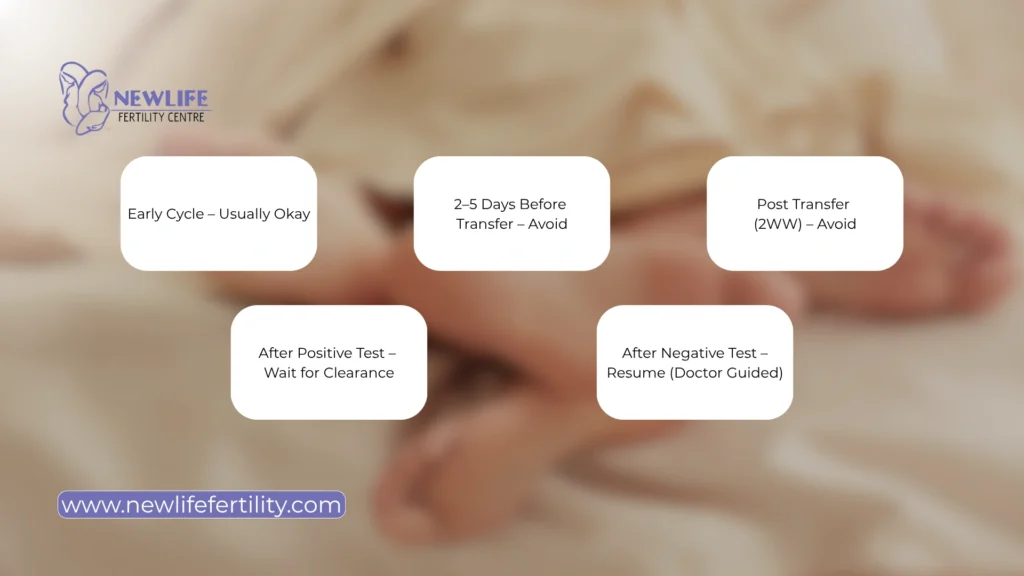
Let me share a simple, at a glance version so you can refer back to this without rereading everything.
- During the early cycle phase, sex is generally okay with your doctor’s guidance
- In the 2 to 5 days immediately before transfer, avoid it
- After the transfer and during the two-week wait, avoid it
- After a negative pregnancy test, resume based on your doctor’s advice
- After a positive pregnancy test, wait for further clearance from your clinic, often until after the first ultrasound
At this point, you might be thinking, “Okay… but why does all of this matter so much?”
Let’s simplify it in a way that actually makes sense.
A simple way to think about this so you stop overthinking it

Let me share an analogy that might make all of this click. Think about when you have guests coming over for something important, maybe a small get together or a dinner you have planned carefully. You clean the space, set everything up, and in those final moments, you try not to disturb anything. No last minute chaos, no unnecessary movement, just keeping things calm so everything goes smoothly.
That is exactly what this phase is like. During the implantation window, something incredibly delicate is trying to settle in. Your job, through medications, rest, and yes, temporarily avoiding sex, is simply to keep things as calm and undisturbed as possible.
You are not being asked to do this because your body is fragile. You are being asked to do this because the process is precise, and small precautions add up to better peace of mind.
And if you have already had sex after transfer, stop. Breathe. Tell your doctor. And then let it go, because guilt and anxiety do far more measurable harm to your wellbeing than a single moment of intimacy.
Sex before and after frozen embryo transfer: What should you really do from here?
IVF asks a lot of you, physically, emotionally, and even in the smallest everyday decisions. Questions like sex before or after a frozen embryo transfer are more common than you think, and wanting clarity is completely valid.
The simplest way to approach this is to follow your clinic’s advice first, and use this guide to understand the why behind it. When you understand the reasoning, the restrictions feel less confusing and more intentional.
NewLife Fertility Centre supports you with trusted guidance on frozen embryo transfer and next steps.
If you ever feel unsure, talk to your fertility team. At NewLife Fertility, we encourage open, judgment free conversations so you always feel supported and informed.
And if you need personalized guidance for your FET cycle, you can book a free consultation with our team. Because sometimes, a simple conversation can give you the clarity and peace of mind you need right now.
Common questions couples ask regarding sex before and after frozen embryo transfer
Yes, in the early part of your cycle, but stop 2 to 5 days before transfer and always follow your clinic’s specific instructions.
Generally yes, with the conditions mentioned above. The closer you get to transfer day, the more caution is needed.
No, not on the day of transfer and not in the days immediately before or after.
Most clinics recommend waiting until after your pregnancy test, which is usually 10 to 14 days after transfer, and sometimes longer if the result is positive.
It can, mainly because orgasm may cause uterine contractions during the implantation window. The risk is not absolute, but it is significant enough that most clinics advise avoiding it.