You’ve qualified for Ontario’s funded IVF program.
That’s genuinely great news. But now comes the part nobody fully explains upfront: what does “funded” actually cover, and what are you still going to be paying for yourself?
Because the thing is a funded cycle is not the same as a free cycle. The Ontario Fertility Program covers a meaningful chunk of the cost, but there are real gaps, and walking into treatment without knowing what they are leads to unexpected bills at some of the most stressful moments of the process.
Don’t worry because in this guide I’m going to cover exactly
1/ what an OHIP-funded IVF cycle includes,
2/ what falls outside it,
3/ how cancelled cycles are handled (one of the most misunderstood parts of the whole program), and
4/ what your options look like once the funded cycle ends.
One note before we start: if you’re still figuring out whether you qualify, or how the waitlist works, those topics have their own dedicated guides. This one focuses entirely on the funded cycle itself, what you get, what you pay, and what happens next.
What is an OHIP-funded IVF cycle?
Technically, it’s not OHIP (Ontario Health Insurance Plan) that funds IVF. It’s a common shorthand, but the actual mechanism is different.
IVF in Ontario is funded through the Ontario Fertility Program (OFP), a separate government initiative that provides funding directly to participating fertility clinics. Those clinics are then able to offer eligible patients one funded treatment cycle at no charge for the covered services.
OHIP itself doesn’t process the claim the way it would for a GP (General Practitioner) visit. Your clinic receives a government transfer payment for delivering your funded cycle, and the covered services are provided to you without a bill for those specific items.
Let me share a quick overview:
- One funded IVF cycle per eligible person, for life
- Funded through the Ontario Fertility Program, not OHIP directly
- Delivered by participating fertility clinics only
- Covers the core clinical procedure, not everything attached to it
- All embryo transfers from that cycle are included, one at a time
What does an OHIP-funded IVF cycle cover?
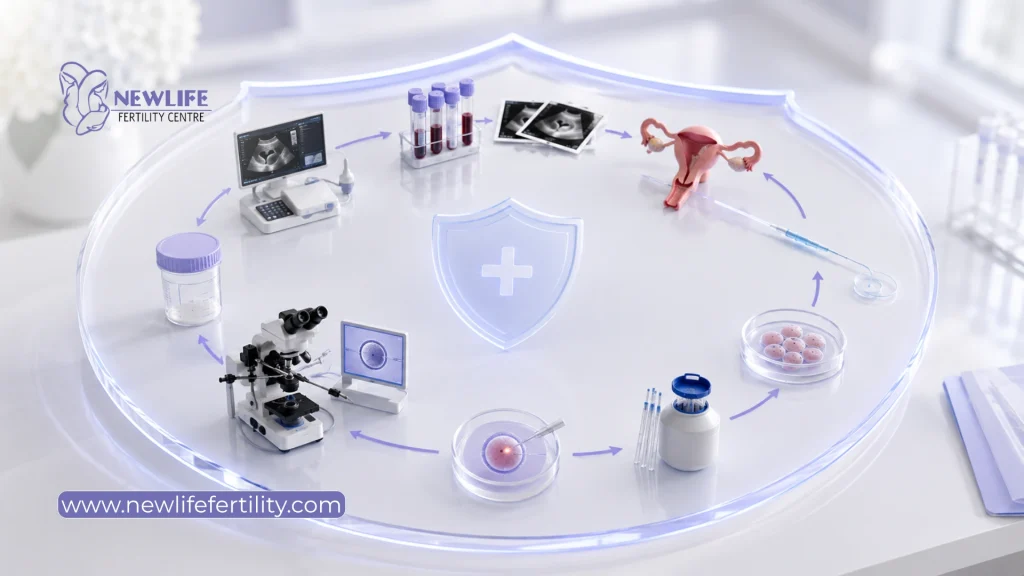
Now this is something that you’re here for. Basically what the funded program typically includes for an eligible patient. Your specific plan may look slightly different depending on your clinical situation, since your physician tailors the protocol to your diagnosis.
Covered services
| Service | Covered Under OFP? |
| Cycle monitoring (bloodwork and ultrasounds) | ✅ Up to two monitoring attempts |
| Egg retrieval procedure | ✅ One retrieval |
| Sperm collection or surgical sperm retrieval | ✅ One attempt |
| Sperm thaw (for donor sperm already purchased) | ✅ |
| ICSI (intracytoplasmic sperm injection) | ✅ |
| Assisted hatching | ✅ |
| Blastocyst culture | ✅ |
| Embryo freezing, thawing, and culture from this cycle | ✅ |
| All embryo transfers from this cycle, one at a time | ✅ |
One thing worth understanding about “up to two monitoring attempts”: if your first monitoring cycle has to be cancelled before retrieval for a medical reason, the program allows a second monitored attempt before it considers your funded cycle used. More on exactly how that works in the cancelled cycle section below.
What isn’t covered under an OHIP-funded IVF cycle?
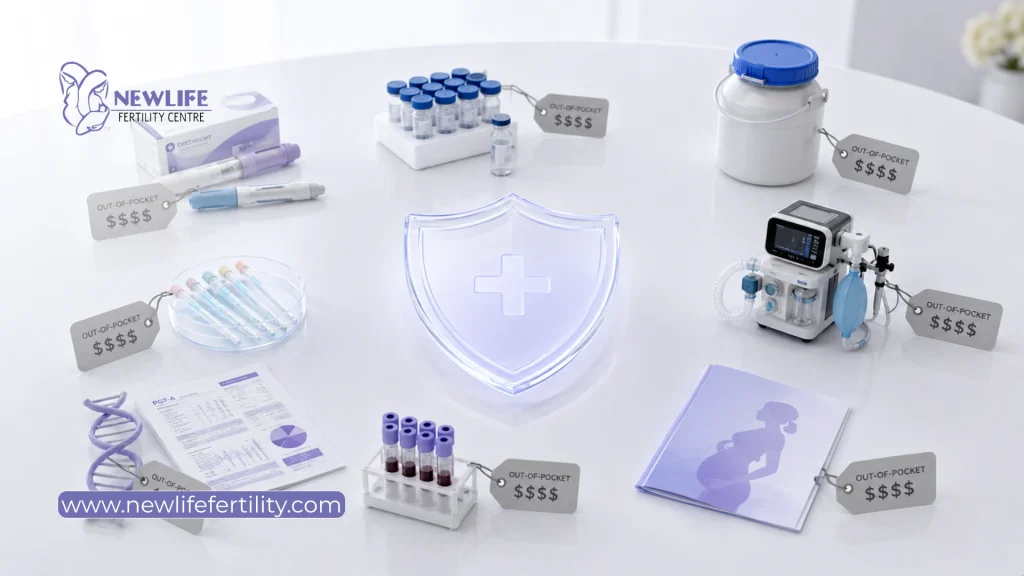
This is the section that usually surprises people the most. And honestly, the gaps are significant enough that budgeting for them before you start is one of the most practical things you can do.
| Service | Covered Under OFP? | You Pay |
| Fertility medications | ❌ | ~$3,000-$8,000 |
| Donor sperm (purchase, shipping, storage) | ❌ | Varies |
| Donor eggs (purchase and related costs) | ❌ | Varies |
| PGT-A / genetic testing | ❌ | ~$3,000+ |
| Annual embryo storage (after funded cycle) | ❌ | ~$700/year |
| Additional IVF cycles beyond the funded one | ❌ | $10,000-$15,000+ per cycle |
| Anesthesia (at some clinics) | ❌ | Varies by clinic |
| Immune testing and add-on therapies | ❌ | Varies |
A few clarifications on the common questions:
Donor sperm purchase: Not funded. However, once you have sperm on file, the thaw and preparation at the time of your funded retrieval is covered.
Donor eggs: The purchase and shipping of donor eggs are not funded. But if your egg donor is an Ontario resident with a valid OHIP card, their egg retrieval procedure may be funded under the program, even though you’re paying for the donor material separately.
Medications: This is typically the largest gap for most patients. Ontario’s funded cycle doesn’t include the medications used to stimulate your ovaries, which can range from around $3,000 to upward of $8,000 depending on your protocol. The Ontario Fertility Treatment Tax Credit (25% of eligible expenses, up to $5,000 a year) can offset a meaningful portion of this, and it’s worth factoring in when you’re building your budget.
Embryo storage: The freezing itself, as part of your funded cycle, is covered. Long-term annual storage once your funded cycle is complete is not.
How many funded IVF cycles can you receive in Ontario?

One, for life.
That’s the program’s fundamental rule. One funded cycle per eligible person, regardless of the outcome.
There is one exception: if you have acted as a surrogate and carried a pregnancy for someone else, you may be eligible for one additional funded cycle on top of your own.
What about frozen embryos from my funded cycle?
This is where things get more nuanced and where a lot of confusion happens.
Your funded cycle covers the retrieval, fertilization, and all resulting embryo transfers, one at a time, for as long as you have viable embryos from that cycle. So if your retrieval results in five usable embryos, all five transfers are covered under your funded cycle, even if they happen over months or years.
What you’ll pay separately is the annual storage fee to keep those embryos frozen between transfers.
Can I receive another funded IVF cycle?
No. Once your funded cycle has been used (either by reaching retrieval, or by exhausting your two permitted pre-retrieval cancellations), you’re not eligible for another funded cycle. Additional cycles would need to be privately funded.
What happens if your funded IVF cycle is cancelled?
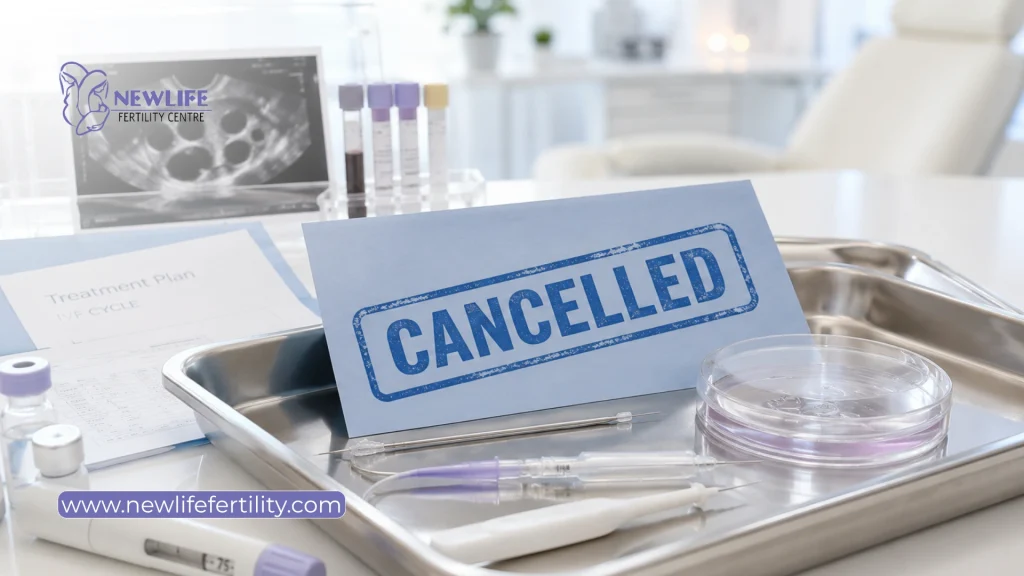
This is one of the most important, and least-explained, parts of the Ontario Fertility Program. And it matters enormously if it happens to you.
The short answer: it depends on when and why the cancellation happens.
Medical cancellation before egg retrieval
If your cycle monitoring has started but your cycle is cancelled before retrieval, that cancellation counts against your funded allowance, but not as your full funded cycle.
The program permits two pre-retrieval cancellations. Each one uses up one of those permitted slots, but doesn’t count as your one funded retrieval cycle. So in theory, you could have two cycles cancelled before retrieval and still have your funded retrieval ahead of you.
After two pre-retrieval cancellations, the program considers your funded allocation exhausted, regardless of whether you ever reached egg retrieval.
Common medical reasons a cycle gets cancelled before retrieval:
- Poor ovarian response to stimulation medication
- Risk of ovarian hyperstimulation syndrome (OHSS), where continuing would pose a health risk
- Too few mature follicles developing to proceed safely
- An unforeseen medical issue identified during monitoring
Does a cancelled cycle count as my funded cycle?
If the cancellation happens before egg retrieval, it counts as one of your two permitted pre-retrieval cancellations, not as your funded retrieval cycle.
If retrieval goes ahead, that is your funded cycle, regardless of what happens next. Even if no eggs are collected, none fertilize, or no viable embryos develop, that retrieval procedure counts as your one funded cycle. The program doesn’t offer a second retrieval because the first one didn’t produce a successful result.
Why the clinic makes the call
Cancellation decisions are clinical decisions made by your physician, not administrative ones. Your doctor’s job is to protect your health and give your funded cycle the best realistic chance of success. A cancelled cycle that protects you from OHSS or gives your body time to respond more optimally isn’t a setback in the way it might feel at the moment.
What costs should you still budget for?
| Treatment | Covered by OFP? | Patient Pays |
| Fertility medications | ❌ | ~$3,000–$8,000 |
| Donor sperm (purchase) | ❌ | Varies |
| Donor eggs (purchase) | ❌ | Varies |
| PGT-A / genetic testing | ❌ | ~$3,000+ |
| Embryo storage (annual, after cycle) | ❌ | ~$700/year |
| Additional IVF cycles | ❌ | $10,000–$15,000+ |
| Frozen embryo transfers (future cycles) | ✅ from funded cycle | None, if from funded cycle |
The Ontario Fertility Treatment Tax Credit doesn’t eliminate these costs upfront, but claiming 25% back on eligible expenses (up to $5,000 a year) does take a real edge off the medication bill specifically.
What happens after your funded IVF cycle?
Your funded cycle is complete once retrieval has happened. What comes next depends on the outcome.
Pregnancy from a fresh or frozen transfer
You’re pregnant, and care transitions to your OB or midwife. Any remaining frozen embryos from your funded cycle remain yours, with annual storage fees.
Frozen embryos available, but no pregnancy yet
Your funded cycle covers the transfer of all viable embryos from your retrieval, one at a time. Transfers from those embryos continue to be funded even after the retrieval itself is done. This can extend your funded cycle significantly if you have several embryos to work with.
No viable embryos, or no pregnancy after all transfers
This is genuinely hard news, and it’s worth talking through with your care team before you’re in that situation rather than after. At this point, your funded cycle is complete, and any additional cycles would be privately funded.
Private IVF options
Additional cycles are available privately through your clinic. The cost varies by clinic and by what your protocol requires, but most patients see $10,000 to $15,000 per cycle before medication. The Ontario Fertility Treatment Tax Credit continues to apply to private treatment costs.
OHIP-funded IVF cycle at a glance
| Question | Answer |
| Number of funded cycles | 1 per lifetime (plus 1 for surrogates) |
| What triggers the cycle being “used” | Egg retrieval proceeding, regardless of outcome |
| Pre-retrieval cancellations permitted | Up to 2 |
| Fertility medications covered | No |
| Embryo freezing from funded cycle | Yes |
| Future transfers from funded embryos | Yes, all of them |
| Annual embryo storage after cycle | No |
| Donor sperm/eggs covered | No (OHIP card required for donor procedures) |
| Single embryo transfer policy | Yes (with limited medical exceptions) |
| Program access | Ontario Fertility Program participating clinics only |
Could an OHIP-funded IVF cycle be the right next step for you?
An OHIP-funded IVF cycle can make fertility treatment more accessible, but it’s important to understand exactly what the program covers and what costs you’ll still need to plan for. Knowing this before treatment begins can help you avoid unexpected expenses, prepare for each stage of your journey, and make informed decisions if additional treatment is needed.
At NewLife Fertility, we’re here to support you every step of the way. Whether you’re preparing for your first funded IVF cycle, trying to understand what’s included, or exploring options beyond the Ontario Fertility Program, our experienced fertility specialists will help you create a treatment plan that fits your medical needs, timeline, and family-building goals.
You don’t have to navigate the process alone.
Book your free consultation with NewLife Fertility today, and let us help you make the most of your OHIP-funded IVF cycle with confidence.
Frequently asked questions about OHIP-funded IVF cycles
It’s a complete IVF cycle funded through the Ontario Fertility Program, covering egg retrieval, fertilization, and all resulting embryo transfers. It’s commonly called an “OHIP-funded” cycle, though technically the Ontario Fertility Program funds it rather than OHIP directly.
One, for life. The exception is one additional funded cycle for patients who have acted as a surrogate.
No. Medication costs are not included in the funded cycle and are typically the largest out-of-pocket expense, often ranging from $3,000 to $8,000 depending on the protocol.
The freezing of embryos created during your funded cycle is covered. Long-term annual storage after your funded cycle is complete is not.
The purchase, shipping, and storage of donor materials are not funded. However, if your egg donor or surrogate has a valid Ontario OHIP card, their clinical procedures may be covered under the program.
If cancelled before egg retrieval, it counts as one of two permitted pre-retrieval cancellations, not as your funded retrieval cycle. If egg retrieval proceeds, that’s your funded cycle, regardless of the outcome.
A pre-retrieval cancellation does not count as your funded retrieval cycle, but it does use one of your two permitted pre-retrieval cancellation slots.
Not unless you’ve acted as a surrogate. Additional cycles beyond the one funded retrieval are privately funded.
Yes. Private IVF is available at any time at participating clinics, and you can continue applying the Ontario Fertility Treatment Tax Credit to eligible expenses.
Yes. NewLife Fertility is a participating clinic in the Ontario Fertility Program and supports patients through both funded and private treatment, depending on where you are in your journey.