Ontario’s Fertility Program has covered same-sex couples since the day it launched, in December 2015.
Ten years on, a lot of people still don’t know that.
It’s an easy assumption to make. Fertility funding sounds built for a very specific kind of patient, a specific diagnosis, a specific kind of infertility. If you’re two women who need donor sperm, or two men building a family through surrogacy, it’s reasonable to wonder whether any of this actually applies to you.
It does. Eligibility for Ontario’s funded IVF program is based on medical need, not on who you are or who you love. But how that funding plays out in practice, what it covers, what it doesn’t, and which treatment path even makes sense, genuinely depends on your specific family-building situation.
So let’s walk through exactly how this works, step by step.
Can same-sex couples get funded IVF in Ontario?

Yes. Same-sex couples are eligible for the same funded IVF cycle as any other Ontario resident who meets the program’s criteria.
“But don’t these programs usually require a medical diagnosis?”
That’s exactly the gap Ontario’s program was built to close. Most public health coverage is written around medical infertility, a diagnosed physical reason someone can’t conceive. Under that kind of narrow definition, a same-sex couple or a single person could be functionally excluded, not because they aren’t infertile in a practical sense, but because there’s no diagnosis code for “my partner and I are both women.”
Ontario’s program explicitly covers what it calls non-medical infertility, including single individuals, same-sex couples, and anyone who needs a donor or surrogate to build their family. Eligibility isn’t based on gender, sexual orientation, or family status. It’s based on whether you need medical assistance to conceive, regardless of why.
That distinction is the whole reason this program works for same-sex couples in the first place. For the full eligibility breakdown, including age limits and OHIP requirements, our Ontario IVF Funding Eligibility Guide covers it in detail.
How does IVF funding work for same-sex couples?

The mechanics are the same program every Ontario resident uses, one funded IVF cycle per eligible patient, per lifetime, delivered through a participating fertility clinic. But there’s one detail that matters a lot more for same-sex couples than it does for most patients: funding is submitted under the person who intends to carry the pregnancy, not necessarily the person providing the egg.
For a lesbian couple doing reciprocal IVF, that means the funded cycle is generally applied under whichever partner is carrying, while the partner providing the eggs undergoes retrieval as part of that same integrated cycle. For a gay male couple working with a gestational carrier, it means your carrier’s OHIP eligibility, not yours, is what determines whether that specific cycle can be funded at all.
This is worth understanding early, because it shapes real decisions, like whether your gestational carrier lives in Ontario and holds a valid Ontario health card. Your fertility clinic will walk you through exactly how this applies to your situation, since the details shift depending on which partner is carrying and whether a donor or gestational carrier is involved.
What fertility treatment options are available for same-sex couples?
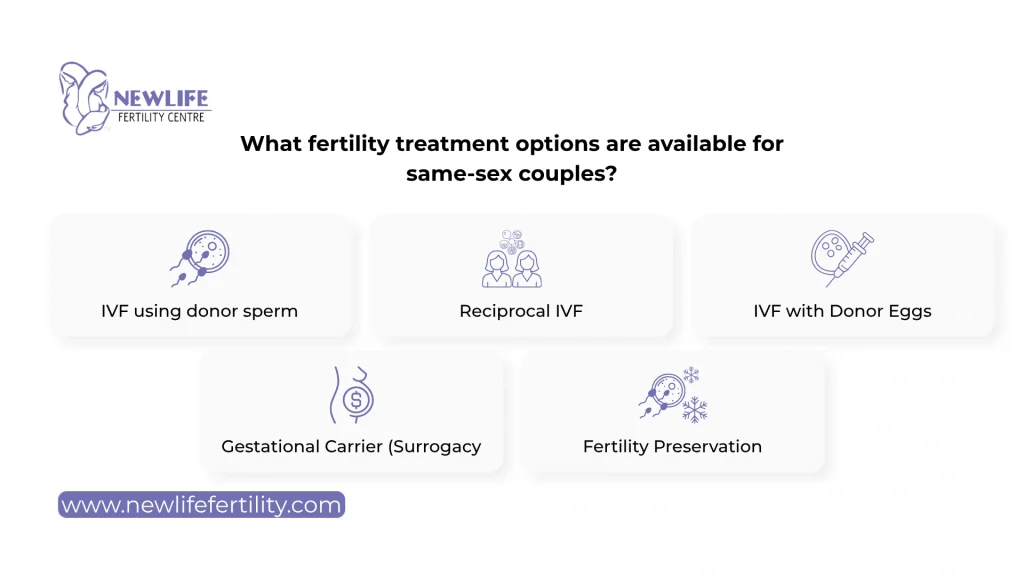
IVF using donor sperm
Donor sperm has to come from a Health Canada-approved sperm bank, which screens donors for infectious disease and genetic conditions before the sample is ever released to a clinic. Most clinics charge a separate sperm preparation fee on top of the sperm itself, often several hundred dollars per cycle, which is billed apart from the funded IVF cycle.
Reciprocal IVF for female same-sex couples
One partner’s eggs are retrieved and fertilized, and the resulting embryo is transferred into the other partner’s uterus, so both partners are physically part of the pregnancy in a different way. It’s one of the most requested pathways among lesbian couples specifically because it lets both partners participate biologically, one through the genetic contribution, the other through carrying.
IVF with donor eggs
Used when a partner’s own eggs aren’t viable, or when a gay male couple is building a family through egg donation and a gestational carrier. Donor egg cycles carry additional screening, legal, and procedural fees on top of the standard IVF cost, since both the donor and the arrangement typically require independent legal review.
IVF with gestational carrier (surrogacy)
Surrogacy is legal in Canada, but only as an altruistic, unpaid arrangement. The federal Assisted Human Reproduction Act makes it a criminal offence to pay someone to be a surrogate, only reimbursement of documented, pregnancy-related expenses is allowed.
As noted above, the funded IVF cycle itself is generally tied to your carrier’s eligibility, not yours. There’s also a specific exception built into the program: someone who acts as a surrogate is eligible for one additional funded IVF cycle in their own lifetime, on top of the one they’d already be entitled to for their own family.
Fertility preservation before treatment (when applicable)
OFP-funded fertility preservation, freezing eggs or sperm, is available, but only for a documented medical reason, such as a treatment that’s known to affect future fertility. It isn’t available for elective or timing-related preservation. This can be relevant for transgender or non-binary individuals preserving fertility before gender-affirming medical treatment, where a physician confirms the medical basis for funding.
What does Ontario-funded IVF cover for same-sex couples?

The covered cycle looks exactly the same as it does for any other funded patient, there’s no separate or reduced version for same-sex couples. One funded cycle includes:
- Cycle monitoring, the ultrasounds and bloodwork that track your response to stimulation
- Egg retrieval
- Fertilization and embryology services, including ICSI where medically appropriate
- The transfer of all resulting viable embryos, one at a time, from that single retrieval
In a reciprocal IVF cycle, this typically means the retrieval from the egg-providing partner and the transfer into the carrying partner both fall under the same funded cycle. Confirm the exact mechanics with your clinic before you begin, since documentation requirements can vary.
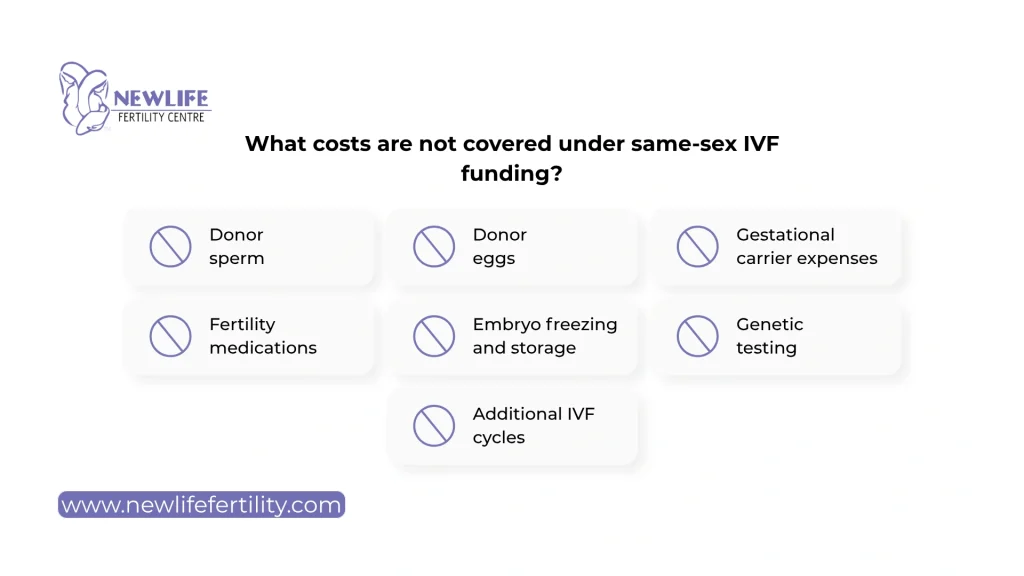
What costs are not covered under same-sex IVF funding?
The gap between “funded” and “fully covered” tends to be wider for same-sex couples than for most patients, simply because more of the treatment path involves services the program was never designed to pay for.
Donor sperm
Donor sperm, including the sample itself and sperm bank fees, typically adds a separate cost per cycle beyond a preparation fee that can run into the hundreds of dollars.
Donor eggs
Donor eggs involve donor screening, legal review, and procedural fees layered on top of standard IVF costs.
Gestational carrier expenses
Payment to a surrogate is prohibited under federal law, but reimbursable costs such as medical expenses, maternity clothing, and lost work income during pregnancy still add up. None of these expenses are covered under the Ontario Fertility Program.
Fertility medications
Fertility medications typically cost $3,000 to $7,000 per cycle, depending on your treatment protocol.
Embryo freezing and storage
Embryo freezing often costs several hundred dollars, followed by annual storage fees.
Genetic testing
Genetic testing, such as PGT-A, is an additional expense if you choose to screen embryos before transfer.
Additional IVF cycles
The Ontario Fertility Program covers one funded IVF cycle per lifetime, with the surrogacy exception noted earlier.
Are there financial assistance options?
There is some relief available. The Ontario Fertility Treatment Tax Credit refunds 25 percent of eligible private fertility expenses, up to $5,000 per year. Some organizations, such as the Fertility Friends Foundation, also offer grants specifically for 2SLGBTQ+ family-building costs. It’s worth asking your fertility clinic whether they partner with similar financial support programs.
How do same-sex couples apply for funded IVF in Ontario?
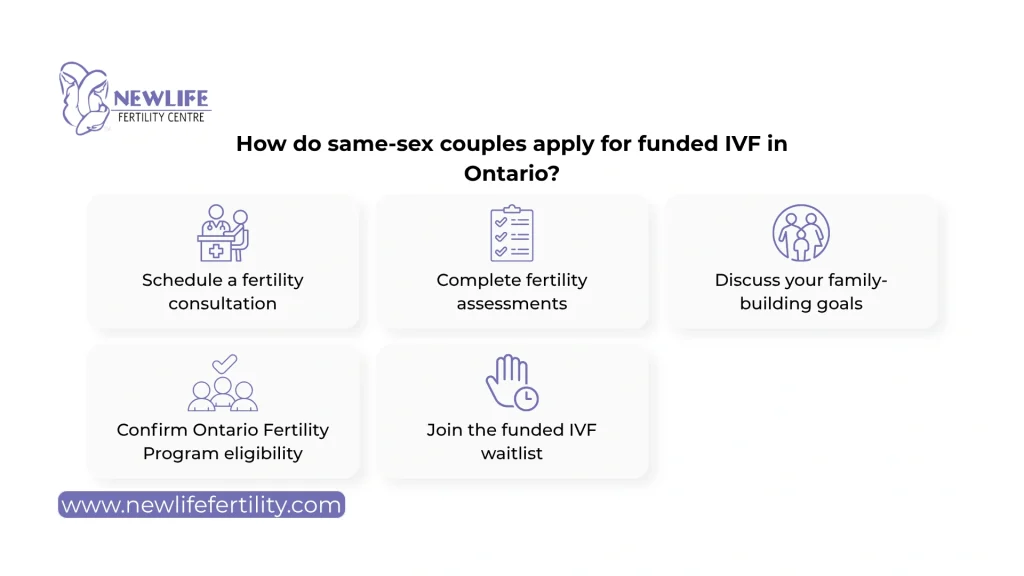
Schedule a fertility consultation
Most clinics require a physician referral, though a small and growing number now allow patients to self-refer directly.
Complete fertility assessments
Bloodwork, ultrasounds, and any relevant testing to confirm a treatment plan, for both partners if both are involved in providing genetic material or carrying.
Discuss your family-building goals
This is the conversation where the specifics get sorted out, whether you’re pursuing reciprocal IVF, donor sperm, donor eggs, or a gestational carrier, and which partner (or carrier) will be the one whose eligibility determines the funded cycle.
Confirm Ontario Fertility Program eligibility
A valid Ontario health card and being under 43 at the time of treatment apply to whichever partner or carrier is the eligible patient for that specific cycle.
Join the funded IVF waitlist
Wait times are set by the individual clinic, not the province, so they vary significantly depending on where you apply.
How to choose an LGBTQ2S+-friendly fertility clinic
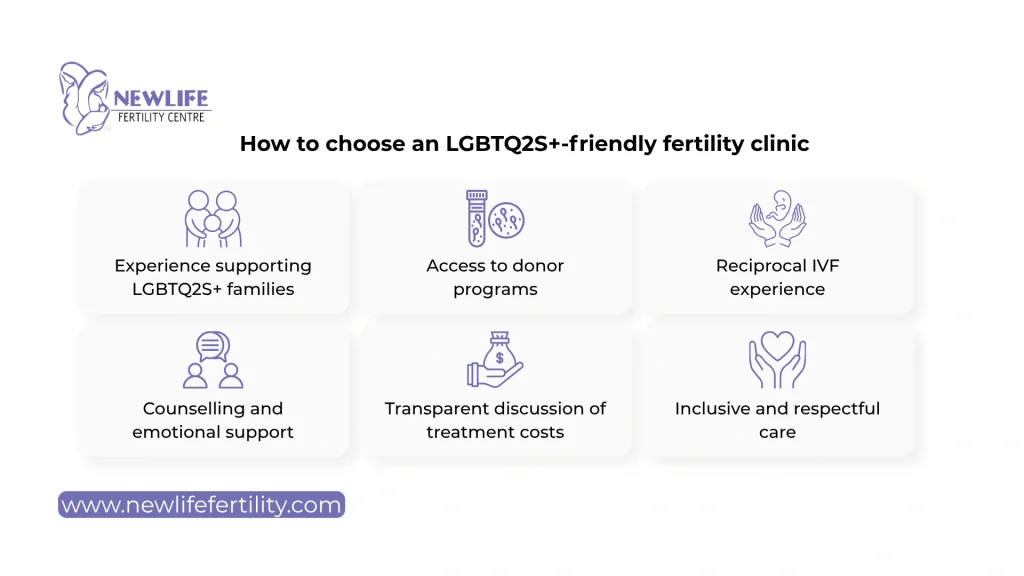
Experience supporting LGBTQ2S+ families
Look for a clinic that treats this as established practice, not a new accommodation. Several Toronto-area clinics run dedicated 2SLGBTQIA+ programs with gender-neutral intake forms and staff specifically trained in this care, rather than applying a standard heterosexual-couple process to your situation.
Access to donor programs
A clinic with an in-house or well-connected third-party reproduction program can save you significant time compared to one that refers you out for every donor-related step.
Reciprocal IVF experience
Ask directly how many reciprocal IVF cycles a clinic has actually run. It’s a well-established procedure at this point, but the coordination between two partners’ cycles benefits from a team that’s done it many times before.
Counselling and emotional support
Family-building through donor conception or surrogacy carries emotional weight beyond standard IVF. Clinics that build reproductive counselling or mental health support directly into the treatment process, rather than treating it as optional, tend to make this part easier.
Transparent discussion of treatment costs
Given how many pieces of this journey sit outside the funded cycle, a clinic that gives you a clear, itemized cost estimate upfront, rather than surprise billing as you go, matters more here than it might for a simpler funded cycle.
Inclusive and respectful care
This shows up in details, how intake forms are worded, whether both partners are addressed and included in appointments, whether staff use correct names and pronouns without being asked twice.
What should same-sex couples know before starting IVF?
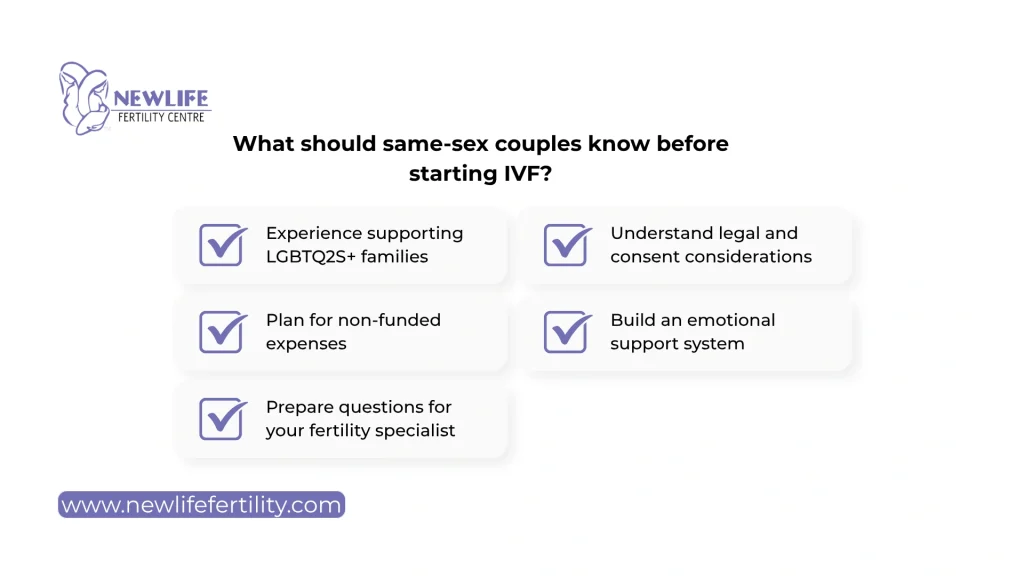
Starting IVF involves more than understanding funding. Same-sex couples should also consider the treatment pathway, legal requirements, financial planning, and emotional support before beginning their family-building journey.
Choose the right treatment pathway
Reciprocal IVF, donor sperm, donor eggs, and gestational surrogacy all lead to parenthood, but they involve very different costs, timelines, and legal steps. Talk through all of them with your specialist before committing to one.
Understand legal and consent considerations
Ontario’s All Families Are Equal Act, passed in 2016, means same-sex parents who use assisted reproduction no longer have to formally adopt their own children, as long as proper agreements are in place before conception. That’s a meaningful legal protection, but it depends on paperwork being done correctly and early. Independent legal counsel for both intended parents and any donor or surrogate isn’t optional in practice, it’s how that protection actually holds up.
Plan for non-funded expenses
Map out the full cost picture, not just the funded cycle, before you start. Donor fees, legal costs, and any surrogacy-related reimbursements can add up to more than the IVF cycle itself.
Build an emotional support system
Whether that’s a clinic’s in-house counselling, a peer support group, or your own therapist, having that support lined up before treatment starts tends to matter more than people expect going in.
Prepare questions for your fertility specialist
Before starting treatment, consider asking questions such as:
- How many reciprocal IVF or donor-conception cycles has this clinic run?
- Who becomes the “eligible patient” for funding in our specific situation?
- What happens if our first funded cycle doesn’t result in a pregnancy?
- What does the full cost breakdown look like beyond the funded portion?
Can funded IVF help you start your family in Ontario?
Same-sex couples in Ontario have real, legitimate access to publicly funded IVF, and that access has existed since the program began. What changes based on your specific situation isn’t whether you qualify, it’s which treatment pathway fits your family, and what it’ll actually cost once you look past the funded portion.
The best next step is usually the same one for everyone: sit down with a fertility specialist who can map your specific path, whether that’s reciprocal IVF, donor conception, or working with a gestational carrier, and tell you honestly where the funding applies and where it doesn’t.
NewLife Fertility has supported 2SLGBTQI+ patients as part of its core fertility services for years, alongside funded and private IVF, donor conception guidance, and the financial counselling that makes the non-funded pieces of this journey easier to plan for.
Our team can walk you through exactly how OFP funding would apply to your specific family-building path, whether that involves a partner, a donor, or a gestational carrier.
Book your free consultation and let’s talk through what building your family in Ontario could look like.
Frequently asked questions about same-sex IVF funding in Ontario
Yes. Eligibility is based on medical need to conceive, not on gender, sexual orientation, or family status.
Yes, reciprocal IVF is explicitly included under the program’s eligibility guidelines.
No. The IVF procedure itself is funded, but the cost of donor sperm and related preparation fees are billed separately.
No. Donor egg screening, legal, and procedural fees are not included in the funded cycle.
Partially, and it’s a nuanced answer. The funded IVF cycle can apply if your gestational carrier meets OFP eligibility, since funding is tied to the person carrying the pregnancy. Surrogacy-related costs themselves, agency fees, legal fees, and reimbursed pregnancy expenses, are never covered by OFP, and payment to a surrogate is prohibited under federal law regardless of funding.
Yes. Marital status doesn’t affect eligibility.
It varies significantly by clinic. Some Toronto-area clinics currently report no waitlist for funded IVF, while others have historically run from six months to well over a year, depending on how many funded cycles that specific clinic was allocated for the year.
Several Toronto-area clinics run dedicated LGBTQ2S+ family-building programs, including reciprocal IVF and third-party reproduction support, alongside general OFP-funded treatment. NewLife Fertility is one of them.