You’re staring at an IVF quote that feels like a down payment on a house.
And somewhere on a forum or a Facebook group, someone mentioned that IVF is “free” in certain countries.
So now you’re wondering. Is that true? Could you actually get treatment somewhere else for little or nothing?
So yes, some countries do fund IVF through public healthcare. But “free” almost always comes with conditions attached. Your age. Your residency. How many cycles you’ve already had. Whether you’re a citizen or just visiting.
In this guide, I’ll walk through 11 countries that offer free or publicly funded IVF in 2026. You’ll see who actually qualifies, how many cycles each country covers, whether foreigners can access any of it, and what you’d pay privately if you don’t qualify.
By the end, you’ll know exactly where the real opportunities are, and where the “free IVF” headlines are more hope than reality.
Is IVF really free in some countries?

Not quite “free” in the way a free coffee sample is free. But for residents who qualify, it can come very close to it.
What does “free IVF” actually mean?
When people say IVF is free somewhere, they usually mean one of these:
→ Government-funded IVF, paid for directly through a national health system
→ Public healthcare coverage, where IVF is treated like any other medical procedure
→ Insurance-funded IVF, where it’s built into mandatory health insurance
→ Partial reimbursement, where the government covers part of the cost and you pay the rest
None of these mean unlimited, no-questions-asked treatment. Every single one comes with rules.
Who usually qualifies for publicly funded IVF?
Across the countries I’ll cover, the same handful of conditions show up again and again.
→ Citizenship or permanent residency (almost always required)
→ An age cutoff, usually somewhere between 39 and 45
→ A documented medical reason for infertility
→ A cap on how many funded cycles you can have
→ In some countries, requirements around marital status or relationship history
If you’re picturing a passport stamp and a free cycle waiting on the other side, this is the part where I gently bring you back to reality. Public funding is built for residents of that country. I’ll get into exactly what that means for international patients shortly.
Quick comparison of countries with free or publicly funded IVF
| Country | Funding Available | Cycles Covered | Main Eligibility | Foreigners Eligible? |
| Israel | Yes, national health basket | Up to 8 (reassessed periodically), until 2 children | Resident, any marital status, under 45 (54 with donor eggs) | No |
| Denmark | Yes, public health service | 6 for a first child, 3 more for a second | Resident with CPR number, referral before age 40 | No (private treatment only, up to 46) |
| Belgium | Yes, mutual insurance reimbursement | 6 cycles, lifetime | Resident, insured, under 43 | No (private treatment only) |
| France | Yes, Assurance Maladie | 4 IVF cycles + 6 IUI attempts | Resident, enrolled in Sécurité Sociale, under 43 | No (private treatment only) |
| Sweden | Yes, regional funding | Around 3 | Resident, under 39 to 40 depending on region | No |
| Norway | Partial subsidy, National Insurance Scheme | 3 per child | Resident, public sector cutoff around age 40 | No |
| Finland | Yes, public hospitals (plus newer private reimbursement) | Around 3 IVF, or up to 6 combined with IUI | Resident, practical cutoff around 40 in public system | No |
| United Kingdom | Yes, NHS (varies by region) | 0 to 3, depending on where you live | Resident, registered with a GP, age limits 35 to 42 | No |
| Canada (Ontario) | Yes, Ontario Fertility Program | 1 cycle, lifetime | Resident, valid OHIP card, under 43 | No |
| Canada (Quebec) | Yes, RAMQ | 1 cycle, lifetime, includes medication | Resident, valid RAMQ card, under 41 to start | No |
| Australia | Partial, Medicare rebate | Unlimited cycles | Resident, Medicare card, diagnosed medical infertility | No (residents and some eligible visa holders only) |
| Netherlands | Yes, mandatory basic insurance | 3 per live-born child | Resident, insured, practical cutoff 42 to 43 | No |
Note: This table is a snapshot for comparison only. Funding rules shift often, so always confirm current details with the relevant health authority before making any plans.
11 countries where IVF is free or publicly funded in 2026
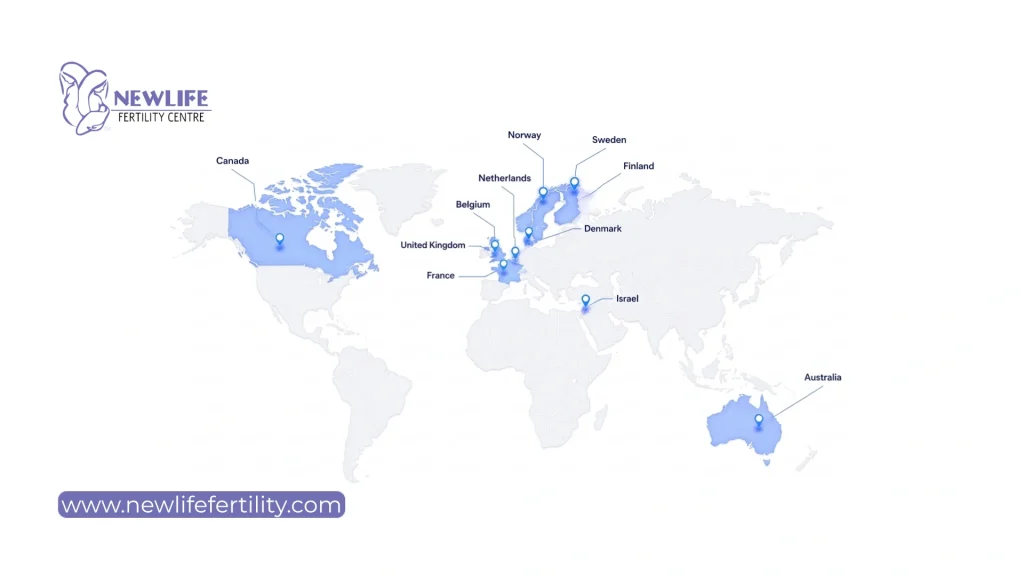
A quick note before we go country by country. I’ve used the same format for each one, on purpose. It makes it much easier to compare your real options side by side instead of reading 11 different stories with no common thread.
Israel

Israel has one of the most generous public IVF systems in the world. Treatment is funded through the national health basket (kupat cholim), which means it works like any other covered medical service under your health insurance fund.
Who is eligible for publicly funded IVF in Israel?
Any Israeli woman can access funded IVF, regardless of marital status or sexual orientation, until she has two children with her current partner. There’s no requirement to be married or in a heterosexual relationship.
How many IVF cycles are covered in Israel?
Historically, there was no hard cap on cycles. Current policy calls for medical reassessment if no embryo has transferred after 4 consecutive cycles, or no pregnancy after 8. In practice, this still makes Israel one of the most generous systems anywhere.
Can international patients receive funded IVF in Israel?
No. You need to be a resident enrolled in an Israeli health fund (kupat cholim) to access this funding.
What does private IVF cost in Israel?
For treatment outside the funded system (for example, beyond the age cutoff), private IVF in Israel typically runs $15,000 to $20,000 or more per cycle.
Key takeaways about IVF funding in Israel
If you’re an Israeli resident, this is about as supportive as public IVF funding gets anywhere on this list. For non-residents, it offers nothing in the way of funding.
Denmark
Denmark funds fertility treatment through its tax-financed public health service, and it’s long been known as one of the most progressive countries in the world for assisted reproduction.
Who is eligible for publicly funded IVF in Denmark?
Heterosexual couples, single women, and same-sex couples are all eligible, a policy that’s been in place since 2007. You’ll need a Danish CPR number (proof of residency) and a referral from your doctor.
How many IVF cycles are covered in Denmark?
Up to 6 publicly funded attempts for a first child. Since December 2024, an additional 3 funded attempts are available for a second child, as long as the referral happens before the woman turns 40.
Can international patients receive funded IVF in Denmark?
No. Public funding requires a CPR number. However, Denmark welcomes international patients for private treatment up to age 46, and it’s known for having one of the largest sperm banks in the world with virtually no wait times for donor sperm.
What does private IVF cost in Denmark?
Around €3,300 to €4,500 (roughly $3,600 to $4,900) per cycle.
Key takeaways about IVF funding in Denmark
For residents, this is one of the most inclusive and generous systems in Europe. For international patients, Denmark remains a popular and welcoming destination for private treatment, just not a free one.
Belgium
Belgium reimburses fertility treatment through its mutual health insurance system (mutualités), and it does something most neighbouring countries don’t: the cycle count doesn’t reset after you have a child.
Who is eligible for publicly funded IVF in Belgium?
Heterosexual couples, single women, and same-sex couples can all access reimbursement, as long as they’re affiliated with a Belgian mutual insurance fund and under the age of 43.
How many IVF cycles are covered in Belgium?
Up to 6 cycles, for life. This is one of the highest cycle allowances anywhere in this list.
Can international patients receive funded IVF in Belgium?
No, reimbursement requires Belgian mutual insurance. That said, Belgium is one of the more affordable countries in Western Europe for private, self-funded treatment, which is part of why it attracts international patients.
What does private IVF cost in Belgium?
Roughly €4,000 (around $4,300) per cycle privately. For residents using reimbursement, the out-of-pocket copay is typically just €300 to €500 per cycle.
Key takeaways about IVF funding in Belgium
If you’re a Belgian resident, 6 lifetime cycles without a reset after a child is hard to beat. If you’re not a resident, it’s still one of the more reasonably priced places in Western Europe to self-fund.
France

France covers fertility treatment through Assurance Maladie, its national health insurance system, and the coverage is fairly comprehensive for those who qualify.
Who is eligible for publicly funded IVF in France?
Since a 2021 law change, single women and same-sex couples are included alongside heterosexual couples. You need to be enrolled in the French Sécurité Sociale, either as a worker, resident, or through PUMA (universal health protection).
How many IVF cycles are covered in France?
Up to 4 full IVF cycles, plus up to 6 IUI attempts, per pregnancy project. Egg retrieval is only covered under 43; frozen embryo transfer can continue to 45.
Can international patients receive funded IVF in France?
No, you need to be enrolled in the French health system, which generally means residency or employment in France.
What does private IVF cost in France?
€2,000 to €4,000 (roughly $2,200 to $4,300) for standard cycles, rising to around €12,000 for donor egg treatment.
Key takeaways about IVF funding in France
Four funded cycles with broad eligibility makes France one of the more generous options in Europe for residents, with reasonably affordable private rates as a backup.
Sweden
Sweden funds IVF at the regional level, which means the exact rules depend on which Swedish region you’re registered in, but the broad strokes are similar across the country.
Who is eligible for publicly funded IVF in Sweden?
Heterosexual couples, lesbian couples (eligible since 2005), and single women (eligible since 2016) can all apply. You’ll need a referral and to be registered in a Swedish region.
How many IVF cycles are covered in Sweden?
Typically around 3 stimulated cycles, sometimes continuing until a live birth is achieved within that limit.
Can international patients receive funded IVF in Sweden?
No, region-funded treatment is tied to Swedish residency.
What does private IVF cost in Sweden?
Comparable to the broader Western European range, roughly €2,500 to €4,000 per cycle.
Key takeaways about IVF funding in Sweden
A solid, well-established public option, though the age cutoff (often 39 to 40) is on the earlier side compared to some neighbours.
Norway
Norway subsidizes, rather than fully funds, fertility treatment through its National Insurance Scheme. Patients still contribute toward medication costs up until a yearly cap.
Who is eligible for publicly funded IVF in Norway?
You need to be a member of the National Insurance Scheme. Eligibility has historically centred on married or cohabiting couples, with access expanding over recent years to include single women and same-sex couples in many cases.
How many IVF cycles are covered in Norway?
3 cycles per child, whether treatment happens in Norway or, in some cases, abroad through a reimbursement scheme.
Can international patients receive funded IVF in Norway?
No, the National Insurance Scheme is tied to Norwegian residency.
What does private IVF cost in Norway?
Roughly NOK 30,000 to 50,000 (about $2,800 to $4,700) per cycle, alongside a medication co-pay capped at just over NOK 21,500.
Key takeaways about IVF funding in Norway
A meaningful subsidy rather than a fully free ride, with one of the earlier public-sector age cutoffs on this list.
Finland
Finland funds fertility treatment through its public hospital system. Separately, since May 2025, the national insurer Kela also reimburses some costs for private treatment, though that newer scheme is limited to medically diagnosed infertility.
Who is eligible for publicly funded IVF in Finland?
Public hospitals have offered treatment to heterosexual couples, single women, and same-sex couples since 2007. The newer Kela private reimbursement, by contrast, currently applies to medically diagnosed infertility specifically.
How many IVF cycles are covered in Finland?
Around 3 IVF or ICSI cycles, or up to 6 cycles if combined with IUI attempts.
Can international patients receive funded IVF in Finland?
No, both pathways require Finnish residency.
What does private IVF cost in Finland?
€4,200 to €5,000 (roughly $4,500 to $5,400) per cycle privately, with Kela’s newer scheme covering just under a quarter of that for eligible cases.
Key takeaways about IVF funding in Finland
Solid baseline coverage through the public system, with a newer but narrower private reimbursement option layered on top.
United Kingdom

The NHS funds fertility treatment, but how much you actually get depends heavily on where you live. This is widely known in the UK as the “postcode lottery.”
Who is eligible for NHS-funded IVF in the United Kingdom?
National guidelines (NICE) recommend 3 full cycles for women under 40 and 1 cycle for ages 40 to 42. In England, however, each of the 42 local Integrated Care Boards sets its own policy, and most fund far less than the guideline. Scotland funds 3 cycles, Wales 2, and Northern Ireland typically 1.
How many IVF cycles are covered in the United Kingdom?
Anywhere from 0 to 3, depending entirely on your region. Most areas in England fund just 1.
Can international patients receive funded IVF in the United Kingdom?
No, NHS funding requires UK residency and GP registration.
What does private IVF cost in the United Kingdom?
£4,890 to £7,463 (roughly $6,200 to $9,500) per cycle, with costs running higher in London.
Key takeaways about IVF funding in the United Kingdom
National funding technically exists, but whether you benefit from it can genuinely come down to your postcode rather than your medical need.
Canada
Canada has no single national IVF program. Funding is decided province by province, which means your experience can look completely different depending on where you live.
Which Canadian provinces offer publicly funded IVF?
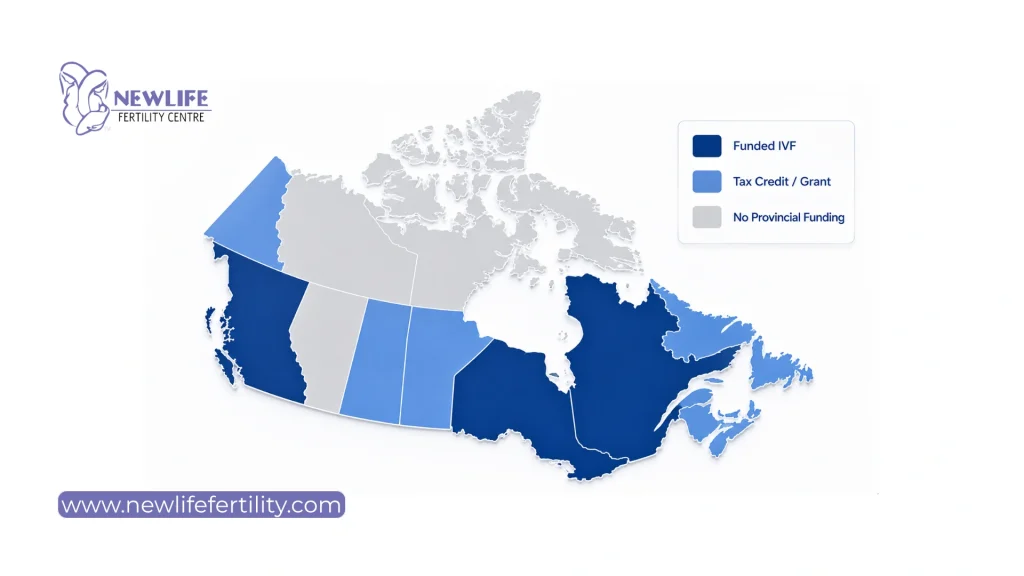
Ontario: One funded IVF cycle through the Ontario Fertility Program
The Ontario Fertility Program (OFP), accessed through OHIP, funds one complete IVF cycle per person, for life, regardless of gender, sexual orientation, or relationship status. An additional cycle is available if you’ve acted as a surrogate. The program covers egg retrieval, fertilization, embryology, and embryo transfers from that cycle, but not medication, donor materials, storage, or genetic testing.
A new Ontario Fertility Treatment Tax Credit, introduced for 2025, refunds 25% of eligible fertility expenses up to $5,000 a year. Ontario has also committed $50 million toward funding thousands of additional cycles as part of a plan to triple program capacity by 2028.
Quebec: Canada’s most comprehensive publicly funded IVF program
Quebec’s program, through RAMQ, is arguably the most complete single-cycle coverage in the country. It funds one IVF cycle for life, and unlike Ontario’s program, this includes medication and embryo freezing and storage for the first year.
You need to be between 18 and 41 to start treatment, and under 42 for embryo transfer. Quebec also covers unlimited IUI cycles, and offers an income-based tax credit (20% to 80% of costs, up to $20,000 a year) for anyone needing treatment beyond that one funded cycle.
Other provinces: Grants, tax credits, and regional funding options
→ British Columbia offers an income-based grant of up to $19,000 toward one cycle.
→ Manitoba and Nova Scotia each offer a 40% tax credit on fertility expenses, up to $20,000 in costs.
→ Prince Edward Island reimburses $5,000 to $10,000 annually, based on income.
→ Newfoundland and Labrador offers a $5,000 subsidy per cycle for those travelling elsewhere in Canada for treatment.
→ New Brunswick offers a one-time grant covering 50% of costs, up to $5,000.
→ Alberta, Saskatchewan, and the territories currently offer no direct funding or tax credit at all, which affects roughly 29% of the Canadian population.
Who is eligible for publicly funded IVF in Canada?
In every province with funding, eligibility is based on provincial health coverage, not on gender, sexual orientation, or family structure.
Can international patients receive funded IVF in Canada?
No, provincial health coverage (OHIP, RAMQ, and similar) is reserved for residents of that province.
What does private IVF cost in Canada?
In Ontario, a privately funded cycle including medication often runs $12,500 to $20,000 CAD.
In Quebec, self-funded cycles typically range from $6,000 to $11,000 CAD.
Key takeaways about IVF funding in Canada
Where you live in Canada matters enormously. Quebec and Ontario offer real, meaningful support. Several provinces currently offer nothing at all.
Australia
Australia doesn’t fund IVF outright, but Medicare provides a rebate that covers a substantial portion of treatment costs for anyone diagnosed with medical infertility.
Who is eligible for Medicare-supported IVF in Australia?
You need a Medicare card and a documented medical infertility diagnosis, along with a referral from a GP or specialist. As of 2025, Medicare eligibility no longer considers relationship status, sexual orientation, or gender identity, which has broadened access considerably for LGBTQ+ patients and families.
How many IVF cycles are covered in Australia?
There’s no cap on the number of cycles, and rebates aren’t means-tested. Some states, like Victoria, do apply an age cutoff (46 for a first cycle, 51 for embryo transfer).
Can international patients receive funded IVF in Australia?
No, Medicare is for residents and certain eligible visa holders, not short-term international patients.
What does private IVF cost in Australia?
The sticker price often sits around $9,000 to $10,000 AUD per cycle before any rebate, with an out-of-pocket “gap” of roughly $2,000 to $5,000 AUD remaining after Medicare’s contribution. New South Wales also offers an additional $2,000 rebate on top of the Medicare amount.
Key takeaways about IVF funding in Australia
Unlimited rebated cycles is a real advantage, but this is a partial rebate system, not free treatment. There’s always a gap to budget for.
Netherlands
The Netherlands builds fertility coverage directly into its mandatory basic health insurance (basisverzekering), which means it’s less of a special program and more of a baseline expectation for everyone insured in the country.
Who is eligible for publicly funded IVF in the Netherlands?
You need to hold Dutch basic health insurance, which is mandatory for residents. Coverage applies broadly to couples and individuals undergoing IVF or ICSI for medical infertility.
How many IVF cycles are covered in the Netherlands?
3 IVF or ICSI cycles per live-born child, along with unlimited frozen embryo transfers from those cycles and unlimited IUI or ovulation induction cycles.
Can international patients receive funded IVF in the Netherlands?
No, this is tied to mandatory Dutch insurance, which is a residency-based system.
What does private IVF cost in the Netherlands?
A self-funded cycle (for example, a 4th cycle beyond what’s covered) typically runs €3,000 to €5,000 (roughly $3,200 to $5,400).
Key takeaways about IVF funding in the Netherlands
One of the simplest and broadest models on this list, since it’s baked directly into standard health coverage rather than a separate application process. The tradeoff is a fairly firm age cutoff around 42 to 43.
IVF treatment costs around the world (2026)
| Country | Average IVF Cost (private, per cycle) | Government Funding | Average Out-of-Pocket Cost (for eligible residents) |
| Israel | $15,000–$20,000+ | Yes, extensive | Low to none |
| Denmark | $3,600–$4,900 | Yes | Low for residents |
| Belgium | ~$4,300 | Yes | ~€300–500 copay |
| France | $2,200–$4,300 | Yes | Largely covered |
| Sweden | ~$2,500–$4,000 | Yes (regional) | Low, capped visit fees |
| Norway | $2,800–$4,700 | Partial | Medication co-pay only |
| Finland | $4,500–$5,400 | Yes (public) / partial (Kela) | Low in public system |
| United Kingdom | $6,200–$9,500 | Varies (postcode lottery) | $0–full price, region-dependent |
| Canada (Ontario) | $9,000–$14,500 CAD-equivalent | Yes, 1 cycle | Medication & extras only |
| Canada (Quebec) | $6,000–$11,000 CAD | Yes, 1 cycle incl. medication | Near $0 for funded cycle |
| Australia | ~$9,000–$10,000 AUD | Partial (Medicare rebate) | ~$2,000–$5,000 AUD gap |
| Netherlands | $3,200–$5,400 | Yes, 3 cycles | Low (deductible only) |
This is where your pricing reality usually starts to come into focus. Where there’s strong funding, like Quebec, Belgium, or Israel, residents pay very little. Where funding is partial or postcode-dependent, like Australia or the UK, there’s almost always a meaningful gap left over.
Which country offers the best IVF funding?
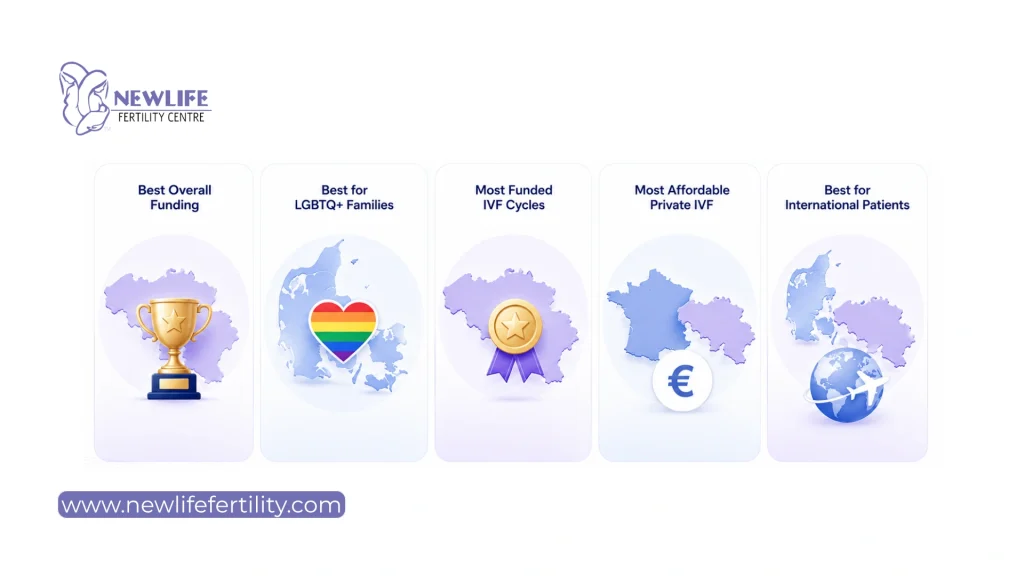
Best overall funding
Belgium stands out here, mostly because of one detail: 6 lifetime cycles that don’t reset after you have a child. Quebec is a close second, since its single funded cycle includes medication, which most other programs leave out entirely.
Best for LGBTQ+ families
Denmark has one of the longest track records of inclusive fertility law in the world, with no marital status requirement and one of the largest sperm banks anywhere. Ontario and Quebec also stand out for explicitly removing gender, sexual orientation, and relationship status from their eligibility criteria.
Best for the highest number of funded cycles
Belgium, at 6 cycles for life, is the most generous by cycle count on this list.
Best for affordable private IVF
If public funding isn’t an option for you, France and Belgium tend to offer some of the more reasonable private cycle costs in Western Europe, generally in the €2,000 to €4,000 range.
Best for international patients
No country here funds treatment for non-residents. But Denmark and Belgium have long-standing, well-established infrastructure for international patients seeking private treatment, including multilingual clinics and shorter waits for donor gametes than many neighbouring countries.
Can you travel abroad to receive free IVF?

This is the question behind almost everyone’s search, so let’s be direct about it.
Can foreigners qualify?
In nearly every case, no. Public IVF funding is built for residents and citizens, financed through taxes or mandatory insurance that you’d need to be paying into. Showing up as a visitor doesn’t unlock it.
Residency requirements
Most countries on this list require something concrete: a CPR number in Denmark, RAMQ or OHIP coverage in Quebec or Ontario, enrollment in Assurance Maladie in France, a Medicare card in Australia. These aren’t paperwork formalities you can skip. They’re the entire basis of the funding.
Waiting lists
Even for residents, funded treatment often comes with a wait. In parts of England, NHS waits can stretch past 18 months. In parts of Ontario, funded cycle waitlists have run 18 to 24 months. Funding and speed are often two separate problems.
Medical tourism vs public healthcare
What you can access abroad is private treatment, not public funding. Countries like Denmark, Belgium, and the Czech Republic have built strong reputations specifically around welcoming international patients into their private systems, often with shorter donor waitlists or more flexible legal frameworks than a patient’s home country offers. That’s a real and valid option. It’s just a different option than “free IVF,” and it’s worth going in with that distinction clear from the start.
What should you consider before choosing a country?
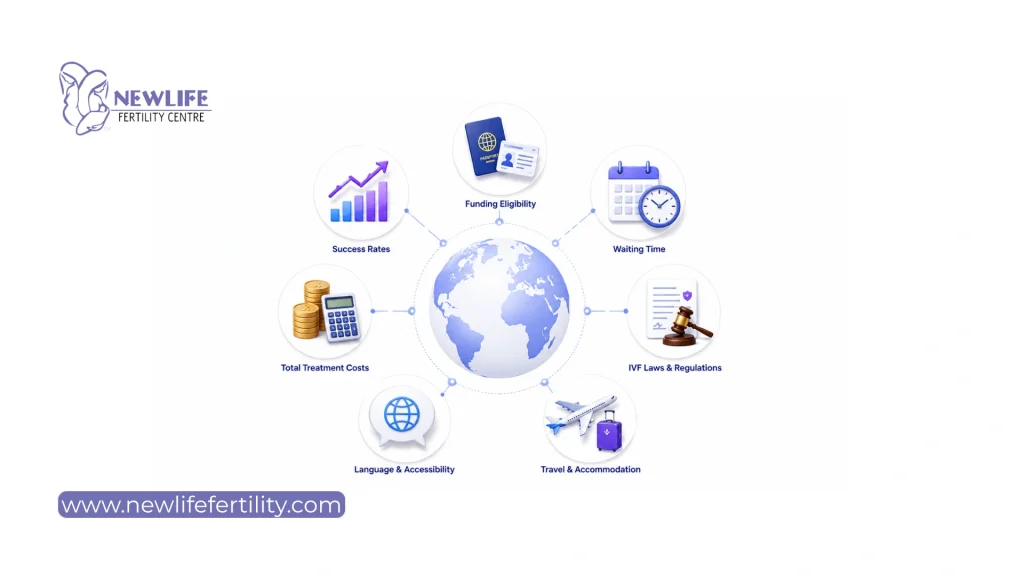
Funding eligibility
Start here, honestly. If you’re not a resident or citizen, public funding in any of these countries is off the table, no matter how good it sounds in a comparison table.
Success rates
A funded cycle in a country with lower success rates isn’t necessarily the better deal. We’ll get into this more in a moment, because it matters just as much as the funding itself.
Waiting time
Free or low-cost treatment that takes two years to access isn’t free in every sense that matters, especially if your fertility window is part of the equation.
Total treatment costs
Funding rarely covers everything. Medication, genetic testing, storage, and donor materials are commonly left out, even in generous programs like Ontario’s. Always ask for the full picture, not just the headline coverage.
IVF laws and regulations
Some countries restrict who can access treatment based on marital status, sexual orientation, or whether you’ve used other treatments first. These rules vary enormously and can rule a country out entirely regardless of cost.
Language and accessibility
If you’re considering travelling for private treatment, look into whether the clinic has English-speaking staff and experience working with international patients specifically.
Travel and accommodation
For anyone considering cross-border treatment, this adds real cost on top of the clinical fees, and it’s easy to underestimate.
IVF success rates: why they matter as much as funding
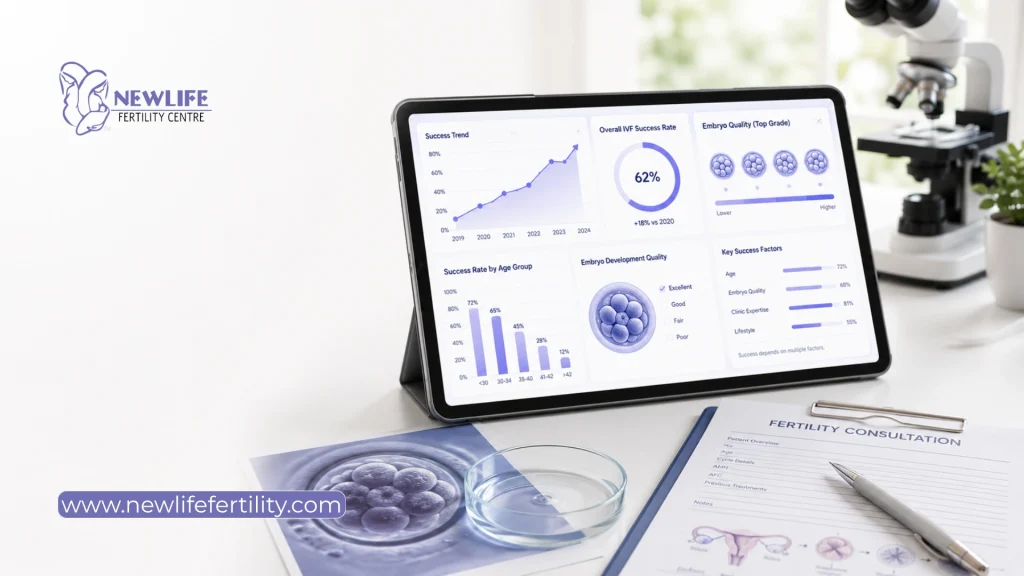
A free or low-cost cycle is only as good as its odds of actually working.
Success rates depend far more on individual factors than on which country you’re in. Maternal age remains the single biggest factor: live birth rates per cycle tend to run around 40% to 50% for women under 35, drop to roughly 25% to 30% for women 35 to 40, and decline further after 40, particularly when using your own eggs.
Embryo quality, clinic experience, and the specific cause of infertility all matter too. A country offering 6 funded cycles isn’t necessarily the better choice if its clinics have lower success rates per cycle than a country offering 3.
This is exactly why “where is IVF cheapest” and “where will IVF actually work for me” can be two very different questions, and why it’s worth asking any clinic, anywhere, for their actual success rates broken down by age group rather than a single average number.
When paying privately may still make sense
Not everyone fits neatly into a funded program, and that’s a completely normal place to be.
You might be a few years over the age cutoff. You might have already used your one funded cycle. You might be facing a waitlist that doesn’t match your timeline. Or funding simply might not exist where you live.
In any of these situations, private treatment isn’t a failure or a fallback. It’s simply a different, faster, and more flexible path, with more control over timing and protocol than a public system can usually offer.
What if you don’t qualify for publicly funded IVF?
Finding a country with free or publicly funded IVF is only one part of the journey. The next step is understanding whether you actually qualify and what your best options are based on your fertility needs, timeline, and long-term family goals.
If you’re eligible for a funded program, knowing the application process and what’s covered can help you plan with confidence. And if you don’t qualify, or you’ve already used your funded cycle, private fertility treatment may still be the right path toward growing your family.
At NewLife Fertility, we help individuals and couples understand every option available to them. Whether you’re exploring Ontario’s funded IVF program, considering another treatment cycle, or looking into donor conception, reciprocal IVF, or surrogacy, our experienced team will guide you with a personalized treatment plan tailored to your unique situation.
You don’t have to navigate funding rules, eligibility requirements, or treatment decisions on your own.
Book your free consultation with NewLife Fertility today, and let us help you take the next step toward building the family you’ve been dreaming of.
Frequently asked questions about countries with free IVF
Israel, Denmark, Belgium, France, Sweden, Norway, Finland, the United Kingdom, Canada (specifically Quebec and Ontario), Australia, and the Netherlands all offer some form of free or publicly funded IVF for eligible residents, though the extent of coverage varies widely.
The closest to genuinely “free” for eligible residents are Israel, Quebec, and Belgium, where funded cycles cover most or all standard treatment costs, including medication in Israel and Quebec’s case.
No. Every country on this list ties public funding to residency, citizenship, or enrollment in a national health or insurance system. Foreigners can typically access private treatment in these countries, just not the funded version.
Partially, and inconsistently. NHS funding exists, but in England it depends entirely on your local Integrated Care Board, which can mean anywhere from 0 to 3 funded cycles. Scotland, Wales, and Northern Ireland each have their own more consistent national policies.
Not fully free, but heavily subsidized through Medicare rebates for anyone with a documented medical infertility diagnosis. There’s no cap on the number of cycles, but an out-of-pocket gap typically remains after the rebate.
Belgium offers the highest cycle allowance on this list, with up to 6 funded cycles for life, without resetting after a child is born.
Rarely entirely free. Most programs leave out costs like medication, genetic testing, donor materials, or long-term storage. Quebec and Israel come closest to fully covering a cycle. Eligibility rules and coverage details also change over time, so it’s always worth confirming the latest requirements directly with the relevant health authority or a fertility clinic before making any decisions.
IVF funding in Canada depends on the province where you live. For example, Ontario offers one publicly funded IVF cycle for eligible patients through the Ontario Fertility Program, while Quebec provides broader fertility funding. Other provinces may offer grants, tax credits, or limited financial assistance.
Yes. Canada welcomes international patients seeking private fertility treatment. While publicly funded IVF programs are generally limited to eligible provincial residents, international patients can access high-quality private IVF care at licensed fertility clinics across the country.
Canada is known for its high medical standards, experienced fertility specialists, inclusive care for LGBTQ+ individuals and single parents, and a well-regulated healthcare system. Patients also benefit from advanced fertility technologies and transparent treatment protocols.
Yes. If you don’t qualify for a publicly funded IVF program or have already used your funded cycle, NewLife Fertility offers personalized fertility care tailored to your unique needs. Our team will explain your treatment options, discuss costs, and create a plan that aligns with your family-building goals.
Yes. NewLife Fertility welcomes patients from around the world. Our experienced team supports international patients throughout the IVF journey, from virtual consultations and treatment planning to coordinating care once you arrive in Canada.
Absolutely. If you’re considering the Ontario Fertility Program, NewLife Fertility can help you understand the eligibility criteria, explain what is covered, and discuss your options if you need additional treatment beyond the funded cycle.