You just received your FET protocol from your doctor, and suddenly progesterone is everywhere. It is in your injection schedule, your blood reports, your anxious 2 AM Google searches, and probably your conversations with your partner too.
“Start progesterone on Day 14.”
“Your level is 18.3. Is that good?”
“Do not miss a single dose.”
It can feel like you are being handed the most important exam of your life with no time to study.
Here is the thing though. You are not expected to understand all of this overnight. Progesterone during a frozen embryo transfer cycle is genuinely complex, and the anxiety you feel around it is completely normal.
Most women going through frozen embryo transfer are not beginners, but they are also not endocrinologists. They are somewhere in the middle. They know what IVF is, they have been through multiple appointments, and now they are trying to make sense of the hormonal details explained in a five minute consultation.
This guide is written exactly for that space.
By the time you finish reading, you will understand:
- Why progesterone matters so much in FET
- When it starts and stops
- What your levels actually mean
- And most importantly, what you can stop worrying about
Let’s take it one step at a time, starting with 👇
Why is progesterone important in frozen embryo transfer?

To understand what progesterone does in FET, it helps to first look at what it does naturally in your body.
In a natural cycle, when you ovulate, your body releases progesterone. That progesterone sends a very specific signal to your uterine lining: “Get ready. An embryo may be arriving soon.”
In response, your uterus transforms its lining into a soft, nutrient rich environment, one that is hospitable for implantation.
Now, in a frozen embryo transfer cycle, most women are on a medicated protocol. Your ovaries are intentionally kept quiet, which means your body is not producing the progesterone it would naturally release after ovulation. That is where supplementation comes in.
Your doctor is essentially recreating, through medication, the exact hormonal environment your uterus would have in a natural cycle. Without adequate progesterone, the lining does not complete its transformation, and an embryo placed into an unprepared uterus simply cannot implant.
Think of it like a hotel check in scenario.
You have a reservation, your embryo, and the hotel room needs to be fully prepared before you arrive.
Clean sheets, the right temperature, everything in order.
Progesterone is what tells the hotel staff to start getting the room ready. Estrogen built the structure of the room during the earlier part of your cycle. Progesterone now does the finishing work, layering in exactly the right signals at exactly the right time.
When do you start progesterone for frozen embryo transfer?

The timing of your first progesterone dose is one of the most carefully calculated decisions in your entire FET cycle.
It is not random. It is not the same for everyone. It depends on the type of embryo being transferred.
In a typical medicated FET cycle:
- You first take estrogen to build the uterine lining
- Once the lining reaches around 7 to 8 mm, confirmed by ultrasound
- Your doctor tells you when to start progesterone
This marks the beginning of the progesterone window.
Missing this timing, even by a day, can impact outcomes.
If you are transferring:
- Day 5 blastocyst → Start progesterone 5 days before transfer
- Day 3 embryo → Start progesterone 3 days before transfer
The logic is simple.
Your doctor is synchronizing your uterus with the biological age of the embryo. The goal is to recreate what would have happened naturally inside your body.
Even a one day difference matters:
- Too early → uterus gets ahead
- Too late → embryo arrives too soon
Either way, the window for implantation narrows.
Your protocol is precise because biology is precise.
How many days of progesterone before frozen embryo transfer?
This is one of the most common questions, and it connects directly to timing.
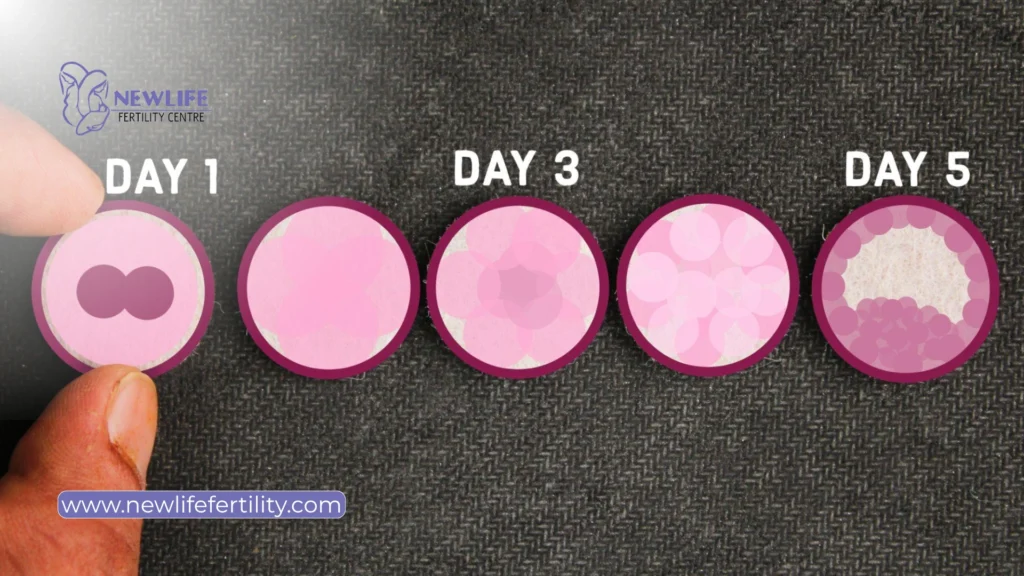
The rule is simple. The number of progesterone days matches the age of the embryo.
- Day 3 embryo → 3 days of progesterone
- Day 5 embryo → 5 days of progesterone
Some clinics may adjust this slightly based on your response, but the principle stays the same.
This concept is called synchronization.
Your uterus and your embryo need to be on the same clock.
The embryo, frozen at Day 5 of its development, is biologically expecting to arrive in a uterine environment that has been primed by exactly five days of progesterone. This is what would have happened naturally if it had been developing inside you all along.
When the synchronization is right, the embryo finds the receptive window it needs.
When it is off, even slightly, implantation becomes less likely.
It is worth knowing that some clinics use a test called the Endometrial Receptivity Analysis (ERA) to personalize this timing further, particularly for women who have had repeated implantation failures.
This test can reveal whether your uterus reaches its receptive window exactly on the standard day or whether it is slightly shifted, earlier or later than average.
If your clinic has recommended this test, it is a sign they are being especially thoughtful about matching your specific biology to the embryo’s needs.
What is the ideal progesterone level for frozen embryo transfer?

This is the question that sends most women to their phones at midnight, typing numbers into search boxes and comparing their reports to strangers on Reddit.
Let me talk about this honestly.
There is no single universal “perfect” progesterone number.
Clinics use different testing methods, different supplementation routes, and different threshold ranges.
Most fertility specialists look for a progesterone level above 10 ng/mL on the day of or just before transfer when using injectable progesterone. Some clinics may set their threshold slightly lower or higher depending on their protocols.
When vaginal progesterone is used, serum levels often read lower. This happens because the medication goes directly to the uterine tissue without releasing as much into the bloodstream. It does not necessarily mean the uterus itself is under-exposed.
This distinction between blood levels and tissue levels is important. When you take progesterone vaginally, a lot of it gets absorbed directly into the uterine lining through what is called the “first-pass uterine effect.” The level you see on your blood report may look modest, but the actual progesterone reaching your uterus may be quite adequate.
This is a key reason why you should not compare your levels to someone using a different delivery method.
What your doctors are watching for, more than any single number, is the trend and the context. Is your level above the clinic’s minimum threshold? Is it consistent? Is there any indication of a sudden drop?
These are more informative questions than comparing one number with another. Numbers vary across labs, methods, and individuals. Trends, in this case, matter more than absolute values.
If your level is within your clinic’s acceptable range, try to breathe. Your doctor will tell you if something needs to change.
Progesterone levels before and on the day of transfer
Many clinics will check your progesterone level one final time either on the morning of transfer or in the day or two leading up to it. This is a precaution, not a test you can “fail” by a few points.
What your doctor is checking is whether your progesterone is still at a level that supports a receptive uterine environment. If the level is within range, the transfer proceeds.
If it is lower than expected, your doctor may adjust your supplementation. This could mean increasing the dose, switching the delivery method, or adding an injection on top of vaginal progesterone before going ahead.
If your progesterone is too low on the day of transfer, some clinics may delay by a day or two to allow supplementation to catch up rather than cancelling outright. The goal is always to give the transfer the best possible chance, not to rush through a suboptimal situation.
If levels are significantly elevated above normal, that can also be a concern. This is not because high progesterone is inherently dangerous but because it may indicate that the uterine lining has already moved past its optimal receptive window.
This is uncommon, but it does happen, and we will look at it in more detail in the next section.
What happens if progesterone is too high before FET?

Elevated progesterone before embryo transfer is something your clinic monitors for, and understanding what it means can save you from unnecessary panic if it happens to you.
A persistently high progesterone level before the transfer begins can sometimes indicate that the uterine lining has been exposed to progesterone too soon. This means it may have already passed through its receptive window before the embryo even arrives.
The lining, like many things in biology, follows a specific timing. It opens, becomes receptive, and then closes. If progesterone pushes that window to open too early, the transfer window may be missed.
This is also one of the reasons why elevated progesterone in the stimulation phase of a conventional IVF cycle, the cycle where eggs are retrieved, often leads doctors to recommend a freeze all approach. Instead of doing a fresh transfer into a hormonally compromised uterus, embryos are frozen and transferred later in a more controlled cycle.
In some cases, a cycle may be cancelled if progesterone levels are significantly elevated before supplementation has properly begun. This can suggest that the body may have ovulated on its own despite suppression, disrupting the carefully planned timeline.
If your cycle is cancelled for this reason, it is important to understand what it really means. It is an optimization, not a failure. Cancelling a cycle because the timing is off is your medical team protecting your embryo.
A transfer done in the wrong hormonal environment is far more likely to fail than a rescheduled transfer done in the right one. Most patients who cancel for this reason go on to have successful transfers in the next cycle.
What happens if progesterone is too low after FET?

After your transfer, progesterone monitoring continues, usually with blood draws at regular intervals, including on the day of your beta hCG test and sometimes during early pregnancy if you test positive. A drop in progesterone after transfer is something clinics take seriously.
The reason is straightforward. In the early weeks after a FET, before the placenta develops its own independent progesterone production, which happens gradually from around weeks 8 to 10, the supplementation you are taking is the primary source of progesterone supporting the pregnancy.
A significant drop in that level can reduce the support the embryo needs to stay implanted and develop normally.
If your post-transfer progesterone comes back lower than your clinic would like, they will almost always adjust your dosage before drawing any conclusions about the pregnancy itself. This might mean increasing the frequency of your vaginal suppositories, adding an injection, or switching your delivery method entirely.
It is a medical adjustment, not a sign that things have already gone wrong.
One important note. Please do not try to interpret your own symptoms as a proxy for your progesterone level. Progesterone causes many of the same sensations as early pregnancy, like bloating, fatigue, breast tenderness, and mood shifts. It can also mimic symptoms of an absence of pregnancy.
Your symptoms cannot tell you whether your level is adequate. Your blood test can. When in doubt, call your clinic rather than diagnosing yourself based on how you feel.
Types of progesterone used in FET (injections, tablets, and gel)
Not all progesterone supplementation looks the same, and your protocol may differ from your friend’s, your online community’s, or what you read about last cycle. There are three main forms used in FET cycles, each with its own delivery method, advantages, and trade offs.
Progesterone in oil (PIO) injections

Progesterone in oil injections are intramuscular injections, usually given into the gluteal muscle once daily.
They produce high and consistent serum progesterone levels, which is why many clinics prefer them, especially when they are closely monitoring blood values.
What to expect:
- Strong and stable hormone levels
- Easier for clinics to track through blood tests
Trade offs:
- Can be painful
- May cause soreness or lumps at the injection site
- Often requires help from a partner or nurse
Some patients adjust well to injections, while others find them physically and emotionally draining over time.
Vaginal progesterone (suppositories, capsules, gel)

Vaginal progesterone is one of the most commonly used options because of its convenience and effectiveness. It delivers progesterone directly to the uterus through local absorption, even if blood levels appear lower.
What to expect:
- High uterine absorption
- Typically used 2 to 3 times a day
- Can be self-administered
Side effects:
- Mild discharge
- Occasional local irritation
For many women, this is the most manageable option during the FET journey.
Oral progesterone (tablets)

Oral progesterone is less commonly used on its own in FET protocols but may be added alongside other forms. Because it is processed through the liver, its absorption into the bloodstream is lower compared to other methods.
What to expect:
- Usually used as a support, not a primary method
- Easy to take
Some commonly prescribed forms include micronized progesterone like Prometrium or Utrogestan.
Which option is best for you?
Your doctor’s choice depends on multiple factors:
- Your medical history
- Your body’s response to hormones
- Clinic protocols and success data
- Practical comfort and convenience
There is no single “best” method for everyone.
What matters most is:
- Consistency in taking your medication
- Correct dosage
- Following your protocol exactly as prescribed
Even if your protocol looks different from someone else’s, it is tailored for your body and your cycle.
Progesterone levels after frozen embryo transfer
Once your transfer is complete, progesterone monitoring does not stop. It simply shifts its purpose. Before transfer, progesterone was about preparing the uterus. After transfer, it is about sustaining implantation and supporting early pregnancy development.
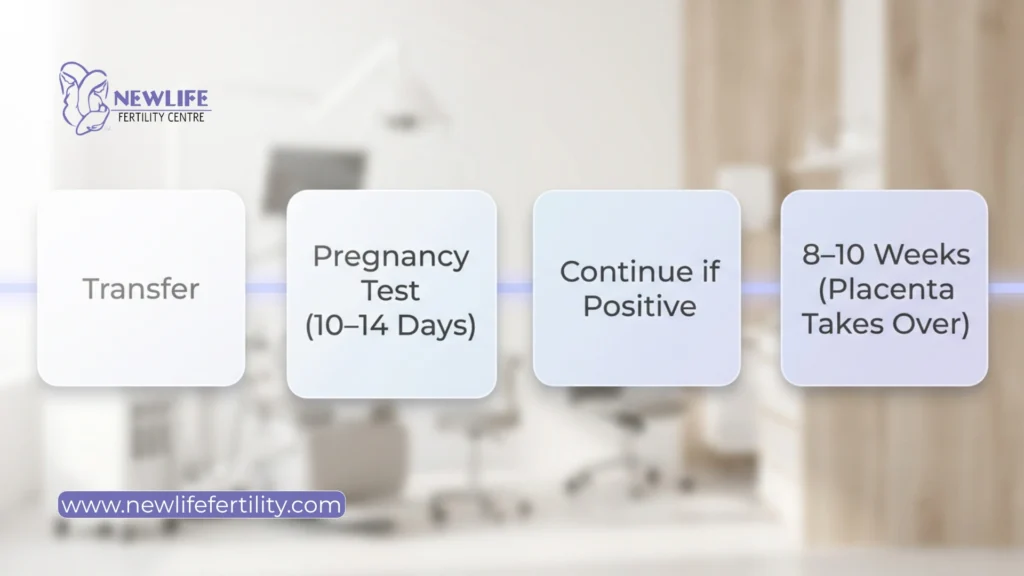
Your clinic will typically check your progesterone level alongside your beta hCG on the day of your pregnancy test, usually 10 to 14 days after transfer. If the result is positive, monitoring continues for a few more weeks.
Clinics look at progesterone and hCG together because the two hormones work alongside each other. A rising hCG is a good sign, and adequate progesterone alongside it is equally reassuring.
There is also a practical relationship between progesterone supplementation and natural pregnancy hormones. Early in pregnancy, the corpus luteum, the structure left behind after ovulation in a natural cycle, produces progesterone.
But in a medicated FET cycle where ovulation is suppressed, there is no corpus luteum. This means the supplementation you are taking is fully responsible for progesterone support until the placenta is capable of taking over.
This is why your doctor keeps you on progesterone for a specific duration, not just until you see a positive test.
How long do you take progesterone after frozen embryo transfer?
This is one of the questions patients feel most anxious about. A big part of that fear comes from worrying about stopping progesterone too early and doing something wrong.
The honest answer varies slightly by clinic, but the general standard is simple.
If your beta hCG test is negative, your clinic will ask you to stop progesterone supplementation at that point. There is no benefit to continuing it if the cycle has not resulted in a pregnancy. Stopping also allows your body to reset for the next cycle.
If your test is positive, you will typically continue progesterone supplementation until somewhere between 8 and 10 weeks of gestational age. Some clinics may extend this up to 12 weeks.
The reason for continuing until this stage is that the placenta needs time to establish itself and take over progesterone production independently. By around 8 to 10 weeks, in most successful pregnancies, the placenta has developed enough to support the pregnancy on its own.
The most important thing to remember is this. Never stop progesterone on your own. Not because you feel ready, not because the pregnancy seems to be going well, and not because someone online stopped earlier and was fine.
Always taper or discontinue under your doctor’s guidance. This is one of those steps where following instructions really, really matters.
Estrogen and progesterone balance in FET cycles

Progesterone does not work alone. Throughout your FET cycle, it works in partnership with estrogen. The balance between these two hormones is what creates the right uterine environment for implantation.
Think of estrogen as the architect and progesterone as the interior designer.
Estrogen, taken in the first phase of your FET cycle, builds up the thickness and structure of your uterine lining. It creates the foundation, including the cells and blood supply.
Once the lining is ready, progesterone takes over. It transforms the lining into a receptive state, producing the nutrients and signals an embryo needs to implant and begin developing.
Without enough estrogen, the lining does not build properly. Without enough progesterone, the lining does not become receptive.
Your clinic monitors both hormones throughout your cycle. Estrogen supplementation, usually in the form of patches, tablets, or injections, often continues alongside progesterone until your pregnancy test and sometimes beyond if you are pregnant.
This is also why your doctor may adjust your estrogen dose during the cycle. It is not a sign that something is wrong. It simply means they are fine tuning the balance, because getting both hormones in the right proportion matters just as much as getting each one into the right range.
Common progesterone mistakes to avoid during FET
This section is worth reading carefully, because these are the kinds of errors that are easy to make when you are anxious, tired, and navigating a complex protocol largely on your own.
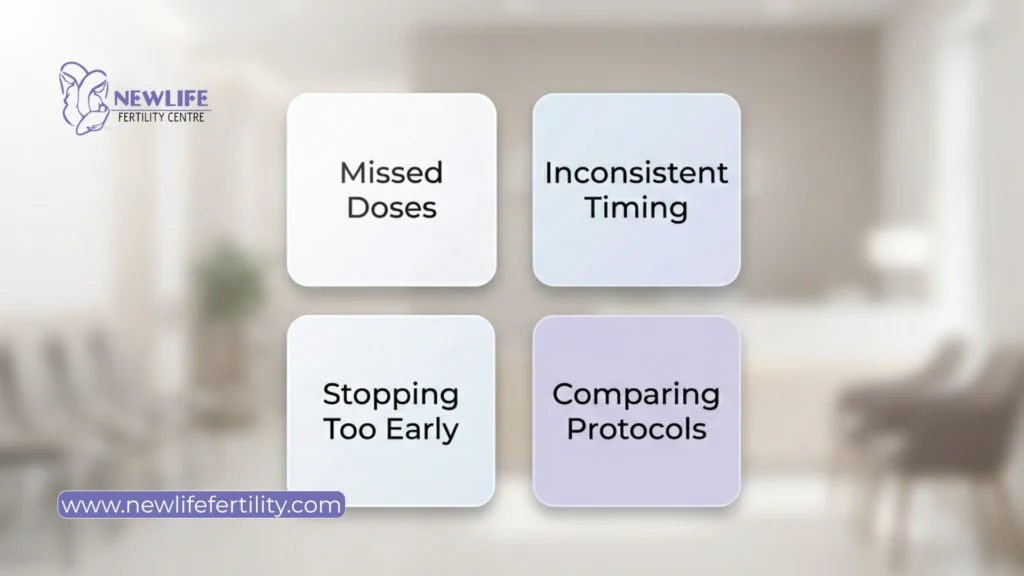
Missing progesterone doses can disrupt hormone levels quickly
Missing doses is the most common and most consequential mistake. Progesterone levels can drop noticeably within hours of a missed dose, particularly with vaginal administration.
If you miss a dose, take it as soon as you remember. If it is close to the time of your next scheduled dose, do not double up. Call your clinic for guidance.
Try to build systems into your life, like alarms, pill organizers, or involving your partner, that make missing a dose less likely.
Inconsistent timing can lead to fluctuating progesterone levels
Wrong timing is subtler but equally important. Progesterone supplementation is most effective when doses are evenly spaced.
If you are taking it three times daily, spreading those doses across roughly eight hour intervals is better than taking all three in the afternoon because you forgot in the morning.
Consistency in timing creates consistency in blood levels.
Stopping progesterone too early can affect pregnancy support
Stopping early is something that happens more often than clinics would like. Patients start feeling confident, or they have an early ultrasound that looks reassuring, and they wonder if they can stop the injections a little ahead of schedule.
Please do not do this without explicit instruction from your doctor.
The placenta’s takeover of progesterone production cannot be seen on an ultrasound. It is a gradual biochemical process, and stopping too early can leave a pregnancy vulnerable in ways that would not be immediately visible.
Comparing your FET protocol with others can create unnecessary stress
Comparing your protocol with others is one of the most insidious mistakes.
Every fertility journey is different. Your dosage, your delivery method, your target levels, and your timeline have been chosen for you based on your age, your diagnosis, your previous cycles, and your clinic’s specific outcomes data.
When you read about someone else’s protocol online and start wondering why yours is different, you are comparing yourself to a data point with no context.
Your doctor is not following a generic template. They are treating you specifically. Trust that.
Final thoughts: Don’t let progesterone stress you out

You have made it through a lot of information, and if your head is spinning slightly, that is okay. Progesterone in FET is genuinely nuanced, but you do not have to master every detail.
Your job is not to become a reproductive endocrinologist. Your job is to take your medication on time, show up for your monitoring appointments, and trust the protocol your doctor has built for you.
The numbers on your report are not a judgment of how well your body is performing. They are data points that your medical team uses to fine tune your care. Some will be exactly where expected. Some may prompt a small adjustment.
Neither outcome means your cycle is doomed or guaranteed. It simply means your doctors are paying attention and doing their job.
What you can control is consistency. Taking every dose at the right time, communicating with your clinic when something feels off, and not stopping any medication without guidance.
Beyond that, give yourself permission to let your team carry the technical weight. They have done this thousands of times. You are in experienced hands.
This cycle matters deeply to you, and that matters. But progesterone levels, injection schedules, and timing are logistics. And logistics can be managed.
You are doing more than you know just by showing up to every step of this process.
Need help understanding your FET plan?
If you are reading this and still feeling uncertain about your progesterone schedule, your levels, or what your protocol actually means for your specific situation, you are not alone.
And this confusion is not a sign of weakness. It is a sign that you care enough to understand what is happening in your body.

NewLife Fertility Centre provides expert care and guidance on frozen embryo transfer and progesterone with personalised fertility care.
At NewLife Fertility, we speak with patients every day who feel exactly like this. They have reports, numbers, and instructions, but they just need someone to walk them through it in a way that actually makes sense.
Sometimes, a simple conversation can remove days of stress.
If you want clarity, reassurance, or just someone to explain your FET plan in plain language, we are here for you.
👉 Book your free consultation call with NewLife Fertility. We’ll go through your reports, your progesterone plan, and your next steps together.
You deserve to feel informed, supported, and confident at every stage of this journey.