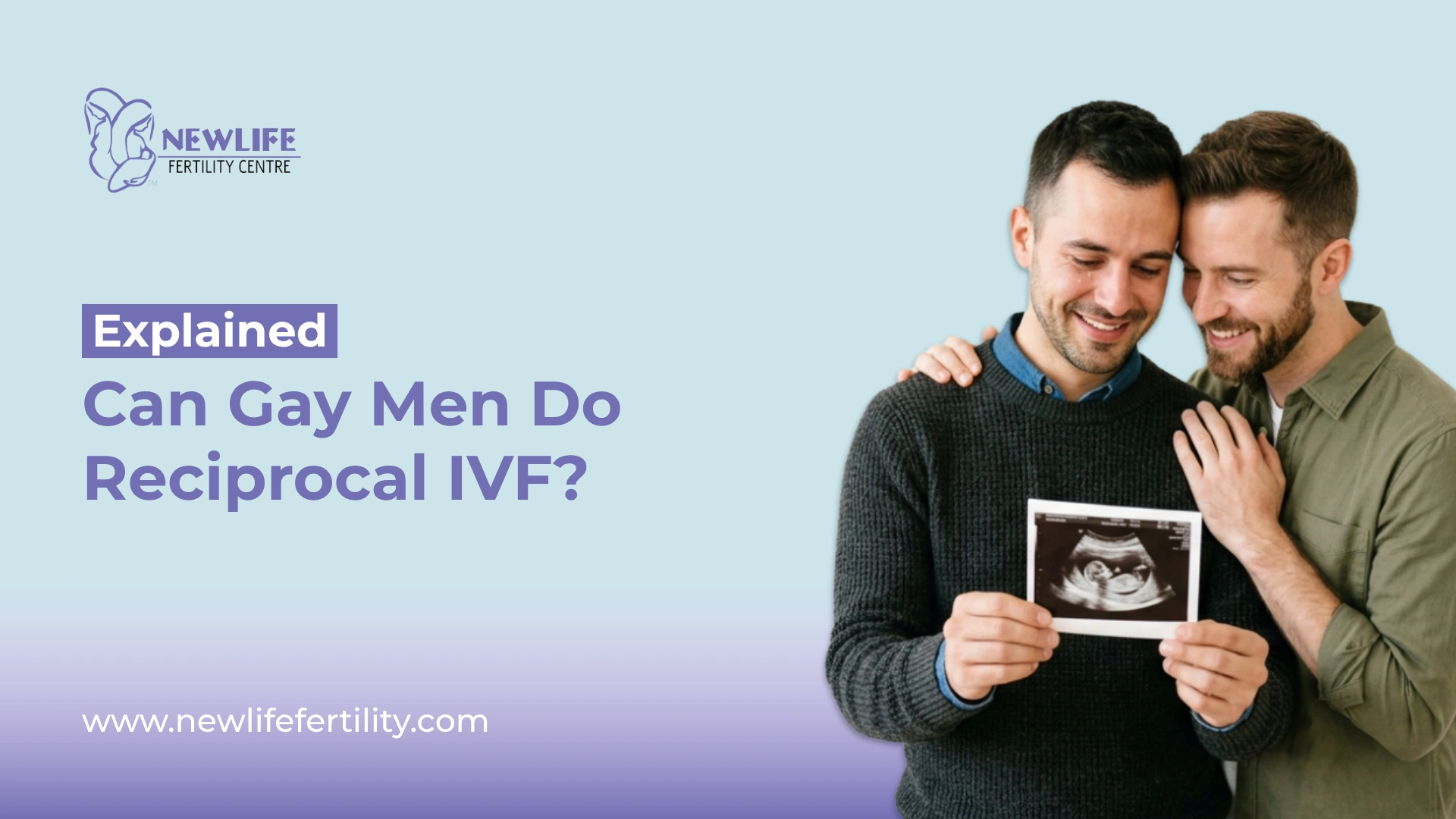
You’ve probably just read about reciprocal IVF for lesbian couples.
One partner provides the eggs. The other carries the pregnancy. Both are biologically part of the baby’s story.
And now you’re sitting here thinking: “Wait. Can we do that too?”
It’s one of the most common questions gay male couples ask when they start researching fertility options.
The honest answer is “not in the traditional sense.”
But here’s what matters more.
The spirit behind reciprocal IVF, both partners being meaningfully involved in creating a baby together, is absolutely available to you. Just through a different path.
This blog is going to walk you through exactly what that path looks like.
→ Why traditional reciprocal IVF works differently for male couples
→ What the real equivalent is for gay men
→ Whether both of you can be biological fathers
→ Egg donors, gestational carriers, costs, and legal considerations in Canada
→ What your actual options are and how to start
Let’s get into it.
What is reciprocal IVF?

Reciprocal IVF is a fertility treatment where both partners in a couple play a direct biological role in creating a pregnancy.
Here’s how it works:
→ One partner provides the eggs
→ Those eggs are fertilized using donor sperm in a lab
→ The resulting embryo is transferred to the other partner’s uterus
→ That second partner carries the pregnancy
One partner’s genetics. The other partner’s body. One baby.
It’s also called shared motherhood or co-IVF. And it was specifically designed for same-sex female couples where both partners have uteruses and one partner has eggs to contribute.
That’s the key detail.
Reciprocal IVF requires both a uterus and eggs from the couple.
And that’s where things look different for gay men.
Can gay men do reciprocal IVF?

The straightforward answer is no, not in the traditional medical sense.
Here’s why, and there’s nothing complicated about it.
Reciprocal IVF works because one female partner provides eggs and the other female partner’s uterus receives the embryo.
In a gay male couple, neither partner produces eggs. And neither partner has a uterus to carry a pregnancy.
So the biological requirements for traditional reciprocal IVF simply aren’t present.
“That’s disappointing. Does that mean we’re left out?”
Not at all.
It means you need a different set of building blocks to get to the same destination.
And those building blocks exist. They’re well-established. And they give you the same opportunity to be meaningfully, biologically involved in creating your family.
What is the equivalent of reciprocal IVF for gay men?

The closest equivalent for gay male couples is IVF with an egg donor and a gestational carrier.
Here’s how the pieces fit together:
→ An egg donor provides the eggs (the biological component that neither partner can contribute)
→ One or both partners provide the sperm
→ The eggs and sperm are combined in a lab to create embryos through IVF
→ A gestational carrier (also called a surrogate) carries the pregnancy
The result: One or both partners have a genetic connection to the baby. A carefully chosen woman carries and gives birth. And both of you are involved in the journey from the very beginning.
“Is it really the same thing as reciprocal IVF, just for men?”
Not identical. The biology is different because you need two additional people involved, an egg donor and a gestational carrier, instead of just one.
But the intention is exactly the same.
Both partners get to participate. Both partners get to make the decisions. And one or both partners get to have a biological connection to their child.
That’s the heart of what reciprocal IVF offers. And it’s fully available to you.
How does reciprocal IVF for gay men work?
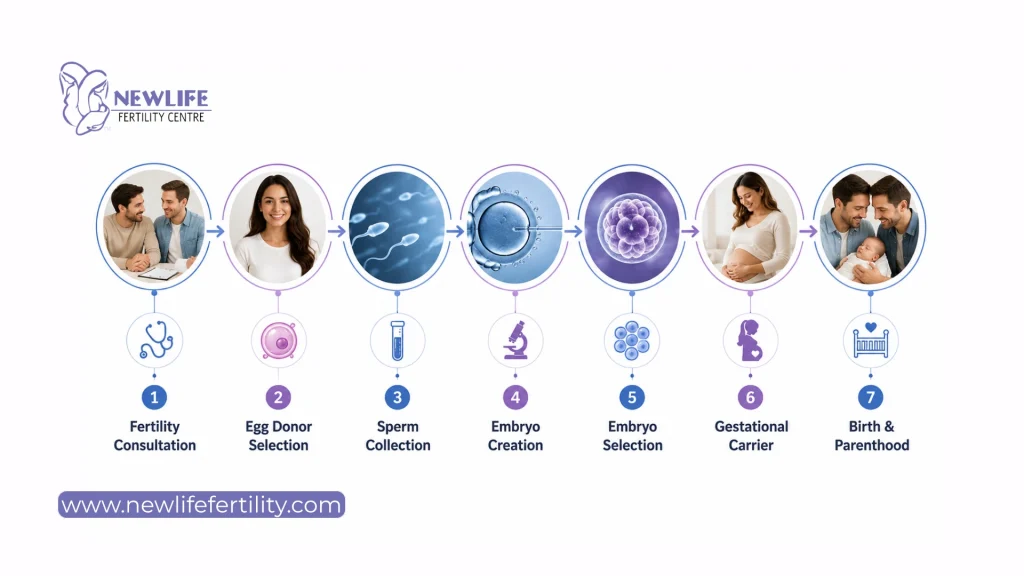
Here’s the essential overview of the process.
Step 1: Fertility consultation and planning
Both partners have an initial consultation with a fertility specialist. This is where you discuss your goals, your health, your timeline, and your options. Semen analysis is typically done for both partners at this stage.
Step 2: Choosing an egg donor
You’ll select an egg donor together. This can be an anonymous donor through a licensed egg donor agency or, in some cases, a known donor such as a trusted friend.
Donors go through extensive medical, genetic, and psychological screening before being approved.
Step 3: Sperm collection and preparation
One or both partners provide sperm samples. If both partners want to contribute, sperm is collected and prepared from each partner separately.
Step 4: Creating embryos through IVF
The egg donor goes through hormonal stimulation and egg retrieval. Her eggs are fertilized with one or both partners’ sperm in the lab. Over five to six days, the embryos develop and are monitored.
Step 5: Embryo selection and transfer
The highest quality embryos are selected. Pre-implantation genetic testing (PGT-A) can be used to identify the most viable ones. The chosen embryo is then transferred to the gestational carrier’s uterus.
Step 6: Pregnancy through a gestational carrier
The gestational carrier carries the pregnancy to term. She has no genetic connection to the baby. Medically, she is a host for an embryo that does not contain her DNA.
Step 7: Birth and parenthood
The baby is born. Legal processes ensure both partners are recognized as the child’s parents. You bring your baby home.
Can both gay partners be biological fathers?

This is one of the first questions most gay male couples ask.
And the answer is: it’s possible, yes.
Here’s how it works.
Using one partner’s sperm
The most straightforward approach is choosing one partner’s sperm to fertilize the egg donor’s eggs. That partner then has a genetic connection to the baby.
Many couples make this decision based on medical factors. Semen analysis results can influence the choice. Sometimes one partner has a stronger sperm profile. Sometimes both are comparable and it comes down to personal preference.
Creating embryos with both partners’ sperm
If both partners want a biological connection, you can fertilize separate batches of eggs with each partner’s sperm.
This creates two sets of embryos: some genetically connected to Partner A, some to Partner B.
Your fertility clinic will then help you select the best embryo for transfer, from whichever batch, based on quality and viability.
“So we could each be the biological father of a different child?”
Exactly.
Many couples use this approach across two pregnancies. Partner A’s embryos are used for the first baby. Partner B’s embryos for the second. Both children are genetically connected to one father each and share the same egg donor.
It’s one of the most intentional and deeply considered ways to build a family of two children where both partners have their own biological connection.
“What if we only want one child?”
Then you simply decide together whose sperm to use, or let the embryo quality guide the decision. Remaining frozen embryos can be saved for the future.
What does the egg donor’s role look like?

The egg donor is an essential part of this journey, but it helps to understand exactly what her role is and isn’t.
What an egg donor does
She goes through a stimulation cycle, similar to what the egg partner in reciprocal IVF does. Hormone medications stimulate her ovaries to produce multiple eggs. Those eggs are then retrieved in a short procedure.
After that, her involvement in the pregnancy ends.
She provides the genetic material. The gestational carrier provides the pregnancy. You provide the sperm and the parenting.
Anonymous vs. known egg donors
Anonymous donors are the most common route. They are recruited, screened, and matched through licensed agencies or fertility clinics. You typically receive detailed information about the donor including physical characteristics, health history, educational background, and personal interests.
Some donors are identity-release donors. This means the donor-conceived child can choose to contact them once they turn 18 if they wish.
Known donors are women you already know personally who choose to donate. This route involves additional medical screening, psychological evaluation, and legal agreements. It takes longer. But for some couples, having that personal connection matters enough to go through the extra steps.
Questions worth thinking about together
→ What qualities matter most to us in an egg donor?
→ Do we want our child to have the option of knowing the donor one day?
→ Are we aligned as a couple on this decision?
Your clinic will give you resources to work through this. You don’t have to figure it out alone.
What does a gestational carrier’s role look like?

A gestational carrier is the person who carries and gives birth to your baby.
She is sometimes called a surrogate, but there’s an important distinction.
Gestational carrier vs. traditional surrogate
| Gestational Carrier | Traditional Surrogate | |
| Genetic connection to baby | ❌ No | ✅ Yes (her own eggs) |
| Carries the pregnancy | ✅ Yes | ✅ Yes |
| Used in gay male IVF | ✅ Yes | ❌ Rarely |
A gestational carrier has no genetic connection to the baby. She carries an embryo created from the egg donor’s eggs and your sperm. The baby is genetically yours and the donor’s, not hers.
A traditional surrogate uses her own eggs, meaning she would be the genetic mother of the baby. This arrangement is much less common today and comes with significantly more legal complexity.
For gay male couples going through IVF with egg donation, a gestational carrier is the standard and strongly preferred approach.
How gestational carriers are screened
Gestational carriers go through thorough medical and psychological evaluation before being approved. They must meet specific health criteria, have had at least one successful pregnancy of their own, and be psychologically assessed to ensure they understand and are comfortable with the arrangement.
The relationship during pregnancy
Every arrangement is different. Some couples prefer minimal contact during the pregnancy. Others develop a warm and ongoing relationship with their carrier.
What matters most is that expectations, boundaries, and communication preferences are discussed and agreed upon clearly before the pregnancy begins. Your clinic and legal team will help structure this.
Reciprocal IVF vs IVF with surrogacy: Understanding the difference
Because the question of “can gay men do reciprocal IVF” comes up so often, here’s a clean side-by-side:
| Reciprocal IVF (for female couples) | IVF with Egg Donor + Gestational Carrier (for male couples) | |
| Who provides eggs | One female partner | Egg donor |
| Who carries the pregnancy | Other female partner | Gestational carrier |
| Who provides sperm | Anonymous sperm donor | One or both male partners |
| Both partners biologically involved | ✅ Yes | ✅ Yes (through sperm) |
| Genetic connection to baby | One partner (egg provider) | One or both partners (sperm) |
| Third parties needed | Sperm donor only | Egg donor + gestational carrier |
| Available in Canada | ✅ Yes | ✅ Yes |
The core intention is the same. Both routes allow both partners to be involved. The biology and the support team look different.
Family-building options for gay male couples

IVF with egg donation and a gestational carrier is the most common path to biological parenthood for gay male couples. But it’s not the only path to parenthood.
Here’s the broader picture.
Biological parenthood through IVF and surrogacy
This is the route covered in this blog. One or both partners contribute sperm. An egg donor and gestational carrier complete the journey. Your child is genetically connected to you.
Adoption
Adoption is a deeply meaningful path to parenthood and is open to same-sex couples in Canada. The process and timeline vary depending on whether you pursue domestic adoption, international adoption, or foster-to-adopt programs.
Foster-to-adopt
Some couples choose to foster children with the intention or possibility of adoption. This is a way to provide a loving home to children who need one, with the possibility that it becomes permanent.
There is no hierarchy here. Every path to parenthood is legitimate. What matters is which path fits your family’s values, circumstances, and goals.
Challenges and honest considerations for gay male couples

This journey is extraordinary. It’s also longer, more complex, and more costly than most fertility treatments.
Going in with clear eyes helps.
You need two additional people involved
Unlike reciprocal IVF for lesbian couples, your path to biological parenthood requires both an egg donor and a gestational carrier. That means two sets of relationships, two sets of legal agreements, and two sets of timelines to coordinate.
The timeline is longer
Finding and matching with both an egg donor and a gestational carrier takes time. Then there’s the stimulation cycle, egg retrieval, embryo creation, and transfer. The process from starting to holding your baby is often 18 months to two years or more.
The cost is significant
This is one of the most expensive fertility journeys. Egg donor fees, gestational carrier compensation, IVF procedures, legal costs, and agency fees all add up. Having a clear financial plan before you start is not optional.
Emotional complexity is real
Fertility journeys are emotionally demanding in any context. This one involves more moving parts, more people, and more waiting. The couples who navigate it best tend to go in as a strong, communicative team and get support when they need it.
It can and does work
Many gay male couples have built their families this way. The medical process is well-established. The legal framework in Canada supports it. And the result, a child who is genetically yours, is exactly the same.
How much does IVF and surrogacy cost for gay men in Canada?

This is not a small financial commitment. Here’s an honest breakdown of the major cost components.
Egg donor costs
→ Egg donor agency fees
→ Donor compensation and medical costs
→ Egg retrieval procedure
→ Donor legal fees
IVF and embryo costs
→ Fertility clinic consultation and testing fees
→ Embryo creation and lab fees
→ Pre-implantation genetic testing (PGT-A) if used
→ Embryo freezing and annual storage
Gestational carrier costs
→ Carrier compensation (in Canada, gestational carriers are compensated for expenses, not paid a fee, as altruistic surrogacy is the legal standard)
→ Carrier medical and psychological screening
→ Pregnancy-related expenses
→ Carrier legal fees
Legal costs
→ Surrogacy agreement
→ Egg donor agreement
→ Parentage order filing
Is surrogacy paid in Canada?
Canada operates under an altruistic surrogacy model. Gestational carriers cannot be paid a fee for carrying the pregnancy, but they are reimbursed for all reasonable pregnancy-related expenses. This is different from the United States, where commercial surrogacy is available and costs are typically higher overall.
The total cost of a gay male IVF and surrogacy journey in Canada varies widely depending on the clinic, the agency, and the specific journey. Speaking directly with a fertility clinic early on will give you the most accurate picture for your situation.
Legal considerations for gay men building a family in Canada

Canada’s legal framework is generally supportive of LGBTQ+ families. But surrogacy and egg donation do involve legal steps that matter.
Surrogacy agreements must be in place before the pregnancy begins
Before an embryo is transferred to a gestational carrier, a formal surrogacy agreement must be signed and legally reviewed by independent lawyers for both the couple and the carrier.
Altruistic surrogacy is the Canadian standard
Commercial surrogacy, where a carrier is paid a fee beyond reasonable expenses, is illegal in Canada. This protects all parties involved. It also means that finding a gestational carrier sometimes takes longer than in countries with commercial models.
Parentage orders establish you as legal parents
After the baby is born, you will need to obtain a parentage order from the court. This legally recognizes both partners as the baby’s parents. In Ontario, this process is well-established for same-sex couples.
Egg donor agreements protect everyone
A formal egg donor agreement, signed before the donation cycle begins, ensures the donor has no legal claim or responsibility regarding the child, and that your rights as the intended parents are protected.
Start the legal process early
Legal steps in surrogacy take time. Engaging a family lawyer who specializes in assisted reproduction law in Canada early in your journey, not after you’ve found a carrier, is strongly recommended.
Your fertility clinic should be able to guide you toward experienced legal professionals who work in this space.
Can IVF with an egg donor and gestational carrier be your path to fatherhood?
While traditional reciprocal IVF is not medically possible for gay male couples, that does not mean parenthood is out of reach. In fact, many gay men build their families through IVF, egg donation, and gestational surrogacy, creating a path that is just as meaningful, intentional, and rewarding.
Whether one partner contributes sperm or both partners create embryos for future family planning, there are several ways to build a biological connection to your child while navigating the journey together as a couple.
Every family’s story is different. Your goals, timeline, budget, and personal preferences all play a role in determining which approach is right for you. That’s why having experienced guidance from the beginning can make such a difference.
At NewLife Fertility, we proudly support LGBTQ+ family building and help gay male couples understand their options with clarity, compassion, and personalized care. From exploring egg donor and gestational carrier options to planning your fertility journey step by step, our team is here to support you at every stage.
You do not need to have all the answers before taking the first step.
Book your free consultation with NewLife Fertility today and start exploring the path to fatherhood that’s right for your family.
Frequently asked questions about reciprocal IVF and family building for gay men
Not in the traditional sense. Reciprocal IVF requires one partner to provide eggs and the other to carry the pregnancy. Since neither male partner can do either, traditional reciprocal IVF is not medically possible for gay male couples. The equivalent is IVF with an egg donor and a gestational carrier.
Yes. In lesbian reciprocal IVF, donor sperm is used to fertilize the eggs. In the male equivalent, one or both partners provide the sperm.
Yes. Both partners can provide sperm, which is used to create separate sets of embryos. The best embryo is then selected for transfer, or each partner’s embryos are used across different pregnancies.
Yes, through sperm contribution. One or both partners can have a genetic connection to the baby. One child may be genetically connected to one partner; a future sibling could be connected to the other.
Yes. Since neither male partner produces eggs, an egg donor is an essential part of the process.
Yes. A gestational carrier is needed to carry the pregnancy since neither male partner has a uterus.
Yes. Altruistic surrogacy is legal in Canada. Carriers are reimbursed for reasonable pregnancy-related expenses but cannot receive a paid fee. Same-sex couples are legally recognized as intended parents under Canadian law.
Yes. Additional embryos created during your cycle can be frozen and used for future pregnancies with a gestational carrier, giving you more options without starting from scratch.