Picture this.
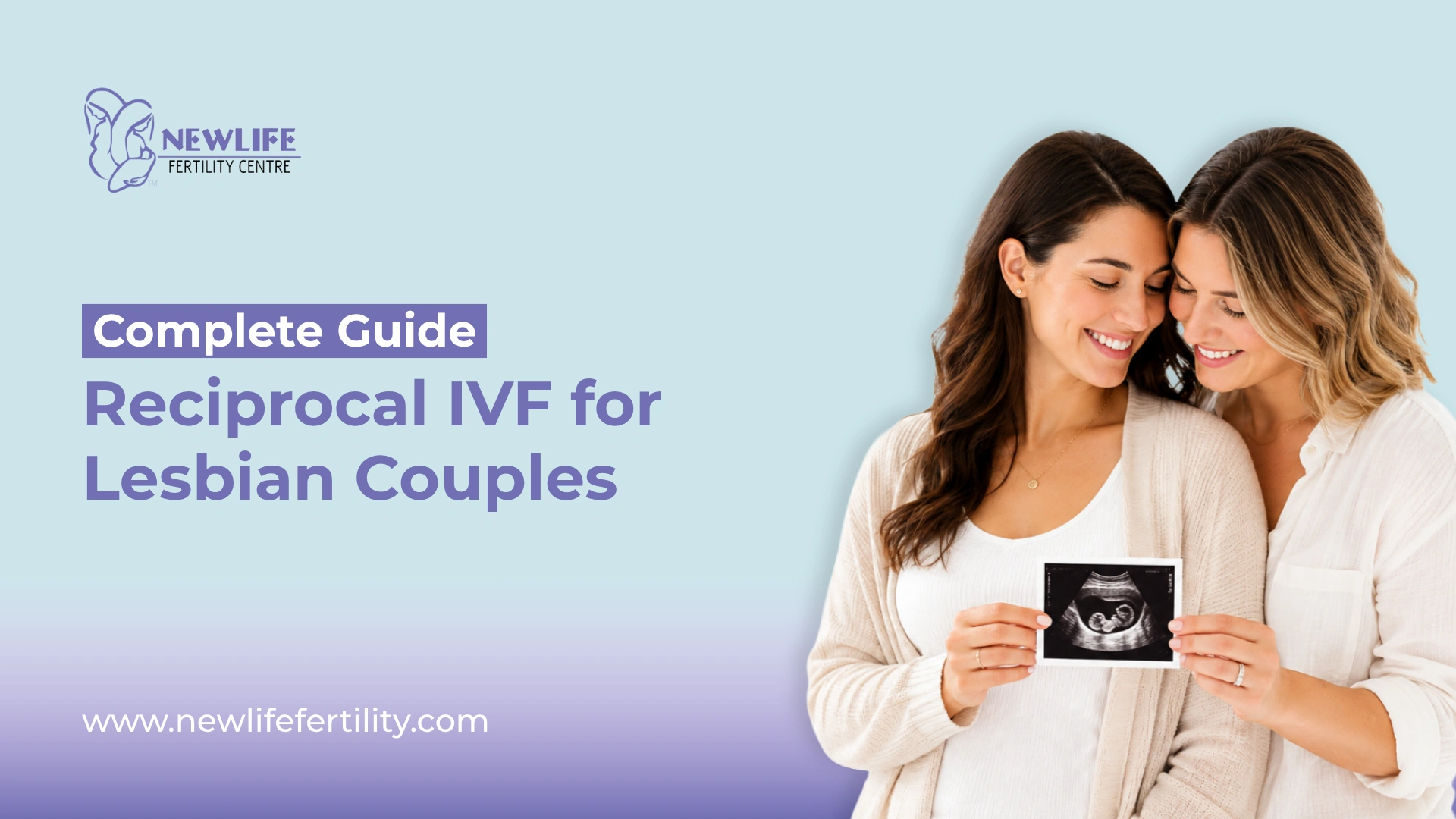
Two of you on the couch one evening, talking about the family you want to build.
One of you wants to carry the baby.
The other wants to be genetically connected to that baby.
And both of you want this to be truly, completely yours, together.
That’s exactly what reciprocal IVF is designed for.
For lesbian couples who want both partners to have a meaningful biological role in their child’s story, it’s one of the most intentional and deeply personal family-building paths available today.
This guide will walk you through everything you need to know.
→ What reciprocal IVF actually is (and why it’s different)
→ How the two of you decide who does what
→ Donor sperm, costs, success rates, and legal considerations in Canada
→ Whether it’s the right fit for your relationship
Let’s get into it.
What is reciprocal IVF for lesbian couples?

Reciprocal IVF is a fertility treatment where both partners play a direct, active role in creating the pregnancy.
Let me share the simplest version:
→ One partner provides the eggs
→ The other partner carries the pregnancy
The eggs from the first partner are fertilized in a lab using donor sperm. The resulting embryo is then transferred to the second partner’s uterus.
One partner’s genetics. The other partner’s body. One baby.
This is also called shared motherhood or co-IVF. And for many lesbian couples, it’s the closest science has come to giving both partners a biological connection to their child.
“But does that mean one of you is more of a biological mother than the other?”
Not in the way most people think.
One partner’s DNA is in the baby. The other partner’s body grows and sustains that baby for nine months.
Both roles are biological. Both are irreplaceable. And both create a bond that lasts a lifetime.
Why do lesbian couples choose reciprocal IVF?

The reasons aren’t purely medical.
For most couples, choosing reciprocal IVF is an emotional decision as much as a clinical one. It’s about both partners feeling like this pregnancy belongs to both of them from the very beginning.
Let me share what comes up most often when couples describe why they chose it.
Both of you are genuinely part of the journey
With standard IVF using donor sperm, one partner carries the pregnancy. The other supports show up and love every second.
But that’s different from both partners having a role that’s uniquely theirs.
With reciprocal IVF, the egg partner goes through ovarian stimulation and egg retrieval. The carrying partner goes through the embryo transfer and pregnancy. Neither of you is on the sidelines. Both of you are in the process.
That shared investment changes the experience in ways that are hard to put into words.
Your child is genetically connected to your family
The egg partner’s DNA is in the baby.
That means your child may carry traits, features, or characteristics from the egg partner’s side of the family. For some couples, that matters enormously. For others, it’s a wonderful bonus rather than the main reason.
Both are completely valid.
You have more options for future siblings
If additional viable embryos are frozen during your first cycle, they can be used for future pregnancies.
Some couples plan for this deliberately. The carrying partner from the first cycle becomes the egg provider for the second. Or the same embryos are used, with the other partner carrying next time.
Two children. Same genetic line on one side. Two different mothers with their own pregnancy story. It’s a kind of family planning that feels beautifully intentional.
Both of you make the decisions together
This might sound obvious, but it’s worth saying.
With reciprocal IVF, both partners are involved in the planning from day one. Who provides eggs. Who carries. When to start. What to do with frozen embryos.
That shared decision-making process often brings couples even closer before a single injection is given.
How does reciprocal IVF work? (The essential overview)
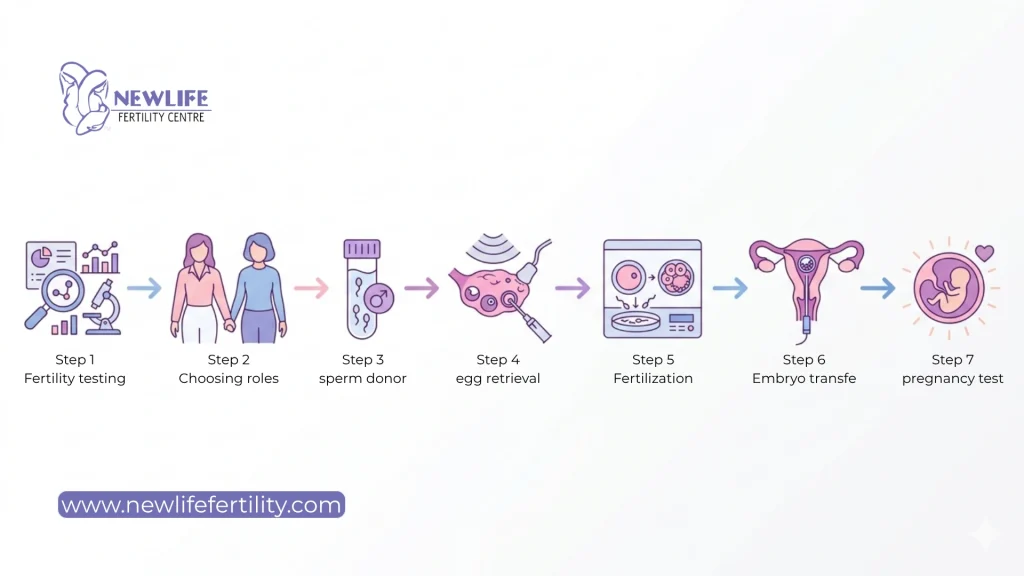
A detailed step-by-step guide on the reciprocal IVF process already exists if you want the full clinical picture. Here’s the essential version.
Step 1: Fertility testing for both partners
Both of you will be assessed. The egg partner’s ovarian reserve and egg quality are the priority. The carrying partner’s uterine health and hormone levels matter too. These results shape your entire treatment plan.
Step 2: Choosing your roles
Who provides the eggs? Who carries? This conversation happens early, sometimes guided by your test results, sometimes by your personal preferences. More on this below.
Step 3: Selecting a sperm donor
You’ll choose a donor together. Anonymous or known, depending on what feels right for your family.
Step 4: Ovarian stimulation and egg retrieval
The egg partner takes hormone medications to stimulate egg production over around 10 to 14 days. When the eggs are ready, they’re collected in a short procedure.
Step 5: Fertilization and embryo development
The retrieved eggs are fertilized with donor sperm in the lab. Over five to six days, the embryos are monitored. The strongest ones are selected for transfer or freezing.
Step 6: Embryo transfer and pregnancy test
The carrying partner’s uterine lining is prepared with hormonal support. The embryo is transferred in a simple procedure. Around 10 to 14 days later, a blood test confirms pregnancy.
Choosing who provides the eggs and who carries

This is often the first real conversation couples have when they start exploring reciprocal IVF.
And it can feel surprisingly difficult.
“We both want to be involved. How do we actually decide?”
Start with what your bodies can tell you.
Egg quality and ovarian reserve naturally decline with age, more noticeably after 35. If one partner is significantly older, the clinic may recommend that the younger partner provides the eggs.
Beyond age, your fertility specialist will look at:
→ Ovarian reserve and egg count
→ Hormone levels
→ Uterine lining quality and shape
→ Any reproductive health history on either side
→ Overall health and any medical factors that might affect either role
For many couples, the medical picture makes the decision feel clearer. Not forced. Just clearer.
What if our test results are similar and we’re close in age?
Then it comes down to what each of you wants.
Some partners feel strongly about carrying a pregnancy. Others feel strongly about having their genetics be part of the baby. Some decide based on career timing. Some based on who has already gone through a significant medical procedure recently.
There is no medically correct answer. The right choice is the one both of you feel good about, with honest input from your fertility team.
What if we both want to carry the pregnancy?
That’s a conversation worth having with your clinic.
In many cases, couples plan across two pregnancies. One partner carries the first. The other carries the second, using frozen embryos from the same cycle. Your specialist can walk you through what that timeline might realistically look like for your situation.
Donor sperm options for lesbian couples
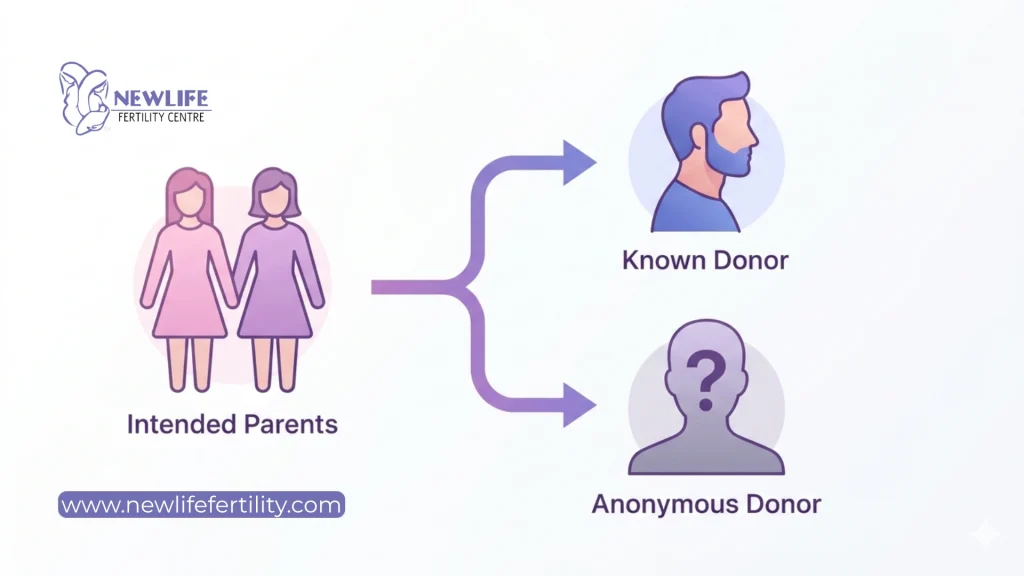
You will need donor sperm for reciprocal IVF. And choosing a donor is a meaningful part of the process.
Here are the main options.
Anonymous donors
Most couples choose an anonymous donor through a licensed sperm bank. These donors have completed extensive medical, genetic, and psychological screening before being approved.
Depending on the sperm bank, you may have access to:
→ Physical characteristics and family health history
→ Educational and personal background
→ Audio or written impressions from clinic staff
→ Identity-release options (the donor has agreed to be contactable by the child at age 18, if the child chooses)
Anonymous donors give you privacy and a wide selection while still providing you with meaningful information to guide your decision.
Known donors
A known donor is someone you already know personally, such as a close friend or a family member, who is willing to donate sperm.
Using a known donor involves additional medical screening, legal documentation, and sometimes a longer waiting period before treatment begins. For some couples, having that personal connection is worth every extra step.
Questions to ask before choosing a donor
Some questions worth discussing together before choosing:
→ What is most important to us as a donor?
→ Do we want our child to have the option of knowing their donor one day?
→ Are we fully aligned on this choice as a couple?
Your clinic will have resources to help guide this process. You don’t have to figure it out alone.
Reciprocal IVF vs. IUI for lesbian couples
If you’ve been researching fertility options, IUI has probably come up too.
Here’s a clear side-by-side comparison.
| Reciprocal IVF | IUI | |
| Both partners actively involved | ✅ Yes | ❌ No |
| Genetic connection for one partner | ✅ Yes | ❌ No |
| Carrying partner uses her own eggs | ❌ No | ✅ Yes |
| Requires donor sperm | ✅ Yes | ✅ Yes |
| Physically involved for egg partner | ✅ Yes | ❌ No |
| Embryos available for future cycles | ✅ Yes | ❌ No |
| Success rate per cycle | Higher | Lower |
| Cost per cycle | Higher | Lower |
“So which one is the better choice?”
It depends on what matters most to your family.
IUI may be the right starting point if:
→ You prefer a less invasive first step
→ Cost is a significant consideration right now
→ The carrying partner is younger and healthy, and using her own eggs feels right
→ You want to keep the process simpler before exploring more complex options
Reciprocal IVF may be the better fit if:
→ Both partners want a direct biological role in the pregnancy
→ One partner specifically wants a genetic connection to the child
→ You want the option of frozen embryos for future pregnancies
→ IUI hasn’t worked after multiple attempts
Neither is the “superior” choice. They serve different needs. The right one is the one that fits your relationship, your bodies, and your goals.
Success rates for reciprocal IVF in lesbian couples

The good news is that reciprocal IVF success rates are comparable to standard IVF, because the core science is the same.
The most important factor is the age and egg quality of the egg-providing partner.
What influences success rates?
→ Egg partner’s age. Egg quality is generally at its best in the mid-20s to early 30s and gradually declines after 35. Younger egg donors tend to produce more viable embryos per cycle.
→ Embryo quality. Not every fertilized egg develops into a high-quality embryo. Pre-implantation genetic testing (PGT-A) can help your clinic identify the embryos most likely to result in a healthy pregnancy.
→ Uterine health of the carrying partner. A receptive, healthy uterine lining plays a significant role in whether the embryo successfully implants.
→ Number of embryos available. More viable embryos created in a single cycle means more opportunities if the first transfer doesn’t result in pregnancy.
Are success rates lower for lesbian couples compared to heterosexual couples?
No. They are not.
Reciprocal IVF outcomes are not inherently lower for same-sex female couples. In some cases, lesbian couples have an advantage other couples don’t: if one partner’s egg quality isn’t optimal, there is another partner whose eggs may work better.
That flexibility simply doesn’t exist in heterosexual IVF.
Your fertility specialist will give you personalized estimates based on your specific test results, not on generic statistics.
How much does reciprocal IVF cost in Canada?

Reciprocal IVF is a more involved treatment than IUI, and the cost reflects that.
Here is a general sense of what typically goes into the pricing.
Core treatment costs usually include:
→ Fertility consultations and baseline testing for both partners
→ Hormone medications for the egg partner during the stimulation phase
→ The egg retrieval procedure
→ Laboratory, fertilization, and embryo culture fees
→ The embryo transfer for the carrying partner
→ Monitoring appointments throughout
Additional costs to factor in:
→ Donor sperm purchase and storage fees
→ Pre-implantation genetic testing (PGT-A), if recommended
→ Embryo freezing and annual storage fees
→ Future frozen embryo transfer cycles if needed
Is any of this covered in Ontario?
Ontario has previously provided funded IVF cycles through the Ministry of Health for eligible patients. Coverage eligibility and funding details can change, so the best step is to ask your fertility clinic directly about current options during your consultation.
Some private insurance plans also cover portions of fertility medications or treatment. It’s worth reviewing your policy before you start.
Legal considerations for lesbian couples in Canada

Canada has strong legal protections for same-sex couples, and Ontario’s legislation specifically supports both partners being recognized as legal parents.
Here’s what to know before you start.
Both partners can be recognized as legal parents
Under Ontario’s All Families Are Equal Act, both partners in a same-sex couple can be listed as legal parents on the birth registration without needing to go through adoption, as long as donor conception is properly documented through your clinic.
Donor agreements are important
Whether you use an anonymous or known sperm donor, your clinic will walk you through the required consent forms and documentation. For known donors especially, a formal legal agreement protects all parties, including your child.
Start the legal conversation early in the process
Your fertility clinic should be experienced with LGBTQ+ family law considerations and will guide you through the necessary documentation as part of your treatment. If you have specific questions about parentage rights, your clinic may be able to connect you with a family lawyer who specializes in assisted reproduction.
Challenges to know before you start

Reciprocal IVF is a meaningful, proven option for lesbian couples. And being honest about the challenges helps you go in prepared.
Both partners are physically involved
This isn’t a treatment one partner goes through while the other waits. The egg partner undergoes hormonal stimulation and a retrieval procedure. The carrying partner prepares for and receives the embryo transfer. Both bodies are part of this. Plan for that together.
Emotions can surface in unexpected ways
Fertility treatment brings up feelings that couples sometimes don’t expect. Anxiety about outcomes. Concerns about roles. The weight of waiting. Open, honest communication between partners before and during treatment makes an enormous difference. Many couples also find that going through this process actually deepens their connection.
It may take more than one cycle
Most clinics will tell you this upfront. Knowing it in advance means you can prepare emotionally and financially rather than feeling blindsided if a first cycle doesn’t result in pregnancy.
It requires financial planning
Reciprocal IVF is not a low-cost treatment. Getting a clear picture of costs, funding options, and how many cycles you’re prepared to pursue before you start helps you make decisions from a calmer, more grounded place.
Is reciprocal IVF right for your relationship?

Only the two of you can decide if reciprocal IVF is the right path.
But these questions are worth sitting with together before your first consultation:
→ Is it important to us that both partners have a biological role in this pregnancy?
→ Are we each genuinely comfortable with the role we’re taking on?
→ Have we talked openly about what happens if the first transfer doesn’t work?
→ Do we have a clear sense of our budget and how many cycles we’re prepared to commit to?
→ Have we aligned on how we feel about donor selection?
→ Are we going into this with realistic expectations and honest communication between us?
You don’t need perfect answers to all of these before your first appointment. But talking through them together means you’re walking into that consultation as a team.
Can reciprocal IVF for lesbian couples be the right path to parenthood for you?
Reciprocal IVF exists because it gives many lesbian couples something deeply meaningful: the opportunity for both partners to play a direct role in bringing their child into the world.
One partner contributes the eggs. The other carries the pregnancy. Together, you share in the decisions, the milestones, the hopes, and ultimately the journey to parenthood.
While reciprocal IVF can be an incredible family-building option, every couple’s situation is unique. Factors like fertility health, personal preferences, donor choices, finances, and long-term family goals all play a role in determining whether it’s the right fit for you.
That’s why having the right fertility team matters.
At NewLife Fertility, we’ve helped LGBTQ+ families across Canada navigate their fertility journey with compassionate care, personalized treatment plans, and honest guidance every step of the way. Whether you’re just beginning to explore reciprocal IVF or ready to take the next step, our team is here to answer your questions and help you understand your options.
You don’t need to have everything figured out before reaching out.
Book your free consultation with NewLife Fertility today and take the first step toward building the family you’ve been dreaming about.
Frequently asked questions about reciprocal IVF for lesbian couples
Yes. Under Ontario’s All Families Are Equal Act, both partners in a same-sex couple can be registered as legal parents when donor conception is properly documented through a licensed fertility clinic. Your clinic will guide you through this process.
Yes. The choice of who provides eggs and who carries is yours to make, with clinical guidance based on both partners’ fertility assessments.
Yes. The egg partner’s testing focuses on egg quality and ovarian reserve. The carrying partner’s testing looks at uterine health and hormone levels. Both sets of results inform your treatment plan.
Yes. If additional viable embryos are frozen during your cycle, they can be used for future pregnancies. This also makes it possible for the other partner to carry the next baby using the same embryo batch.
Per cycle, reciprocal IVF typically offers higher success rates than IUI. However, it is also more physically involved and costs more per cycle. Your clinic can help you compare both options based on your specific fertility results.
Expect several monitoring appointments during the egg stimulation phase, plus the retrieval, the transfer, and follow-up testing. Your clinic will give you a clear schedule at the start of your treatment so you can plan ahead.