You’re lying in bed at 2 AM.
The transfer was days ago.
Your mind is running a hundred miles an hour.
Every tiny twinge in your lower abdomen feels like a sign.
Every bit of tiredness feels like proof.
And somewhere between hope and fear, you’re already reaching for that pregnancy test sitting in your drawer.
“Should I test now?”
“What if it’s too early?”
“What if it’s negative? Does that mean it failed?”
“What if it’s faint? Does that mean anything?”
If any of that sounds like you, take a breath.
You are not overthinking.
You are not being dramatic.
You are going through one of the most emotionally intense waits a human being can experience, and every feeling you’re having right now is completely valid.
This guide is here to help you understand:
- when to test after frozen embryo transfer
- what your results may actually mean
- which symptoms are normal
- and how to get through this waiting period without spiraling every few hours
Let’s go through it together.
When can you take a pregnancy test after frozen embryo transfer?

Let me share the direct answer first 👇
Most clinics recommend taking a pregnancy test around 9 to 14 days after frozen embryo transfer.
And yes, that waiting window can feel painfully long.
But it exists for a very important reason.
After implantation happens, your body needs time to produce enough hCG, the pregnancy hormone, for a test to detect it accurately.
So if you test too early, especially around day 4, 5, or 6, a negative result may not actually mean the transfer failed. It may simply mean your hCG levels are still too low to show up yet.
That’s why early testing can become emotionally confusing.
The exact timing for testing also depends on a few important factors such as:
- whether you had a 3-day embryo transfer or a 5-day blastocyst transfer
- whether your cycle was fresh or frozen
- whether you’re using a home urine test or having a blood test at your clinic
A 5-day blastocyst transfer is already at a more advanced developmental stage when transferred into the uterus. Because of that, implantation may happen slightly sooner compared to a 3-day embryo transfer.
And yes, some people may see an earlier positive with a blastocyst transfer.
But “earlier” still does not usually mean day 4 or 5.
Those super-early tests can easily create unnecessary panic, confusion, or false reassurance during an already emotional waiting period.
How soon after frozen embryo transfer can you test?

“But the doctor said 9 to 14 days and I want to test on day 6. Tell me it’s okay.”
Look, I’m not going to pretend people don’t test early.
Almost everyone does.
So let’s talk honestly about what those early testing windows actually mean.
5dp5dt (5 days past 5-day transfer)
At this stage, hCG may only just be starting to appear. A negative result here is not reliable. And even if you do get a positive, it is often extremely faint and difficult to interpret confidently.
7dp5dt
Some people do start seeing early positives around now, especially with very sensitive tests. But a negative at day 7 still does not confirm failure. Implantation timing varies, and some embryos implant later.
9dp5dt
Tests start becoming more reliable around this point. A positive here can be a strong early sign. But even now, a negative result is not always the final answer. Your clinic blood test still matters most.
10dp5dt and beyond
This is where home pregnancy tests become much more dependable and easier to interpret.
And here’s the part I really want you to remember:
An early negative does not automatically mean a failed cycle.
Implantation timing differs from person to person. hCG levels also rise at different speeds.
So if you tested on day 6 and saw nothing, that does not necessarily mean nothing is happening. In many cases, it simply means your body has not produced enough detectable hCG yet.
Pregnancy test timeline after frozen embryo transfer

Let’s go through this day by day so you know what may actually be happening in your body and what you can realistically expect from a pregnancy test.
Days 1 to 3 after FET
At this stage, implantation has most likely not happened yet.
Your embryo is still moving, settling, and beginning the implantation process.
Any symptoms you notice right now, such as:
- cramping
- bloating
- sore breasts
- fatigue
are much more likely to be caused by progesterone or estrogen medications than pregnancy itself.
And honestly?
Testing now will almost certainly create confusion rather than clarity.
Days 4 to 6 after FET
This is often considered the possible implantation window for many 5-day blastocyst transfers.
Your embryo may be attaching to the uterine lining around this time, and hCG production may just be beginning.
But levels are still usually very low.
That means a negative test during these days is extremely common and often unreliable.
If you test and see one line, please do not assume the cycle has failed.
This is one of the most emotionally difficult phases because it feels like you should “know something” already. But biologically, your body may simply not be far enough along yet.
Days 7 to 9 after FET
This is when some people begin seeing early positive tests.
Especially with highly sensitive home pregnancy tests.
If you notice a faint line, that can absolutely matter. A faint positive still means hCG may be present.
But negatives are still common during this stage too.
And that’s important to understand.
Some perfectly successful pregnancies simply produce detectable hCG a little later than others.
So if you test at day 7 or day 8 and see a negative result, it is still too early to completely rule out pregnancy.
Try not to spiral based on one early test.
Your official blood test window is very close now.
Days 10 to 14 after FET
This is the stage where pregnancy tests become much more reliable.
Home pregnancy tests are usually easier to interpret now, and most fertility clinics schedule the beta hCG blood test somewhere during this window.
A positive result here is generally much more trustworthy.
And if the result is negative, especially when confirmed by a blood test, your clinic can start guiding you clearly about next steps and what to expect moving forward.
Home pregnancy test after frozen embryo transfer
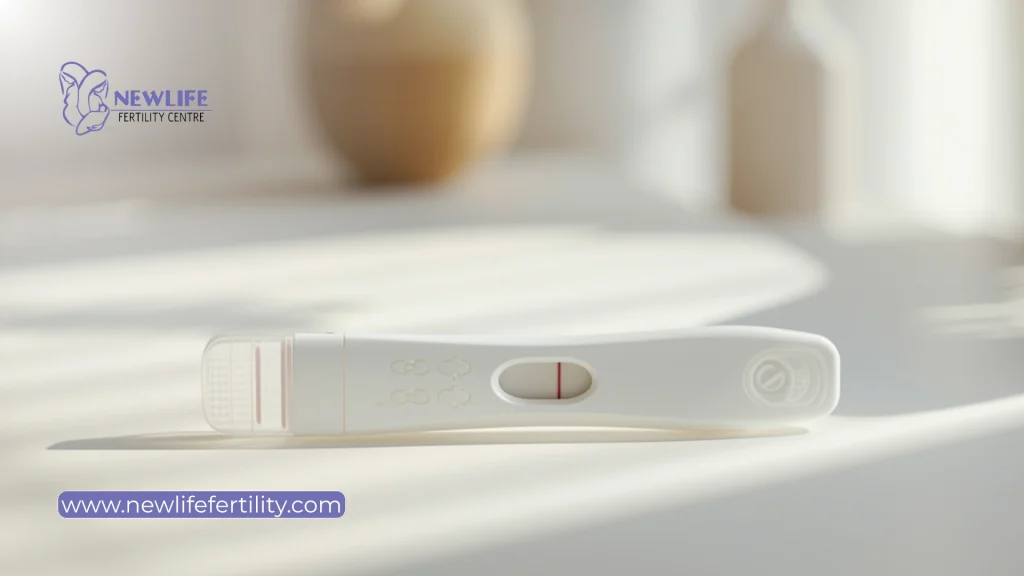
You’ve probably already bought a small collection of pregnancy tests by now.
Honestly, no judgment. Most IVF patients do.
When you’re in the two-week wait, it’s completely natural to want answers as early as possible.
Here’s how to use home pregnancy tests a little more wisely and with a little less panic.
Use first morning urine whenever possible
Your urine is usually more concentrated in the morning, which means hCG levels are easier for the test to detect.
Not all pregnancy tests have the same sensitivity
Some tests can detect very low hCG levels early on, while others require higher hormone levels before showing a positive result.
That’s why one brand may show a faint line while another still looks negative on the exact same day.
A faint line is still a line
If a second line appears within the test’s official time window, even if it’s very faint, it usually means hCG has been detected.
And yes, faint positives after frozen embryo transfer are extremely common in early testing.
Line progression matters more than one single test
Many people compare tests over several days to see whether the line becomes darker over time.
If the line gradually strengthens from day 8 to day 10 to day 12, that can be an encouraging sign that hCG is rising.
But here’s something important that IVF forums rarely explain clearly enough:
Not every test darkens at the same speed.
Different brands, lighting, hydration levels, and even the exact time of day can affect how the line looks.
So if your progression does not match someone else’s photo online, please do not immediately assume something is wrong.
That comparison spiral can become emotionally exhausting very quickly.
The most reliable information will still come from your clinic’s beta hCG blood test, not from trying to analyze every tiny line change under bathroom lighting at 6 AM.
Blood test after frozen embryo transfer

This is considered the gold standard for confirming pregnancy after frozen embryo transfer.
And there’s a good reason fertility clinics rely on it more than home pregnancy tests.
A beta hCG blood test does not simply tell you whether hCG is present or absent. It measures the exact amount of pregnancy hormone in your blood, giving your doctor a much clearer picture of what is happening.
Here are a few important things to understand about beta hCG testing:
Blood tests are far more sensitive than home pregnancy tests
They can detect hCG levels at extremely low amounts, sometimes as low as 1 to 2 mIU/mL. Most home urine tests cannot detect levels that early.
Your first beta hCG gives a starting point
That first number matters, but it is usually not the only thing your clinic looks at.
The second beta hCG is often just as important
Many clinics repeat the blood test around 48 hours later because, in a healthy early pregnancy, hCG levels should typically rise significantly during that time.
Rising hCG levels are generally a reassuring sign
When hCG is increasing appropriately, it often suggests the pregnancy is progressing normally in the early stages.
One blood test alone does not tell the entire story
Your fertility team usually looks at patterns over multiple days before making any conclusions about the pregnancy.
A lot of patients ask:
“So should I skip home testing completely and just wait for the blood test?”
Honestly, waiting for the blood test is often the most emotionally protective approach.
But realistically, many people still test at home during the wait, and that’s understandable.
Just try to remember this:
A home pregnancy test can give you an early clue.
Your beta hCG blood test gives your clinic real medical information.
False positive pregnancy test after frozen embryo transfer

This is a really important thing to understand because it can prevent a lot of confusion, panic, and emotional heartbreak during the two-week wait.
So yes, it is possible to get a false positive pregnancy test after frozen embryo transfer.
Here are the most common reasons why it happens:
Trigger shot residue
Some IVF protocols include an hCG trigger shot before egg retrieval or as part of luteal phase support.
That medication contains synthetic hCG, and traces of it can remain in your system for around 10 to 14 days.
If you test too early, the pregnancy test may detect the leftover medication instead of pregnancy-related hCG produced after implantation.
That means the positive result may reflect the trigger shot, not a confirmed pregnancy.
Evaporation lines
Sometimes home pregnancy tests develop faint gray or colorless lines after the test begins drying.
These are called evaporation lines, and they are not true positives.
A real positive line should:
- appear within the official result window
- contain visible color depending on the test brand
If a line appears much later or looks colorless, it may not represent hCG at all.
Chemical pregnancy
This is one of the hardest situations emotionally.
A chemical pregnancy happens when implantation begins and hCG starts rising, but the pregnancy stops developing very early afterward.
You may briefly see a positive test before the levels begin dropping again.
And yes, even though it happens early, it is still a real pregnancy loss and can feel deeply painful.
If this happens to you, please talk to your fertility clinic and allow yourself support. You do not have to process it alone.
Note:
The most important thing to remember is this:
Not every positive home pregnancy test automatically means a confirmed, progressing pregnancy.
That’s why your clinic follows up with serial beta hCG blood tests to confirm whether hCG is rising appropriately over time.
Negative pregnancy test after frozen embryo transfer

This is probably the section many people search for with their heart racing and their mind already jumping to worst-case scenarios.
So let’s go through the most common situations honestly and gently.
Negative at 6dp5dt
At 6 days past a 5-day transfer, it is still genuinely very early.
Implantation may still be happening, and hCG levels may simply not be high enough yet for a home test to detect.
A negative result at this stage does not reliably mean the transfer failed.
As difficult as it is, the best thing you can do right now is wait.
Negative at 7dp5dt
A negative at day 7 can feel discouraging, but it is still not considered definitive.
Some successful pregnancies do not show a clear positive until day 9 or even day 10 after transfer.
Every embryo implants on its own timeline, and every body produces hCG differently.
So while a positive at this stage can be encouraging, a negative does not automatically close the door.
Negative at 9dp5dt
This is often where anxiety becomes much heavier emotionally.
Because by day 9, many people expect to “know” something already.
And yes, a negative result here can start to feel more significant.
But implantation timing still varies, and some embryos implant later within the normal window.
If your clinic blood test has not happened yet, try not to draw final conclusions from a home test alone.
You still need the beta hCG result to understand the full picture.
Negative at 10dp5dt
By day 10, home pregnancy tests are generally more reliable.
So yes, a negative at this stage may carry more weight emotionally and medically.
But even now, your clinic blood test still matters.
There are situations where:
- home tests stayed negative
- hCG levels were simply still low
- and the beta blood test later detected a developing pregnancy
That’s why fertility clinics always rely on blood work instead of home testing alone.
A lot of people ask:
“Does a negative test always mean the cycle failed?”
And the honest answer is:
Not always.
But I also do not want to give you unrealistic hope.
What matters most right now is waiting for your clinic-scheduled beta hCG blood test before assuming anything either way.
Home pregnancy tests during the early IVF wait can only give partial information.
Your fertility team has the medical tools to tell you what is actually happening.
Common symptoms after frozen embryo transfer

Let’s talk about what you’re probably feeling and what it does and does not mean.
Cramping: Very common after FET. It can be caused by progesterone, the transfer procedure, or potentially implantation. You cannot tell from cramping alone whether the transfer worked.
Bloating: Also very common. This is often caused by progesterone and estrogen support medications used during the FET cycle.
Sore or tender breasts: Progesterone is usually the main reason for this symptom. Breast tenderness is extremely common in FET patients, whether the transfer results in pregnancy or not.
Fatigue: IVF medications, emotional stress, and the physical demands of treatment can all make you feel exhausted. Feeling tired does not confirm pregnancy after frozen embryo transfer.
Spotting: Light spotting between days 6 to 10 after transfer can sometimes happen during implantation. It may appear as a pink or brown discharge. It can also happen because of progesterone suppositories or normal cervical irritation. If bleeding becomes heavy or period-like, contact your clinic.
No symptoms at all: This is also incredibly common and does not mean your transfer failed. Many successful IVF pregnancies begin with little to no noticeable symptoms during the first two weeks.
Here’s the difficult but important truth:
You cannot reliably use symptoms to confirm or rule out pregnancy after frozen embryo transfer.
Progesterone medications can mimic almost every early pregnancy symptom very convincingly.
The only reliable way to know what is happening is through proper pregnancy testing.
What symptoms may happen before a positive pregnancy test?

Some people do notice very subtle early signs before a positive pregnancy test appears. These can include:
→ Light implantation spotting (small amounts of pink or brown discharge, usually around days 6 to 10)
→ Mild cramping that feels different from your usual period cramps, more like a flicker or twinge
→ Increased vaginal discharge
→ Unusual fatigue that feels different from your normal tiredness
→ A sense of fullness or pressure in the lower abdomen
“So if I have all of these, am I pregnant?”
Not necessarily.
Progesterone supplementation, which almost all FET patients take, can cause every one of these symptoms. That’s the frustrating reality of the two-week wait.
These symptoms can sometimes be a hopeful sign.
They can also simply be medication effects.
And unfortunately, there is no reliable way to tell the difference without proper testing.
Why testing early after frozen embryo transfer can be emotionally difficult

Let’s be honest about what often happens during the two-week wait.
You test.
You get a faint line or a negative result.
You take a photo of the test and zoom in way too far trying to see something that may or may not be there.
You post it in an IVF forum asking, “Can anyone else see the line?”
You order more tests.
You test again a few hours later.
You compare your test to someone else’s progression photos from an old Reddit thread at midnight.
If that sounds familiar, you are absolutely not alone.
This is the reality for so many IVF patients, and honestly, it makes complete sense.
You have invested so much into this process:
- your body
- your time
- your emotions
- your money
- your hope
Of course every symptom feels important.
Of course you want answers immediately.
The difficult part is that very early testing often gives incomplete information.
A negative on day 6 can send you into panic even though implantation may not have fully happened yet.
A faint line on day 7 can lead to endless comparison spirals and overanalysis.
And neither result truly tells the whole story yet.
That’s what makes the early testing phase so emotionally exhausting.
You deserve clear and reliable answers, not tiny fragments of information that leave you feeling even more anxious and confused afterward.
What should you do while waiting for your pregnancy test?

I know “just relax” is probably the most frustrating advice anyone can give during the two-week wait.
So instead, let’s talk about things that are actually practical and helpful.
Follow your medications exactly as prescribed
Progesterone and estrogen support are an important part of your FET cycle. They are actively helping support implantation and early pregnancy conditions. Do not stop, skip, or reduce them unless your clinic specifically tells you to.
Choose a testing day and try to stick to it
If your clinic recommends testing on day 10 or day 12, try your best to wait until then.
Testing very early can create unnecessary emotional chaos. A negative on day 5 or 6 may not mean anything medically, but emotionally it can completely derail your mindset for days.
Try not to treat symptoms like proof
You will probably notice symptoms. Some days are stronger. Some days are completely gone.
That does not automatically mean anything has changed.
Most early symptoms during FET are heavily influenced by progesterone and other medications.
It helps to view symptoms as “expected side effects” instead of constant evidence searches.
Stay connected with your clinic
If something feels confusing, unusual, or emotionally overwhelming, reach out to your fertility team.
You do not need to sit alone with panic or uncertainty.
Protect your mental health during the wait
Try to limit how much time you spend comparing your tests, symptoms, or timelines to strangers online.
IVF forums can sometimes make anxiety worse instead of better.
Your body is different.
Your timeline is different.
And your journey does not need to match anyone else’s to be valid.
Your frozen embryo transfer pregnancy test doesn’t define your journey. Your next step does
One test tells you something.
It does not tell you everything.
A positive on day 6 means hCG is showing up in your urine. A negative on day 7 means it was not detectable at that moment. Neither one is the final answer for your cycle.
What gives the clearest picture is your clinic’s serial beta hCG blood testing, real numbers tracked over time to see whether hormone levels are rising the way they should.
The two-week wait after frozen embryo transfer is incredibly hard.
Testing early is tempting.
The emotional spiral is real.
And the hope, fear, symptom-checking, and overthinking you may be experiencing right now all make complete sense.
But one early test result does not define your entire IVF journey.
At NewLife Fertility, we’ve supported patients through every stage of this process, from transfer day to blood test day and everything that comes after. If you feel confused about your results, uncertain about your timeline, or simply need guidance from someone who truly understands the IVF journey, our team is here for you.
You can book your free consultation today and take the next step with clarity, support, and personalized care.
Frequently asked questions about frozen embryo transfer pregnancy test: Timing and symptoms
Most fertility clinics recommend taking a pregnancy test between 9 and 14 days after frozen embryo transfer. The exact timing depends on the type of embryo transferred, whether it was a 3-day embryo or a 5-day blastocyst, and whether you are using a home urine test or having a clinic blood test. Testing too early can often lead to unreliable or confusing results.
Some people may see an early positive around 7 to 8 days after a 5-day blastocyst transfer, especially with highly sensitive home pregnancy tests. However, false negatives are still extremely common before day 9. If you decide to test early, try not to treat a negative result as final until your clinic confirms things with a beta hCG blood test.
Yes, false positives can happen after frozen embryo transfer. One common reason is leftover hCG from a trigger shot, which may remain detectable in your urine for up to 10 to 14 days after injection. Evaporation lines on home tests can also be mistaken for faint positives. Your clinic’s beta hCG blood test is the most reliable way to confirm pregnancy accurately.
Yes, a negative pregnancy test at 7 days past transfer can still be completely normal. Implantation timing varies from person to person, and some embryos implant later than others. At this stage, hCG levels may simply not be high enough yet for a home test to detect. Waiting for your clinic blood test gives a much clearer and more reliable answer.
Home pregnancy tests become much more reliable from around day 10 after frozen embryo transfer, especially when using first morning urine and a sensitive test brand. Before day 9, they should be viewed as early indicators rather than definitive answers. The beta hCG blood test performed by your clinic remains the most accurate pregnancy test after FET.
Some women notice symptoms like light spotting, mild cramping, fatigue, increased discharge, or breast tenderness before getting a positive pregnancy test. However, progesterone support medications used during frozen embryo transfer cycles can also cause these same symptoms. That’s why symptoms alone cannot reliably confirm whether implantation has happened or not.