IVF costs between $10,000 CAD and $20,000 CAD a cycle in Canada, before medications.
Most people don’t hear that number once. They hear it, run it against their savings, and then hear a slightly different total from the next clinic they call.
Somewhere in that math, “free IVF clinical trials” shows up in a search bar.
That’s a fair thing to chase. Some studies genuinely do cover part, or all, of a treatment cycle.
But “free” comes with more conditions than the search results usually show, and that’s exactly where most people get stuck, confused, or quietly give up on the idea.
So let’s actually get into it. What these trials are, who gets in, what’s covered, what isn’t, and how a research study stacks up against government-funded IVF or paying privately.
What are free IVF clinical trials?

A clinical trial is a research study. That’s the whole definition, really.
Researchers are testing something, a new medication, a new lab technique, a new protocol, and they need real patients to participate so they can measure what actually happens.
In exchange for taking part, some studies cover a portion of your treatment. Some cover all of it. Some cover almost none of it and only pay for the specific thing being tested.
“So it’s not automatically free?”
Right. “Free IVF clinical trial” isn’t one standardized program you sign up for. It’s a search term that leads to hundreds of completely different studies, each with its own funding, rules, and goals.
Not all trials are built the same way either, and knowing the type tells you a lot about what to actually expect.
How Fertility Trials Work: Designs and Testing Phases
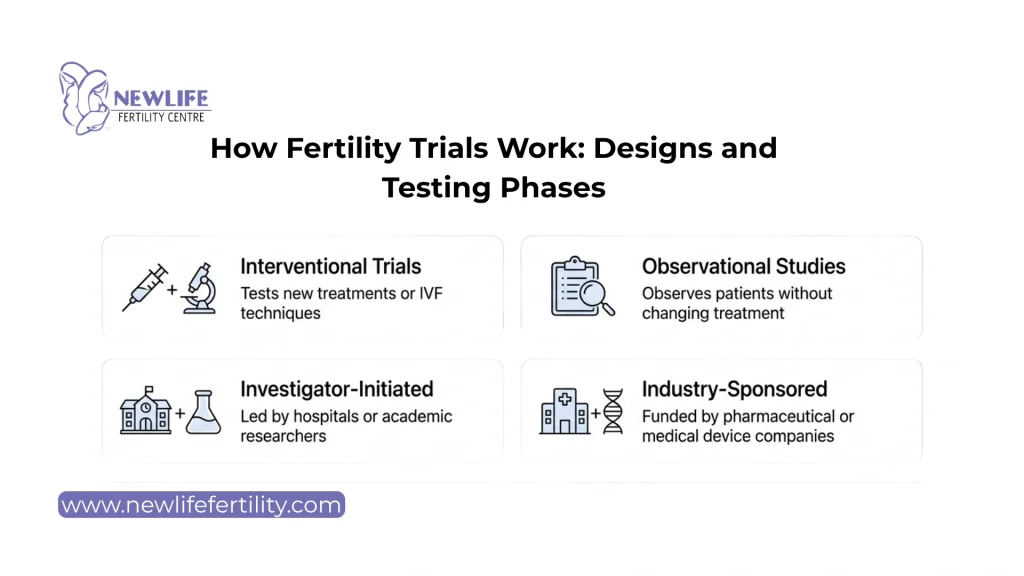
Interventional trials
It tests an actual treatment, a new medication, protocol, or lab technique, on real patients. This is what most people picture when they hear “clinical trial.”
Observational studies
Observational studies don’t change your treatment at all. Researchers just track outcomes from care you’re already receiving. These rarely reduce your cost, but they’re usually low-effort to join if you want to contribute.
Investigator-initiated
These trials are run by an academic or hospital team, often on grant funding, and usually test a technique or protocol rather than a specific drug.
Industry-sponsored trials
These are funded by a pharmaceutical or device company testing their own product. These tend to have the most generous coverage, since the company is footing the bill and needs complete data.
Health Canada also sorts drug trials into phases. Phase I is small and focused on safety. Phase II expands to test whether the treatment actually works. Phase III compares it directly against current standard treatment, often across multiple clinics at once.
By the time a fertility drug trial reaches Phase III, it’s usually already shown real promise, and that’s often the stage most patients get recruited into.
Why are IVF clinical trials conducted?

Every fertility treatment you know about today, IVF itself, ICSI, frozen embryo transfer, started as a clinical trial once.
Trials exist to answer questions doctors and scientists genuinely don’t have answers to yet. Things like:
- Does this new medication improve egg quality?
- Does this lab technique increase implantation rates?
- Is this shorter stimulation protocol just as effective as the standard one?
- Does this approach reduce side effects without hurting outcomes?
And the answers aren’t always the clean, headline-friendly version you’d expect. One recent randomized trial testing CoQ10 supplementation found it increased the number of eggs retrieved during a cycle, but didn’t actually improve pregnancy rates. That’s not a failed study. That’s exactly the kind of nuanced, real answer this research exists to produce, even when it’s more complicated than the marketing version.
Reproductive medicine moves forward because people are willing to be part of that process. Somebody had to be in the first IVF trial for the rest of us to have IVF at all.
In Canada, this doesn’t happen in a free-for-all. Every study involving human participants has to go through a Research Ethics Board such as the Health Canada-PHAC REB, the Hamilton Integrated Research Ethics Board (HiREB), or the Health Research Ethics Board of Alberta (HREBA), following the national Tri-Council Policy Statement (TCPS2).
That board reviews the study before a single patient is enrolled, specifically to protect the people taking part. Drug trials go a step further, since Health Canada has to authorize the trial before it can even start.
That’s not red tape for the sake of it. It’s the system that stands between “promising idea” and “something tested on real people.”
Who may be eligible for free IVF clinical trials?

Here’s the part that trips people up the most, and also the part almost nobody explains well.
“I have infertility, so I qualify for fertility studies, right?”
Not necessarily. And it’s not because researchers are being arbitrary.
A study is only useful if its results can be trusted, and trust depends on comparing similar patients to each other. If a study mixes a 25-year-old with unexplained infertility together with a 41-year-old recovering from cancer treatment, the results become almost impossible to interpret cleanly. Criteria exist to control for variables, not to shut people out for the sake of it.
That means eligibility can be narrower than most people expect. A study might specifically want:
- A tight age range, sometimes as narrow as 25 to 37
- A specific diagnosis, such as diminished ovarian reserve, unexplained infertility, or endometriosis
- Patients who’ve never done IVF before, or the opposite, patients who’ve had a previous failed cycle
- A certain BMI range or general health profile
- Non-smokers, or people not currently on specific medications
- Residency near the research site, since most studies require in-person monitoring throughout
Meeting every listed criterion still doesn’t guarantee a spot. Two more things are usually at play behind the scenes.
First, most interventional trials calculate their target sample size in advance, using statistical methods that determine how many participants they need to detect a real effect. Once a subgroup fills, enrollment for that subgroup closes, even for people who technically qualify.
Second, many trials use randomization, meaning eligible applicants can still be assigned to a standard-treatment comparison group instead of the new approach being tested.
Think of it less like signing up for a service and more like applying for something with a fixed number of seats, calculated by statisticians before the study even opened.
What costs may be covered during an IVF clinical trial?

This is genuinely the most important section for anyone trying to save money.
Coverage depends entirely on what the study is designed to measure, and it tends to follow the trial type described earlier. Investigator-initiated academic trials, often testing a protocol tweak or a lab technique, tend to cover only the specific piece being studied. Industry-sponsored drug trials tend to be the most generous, often covering the full cycle plus monitoring, because the sponsor needs complete data and typically has the budget to fund it.
| May be covered | May not be covered |
| The specific treatment or medication being studied | Travel to and from appointments |
| Monitoring ultrasounds tied to the study protocol | Accommodation, if you’re travelling for the trial |
| Bloodwork required by the protocol | Time away from work |
| Laboratory procedures within the study protocol | Optional add-ons, like genetic testing or ICSI, if not part of the study |
| Some or all of the IVF cycle, if that’s the core intervention | Embryo storage beyond the study period |
Some studies, though not every one, also include a stipend to offset travel time or time away from work. This isn’t universal and it’s rarely a large amount, but it’s worth asking about directly rather than assuming it doesn’t exist.
Always ask for the exact coverage list, in writing, before you agree to anything. “What’s covered” is a question every legitimate study should be able to answer clearly and immediately, without making you dig for it.
What should participants expect during an IVF clinical trial?
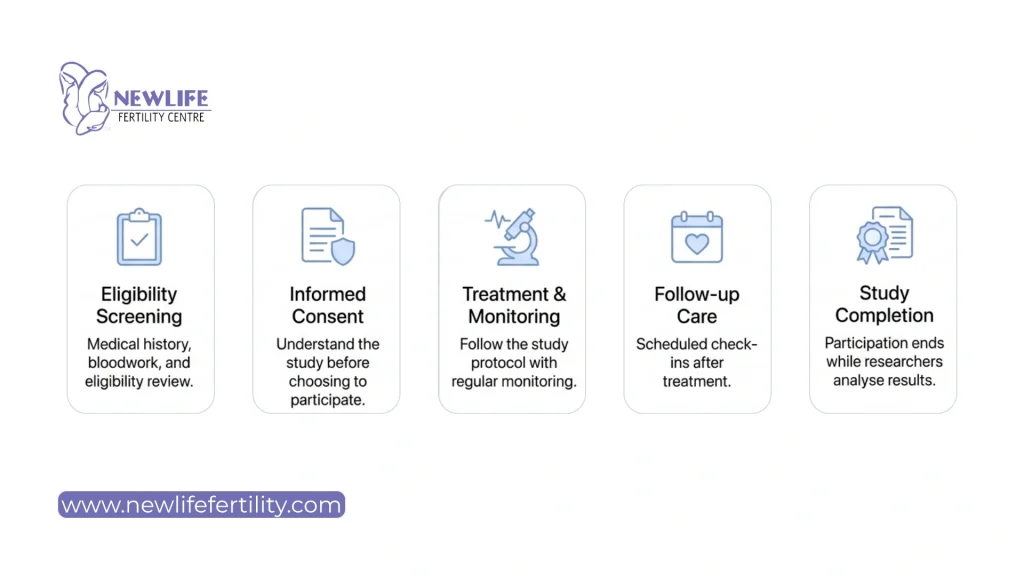
The process has a rhythm to it. Here’s how it typically unfolds.
Eligibility screening
You’ll go through a review of your medical history, sometimes bloodwork or imaging, to confirm you actually meet the study’s criteria. This can take anywhere from one appointment to several, depending on how many exclusion factors the study needs to rule out.
Informed consent
Before anything happens, you’ll be given a consent document explaining the study. By Canadian research standards, that document has to cover specific ground: the study’s actual purpose, what happens at each stage, known and possible risks, any alternative treatments available to you outside the study, who to contact with questions or concerns, and an explicit statement that leaving the study at any time won’t affect your access to standard fertility care.
If any of those pieces feel missing or glossed over when you read it, that’s worth flagging before you sign anything. Take your time here. A good research team wants you to actually understand what you’re agreeing to, not just sign quickly.
Treatment and monitoring
This looks similar to standard IVF in structure, ultrasounds, bloodwork, medication, egg retrieval, possibly embryo transfer, but it follows the study’s fixed protocol rather than a fully personalized plan.
Your monitoring schedule is usually set by the protocol in advance, not adjusted cycle-by-cycle the way a private clinic might tailor it to your individual response. That often means more visits than a typical private cycle, since researchers need consistent data points across every participant to compare results fairly.
Follow-up appointments
Most studies don’t end at pregnancy confirmation. Expect follow-up visits or check-ins, sometimes well into pregnancy or beyond, depending on what’s being measured.
Study completion
Once your involvement wraps up, you may be offered a summary of results, though full study conclusions often aren’t published until well after your part is done. That’s normal. Research timelines run long, sometimes years past your own participation.
What are the benefits and limitations of IVF clinical trials?
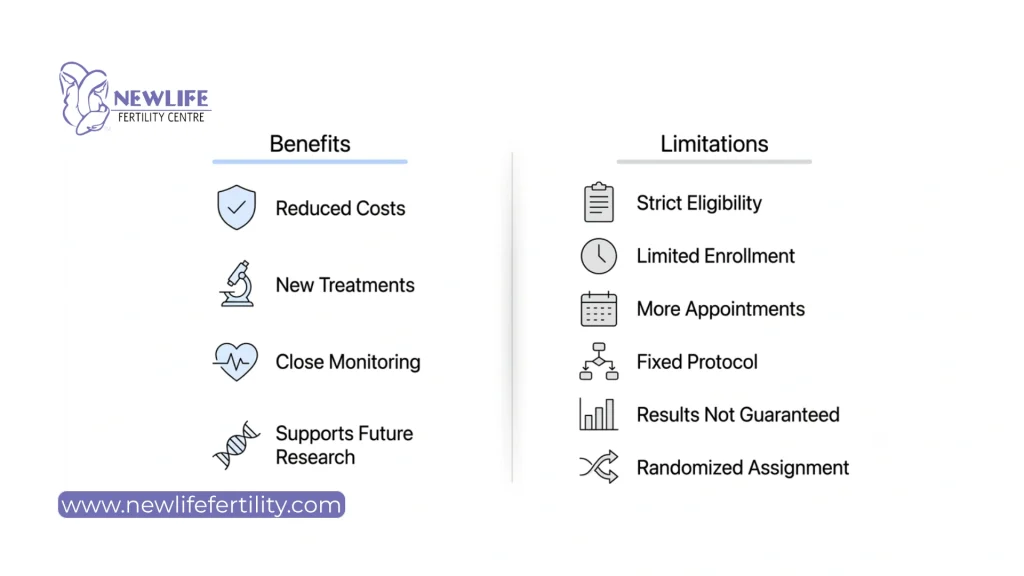
Present a balanced view so readers understand both the potential advantages and the considerations before participating.
Benefits of IVF clinical trials
- Reduced or fully covered costs for the treatment being studied
- Access to new fertility treatments or technologies before they become widely available
- Close medical monitoring throughout the study
- Opportunity to contribute to fertility research that may improve future patient care
Limitations of IVF clinical trials
- Strict eligibility requirements that vary by study
- Limited enrollment, with some studies filling quickly or having waitlists
- More appointments, testing, and paperwork than standard IVF treatment
- Treatment follows a research protocol rather than a fully personalized care plan
- IVF success is not guaranteed, just as with standard fertility treatment
- Some studies may use randomization, meaning participants could receive the current standard treatment instead of the investigational treatment. In Canada, participants continue to receive established, evidence-based fertility care rather than a placebo in place of effective treatment.
How are IVF clinical trials different from government-funded IVF?
These two get confused constantly, and they’re genuinely not the same thing.
| IVF Clinical Trials | Government-Funded IVF |
| A research study | A public funding program |
| Eligibility set by the individual study | Eligibility set by provincial criteria |
| Coverage varies by study design and sponsor | Funding follows fixed government guidelines |
| May involve new, unproven treatments | Standard, established fertility treatment |
| Limited spots, often temporary | Ongoing program, subject to provincial policy |
Government-funded IVF, like Ontario’s Fertility Program, isn’t research. It’s standard, well-established treatment that a province has agreed to subsidize for eligible residents, with outcomes that are already well understood. If you want the full province-by-province rundown of what’s funded where across Canada, that’s exactly what our government funding guide walks through.
And if you’re specifically trying to figure out where Ontario’s program fits into all this, our Ontario IVF funding eligibility guide breaks that down in detail.
A clinical trial, by contrast, is testing something. You might get access to tomorrow’s standard treatment today, or you might be part of proving a new approach doesn’t work as well as hoped. Both outcomes are valuable to science. Only one of them gets you a baby.
Where can patients find IVF clinical trials?

Studies open and close constantly, so there’s no single permanent list. But there are trustworthy places to look, and a couple of ways to search that actually save you time.
Health Canada’s Clinical Trials Database
Health Canada’s Clinical Trials Database lists phase I, II, and III trials involving drugs authorized in Canada. It’s a good starting point, though registration is voluntary, so it isn’t fully comprehensive.
Academic and hospital-affiliated fertility centres
Academic and hospital-affiliated fertility centres often run their own research programs. Clinics connected to a university, like those affiliated with the Lunenfeld-Tanenbaum Research Institute and the University of Toronto, regularly publish active studies on their websites.
Provincial clinical trial registries
Provincial registries, such as Clinical Trials Quebec, compile studies happening within that province specifically.
Ask your fertility clinic
Your own fertility clinic is often the fastest route. Ask directly whether they’re currently running or participating in any studies, and whether you’d be a fit.
What do IVF clinical trials look like in practice?

To give you a sense of what these actually look like in practice: one multi-site Canadian academic trial called Fit-for-Fertility studied whether a structured lifestyle program improved outcomes for women with obesity and infertility, running simultaneously out of Olive Fertility Centre in Vancouver, Mount Sinai Hospital in Toronto, and university hospitals in Montreal and Sherbrooke.
That’s fairly typical of investigator-initiated Canadian fertility research: multiple academic centres, one coordinated protocol, results that eventually feed back into clinical guidelines. It’s also a useful reminder that not every trial tests IVF directly. Some test the conditions around it, which is worth watching for if cost coverage matters more to you than testing a brand-new IVF technique specifically.
Why it’s worth checking regularly
Availability shifts constantly. A study that was full last month might be recruiting again next month, so it’s worth checking back periodically rather than assuming a one-time search covers it.
Questions to ask before joining an IVF clinical trial

Before you sign anything, get clear answers to these.
- What costs are covered, and which expenses will remain out of pocket?
- What happens if the treatment does not result in pregnancy?
- Can participants withdraw from the study, and what happens if they do?
- How long will the clinical trial last, from screening to final follow-up?
- What follow-up care is provided after the study ends?
- Are there any risks or side effects beyond those associated with standard IVF treatment?
- Who should participants contact if they have concerns or experience complications during the study?
Could a free IVF clinical trial be the right next step in your fertility journey?
Clinical trials can genuinely reduce the cost of fertility treatment, and for the right person, at the right time, they can open a door that would otherwise stay closed. But they’re not a shortcut, and they’re not guaranteed. Eligibility is specific, spots are calculated in advance and limited, and participation means following a research protocol rather than a fully personalized plan.
For a lot of people, the better next step isn’t picking one path and hoping it works out. It’s figuring out where they actually stand across every option at once, research studies, government-funded programs like the Ontario Fertility Program, and private treatment, so the decision rests on the full picture instead of whichever option happened to show up first in a search.
That’s exactly where NewLife Fertility comes in. Our team has spent years contributing to fertility research through presentations at CFAS, ASRM, and other reproductive medicine conferences, so we understand the research side of this world as closely as we understand the clinical side.
We’re also a participating clinic in the Ontario Fertility Program, which means we can walk you through funded treatment, private care, and where a clinical trial might genuinely make sense, all under one roof, without you having to stitch the answer together from five different websites.
You don’t have to figure this out alone, and you don’t have to guess which door to knock on first.
Book your free consultation and let’s map out exactly which path fits your fertility journey, together.
Frequently asked questions about free IVF clinical trials
They’re research studies testing new fertility treatments, medications, or techniques, where some or all costs may be covered for participants who qualify, depending on whether the trial is investigator-initiated or industry-sponsored.
It depends entirely on the individual study’s criteria, which often include age range, diagnosis, treatment history, and general health, all set to keep the study’s results scientifically valid.
In Canada, every study involving human participants must be reviewed and approved by a Research Ethics Board under national ethical standards, and drug trials also require Health Canada authorization before they can begin.
Sometimes. It depends on whether medication is the specific thing being studied, or just a supporting part of the protocol.
Timelines vary widely. Some wrap up within a single treatment cycle, others include months or years of follow-up, especially if the study is tracking pregnancy or child outcomes.
Yes. Participation is voluntary, and you can withdraw at any point without losing access to standard fertility care.
Through public registries like ClinicalTrials.gov, hospital or university research pages, or by asking your fertility clinic directly about current studies.
Private IVF is standard, established treatment you pay for directly, with a plan built around you. A clinical trial is research, following a fixed protocol, and may involve a treatment that isn’t yet standard practice.