A couple sits in their car outside the clinic, holding their IVF invoice. They thought the hardest part, financially, was behind them. But then comes the next step, frozen embryo transfer, with a separate cost they didn’t fully expect. And suddenly, the questions start again.
You already went through IVF.
You have embryos waiting.
And now someone handed you a new bill, the frozen embryo transfer cost.
“Wait, this is separate?”
Yes. And we get it. Nobody really prepares you for how much the FET step costs on its own.
So let’s change that right now.
This guide breaks down the real cost of frozen embryo transfer in Canada, including procedure, medications, hidden fees, Ontario funding, and everything in between.
So before you move forward, let’s answer the one question that’s probably already on your mind:
How much does a frozen embryo transfer cost in Canada?

Let’s get straight to the number you came here for.
The average frozen embryo transfer cost in Canada is $3,000 to $7,000+ CAD, including medications. The procedure alone typically ranges from $2,000 to $5,000 CAD. If you’re wondering how much a frozen embryo transfer costs overall, this is the realistic range most patients fall into.
Here’s a quick snapshot:
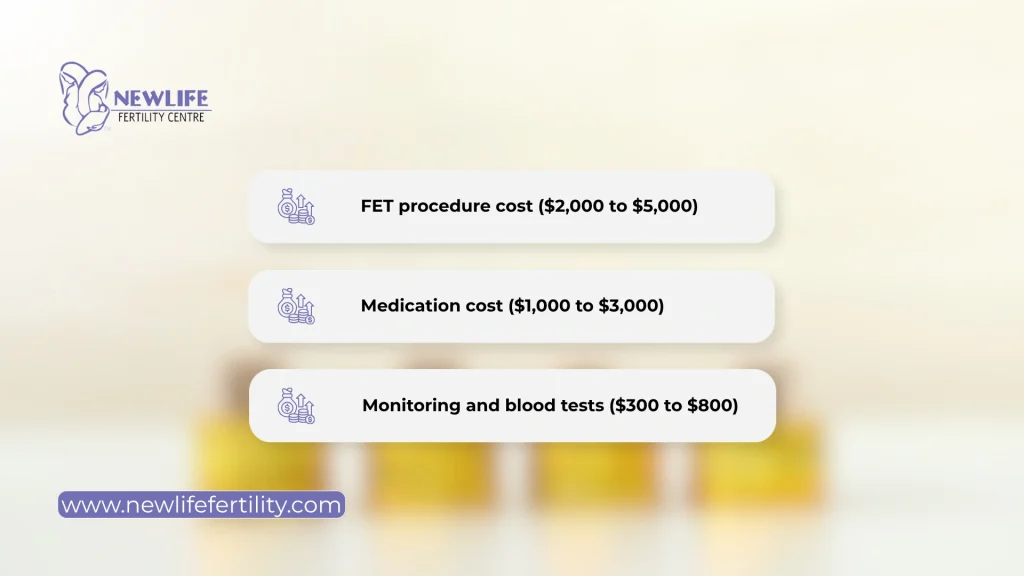
- FET procedure: $2,000 to $5,000
- Medications: $1,000 to $3,000
- Total (realistic): $3,000 to $7,000+
Costs vary depending on your clinic, your treatment protocol, and how your body responds. Most fertility clinics in Canada follow a similar pricing structure, but your final bill depends on your specific treatment plan.
In short, two patients at the same clinic can walk away with very different bills. More on that below.
Frozen embryo transfer cost breakdown: what you’re actually paying for
This is the part most clinics don’t explain upfront. Based on typical fertility clinic pricing in Canada, here’s where your money actually goes.
FET procedure cost ($2,000 to $5,000)
This covers the core work, thawing your embryo, the actual transfer procedure, and basic monitoring to prepare your uterus.
Think of it as the base package.
Medication cost ($1,000 to $3,000)
Medications are often where the bill quietly climbs.
For a medicated FET cycle, you’ll typically take estrogen first to thicken the uterine lining, then progesterone to prepare for implantation.
For a natural FET cycle, your body does more of the work on its own, which can significantly reduce your medication bill.
Monitoring and blood tests ($300 to $800)
During your FET cycle, your clinic tracks your hormone levels and uterine lining through blood tests and ultrasounds.
These monitoring visits add up, especially if your body takes more time to respond.
Additional or hidden costs
This is where bills quietly increase.
Watch out for:
- Embryo storage fees, if your embryos have been frozen for some time, you may owe annual storage charges
- Assisted hatching, a lab technique used in some cases to improve implantation odds, usually $300 to $600 extra
- Extra consultations, if your plan needs adjusting mid-cycle
- Additional monitoring visits if your lining needs more time
Ask your clinic for a full itemized quote before you begin. Not a range. An actual breakdown.
Frozen embryo transfer cost in Ontario: Is it cheaper?

Here’s what a lot of people don’t fully understand about Ontario, and it’s worth knowing clearly.
Ontario has the Ontario Fertility Program, which can provide government-funded IVF cycles for eligible patients.
If your FET is part of a government funded IVF cycle, the transfer itself may be partially or fully covered under that cycle.
But here’s the honest part:
Medications are almost never covered. So even if your procedure is funded, expect to pay $1,000 to $3,000 out of pocket for drugs.
There are also wait times for funded cycles, sometimes several months.
And if you’re doing a self-funded FET, not linked to a funded cycle, you pay the full costs like anyone else in the country.
So yes, Ontario can be cheaper, but it depends heavily on your eligibility and situation. Don’t assume funded means free.
Why does frozen embryo transfer cost vary so much?

Because no two FET cycles are identical.
Here’s what moves the number up or down:
Clinic reputation and location
A well-known fertility clinics in Downtown Toronto Downtown Toronto will price differently than a smaller clinic in a mid-sized city.
Type of cycle
Natural FET cycles cost less than medicated ones because you use fewer, or no, drugs.
Number of monitoring visits
If your lining takes longer to prepare, you get more ultrasounds and blood tests. More visits means more cost.
Add-ons
Assisted hatching, embryo glue, or other lab enhancements are optional but add to the total.
Complications or protocol changes
Sometimes a cycle needs to be cancelled and restarted. That is an extra cost most people do not plan for.
Two patients rarely pay the exact same amount. That is simply the reality of fertility treatment.
Is frozen embryo transfer cheaper than full IVF?

Yes, but only when you look at it step by step.
A full IVF cycle in Canada typically costs $10,000 to $15,000 or more, plus $3,000 to $5,000 for medications. This already includes egg retrieval, fertilization, embryo creation, and in many cases, freezing.
So by the time you reach FET, you have already paid for the most expensive part.
A frozen embryo transfer then costs around $3,000 to $7,000 or more.
That is why FET feels cheaper. You are not repeating IVF again. There is no egg retrieval, no stimulation injections, and no lab fertilization. You are only paying for the transfer step.
The simplest way to look at it is this. IVF is the process of creating embryos, which is the expensive part. FET is the process of using those embryos, which costs less.
So yes, freezing embryos earlier does cost money, and that is part of your overall journey. But compared to starting a brand new IVF cycle again, FET is still a much more affordable next step.
Frozen embryo transfer medication cost: What to expect?

Let’s go a little deeper here because medication costs catch a lot of people off guard. For many patients, this is the most unpredictable part of the frozen embryo transfer price.
For a medicated FET cycle, expect to pay $1,000 to $3,000 CAD for drugs alone.
What affects your medication cost?
- Dosage: Higher doses cost more. Simple.
- Duration: Some protocols run longer, which means more weeks of medication.
- Body response: If your lining does not respond as expected, your doctor may adjust the protocol, which can extend your medication use.
Natural cycle FET is an option for some women. If your cycle is regular and your body ovulates predictably, you may be able to do FET with minimal or no medication.
Natural cycle means lower cost. Medicated cycle means higher cost.
Ask your doctor which protocol makes sense for your body, not just your budget.
What factors affect your total FET cost?

Here’s a practical summary before you build your budget:
Your treatment plan
Natural vs. medicated cycles are the biggest cost drivers after the procedure itself.
How your body responds
More monitoring visits if your lining is slow to respond.
Clinic protocols
Each clinic has slightly different standards for monitoring frequency and add-on recommendations.
Insurance coverage
Some plans cover medications partially. Even partial coverage helps.
Need for additional procedures
Assisted hatching, ERA testing, or other add-ons are optional, but not always.
Can insurance cover frozen embryo transfer in Canada?

Sometimes. But rarely completely.
Some private insurance plans in Canada cover:
- A portion of fertility medications
- Some diagnostic tests, like bloodwork and ultrasounds
- Partial reimbursement for the procedure in certain cases
Most patients still pay the majority out of pocket.
If you’re in Ontario and eligible for the Ontario Fertility Program, that can help with the procedure. This is why frozen embryo transfer costs in Ontario can sometimes be lower than other provinces. But medications remain your responsibility in almost all cases.
The realistic takeaway: insurance is a bonus, not a plan. Budget as if you’re paying everything, and treat any coverage as a welcome reduction.
Check your benefits booklet carefully, or call your insurer directly, before your cycle begins.
Tips to manage your frozen embryo transfer costs

Here’s what actually helps:
Ask for a full written cost estimate before you start
Not a range. Not a ballpark. Ask for an itemized breakdown of every charge, procedure, monitoring, medication, storage, and potential add-ons.
Check your insurance before cycle day one
Not after. Call your provider, ask specifically about fertility medications and procedures, and get it in writing.
Compare clinics, but not just on price
A lower price at a clinic with lower success rates is not always the better deal. Look at both cost and outcomes.
Build a 20 to 30 percent buffer into your budget
Unexpected monitoring visits, protocol changes, and small add-ons happen. They are normal. Plan for them.
Ask about natural cycle FET
If you are a good candidate, it can meaningfully reduce your medication costs without compromising your chances.
Is frozen embryo transfer worth the cost?

That’s a deeply personal question. But here’s what the data and experience show.
FET success rates in Canada are genuinely strong. Many clinics report around 40 to 60 percent success rates per transfer for good quality embryos, depending on age and embryo grading.
It is also significantly cheaper than starting another full IVF cycle from scratch.
And you are working with embryos you have already created, which means less physical and emotional strain on your body.
Is it guaranteed? No. But nothing in fertility treatment is.
What it offers is a real, practical next step, one that balances cost, effort, and hope in a way that makes sense for many people.
Frozen embryo transfer cost in Canada: what should you plan for next?
If there’s one thing to take away, it’s this. Uncertainty is normal. Lack of clarity doesn’t have to be.
You now have a clear understanding of frozen embryo transfer costs in Canada. You know the realistic ranges, what is included, what is not, and what can push your total higher or keep it manageable.
The next step is simple. Talk to your fertility clinic and ask for a full, itemized cost estimate based on your specific situation. Not a guess. Your actual plan.
And if you are still looking for the right clinic, choose one that is open and transparent about costs from the beginning. That honesty makes a big difference when you are already navigating so much.
At NewLife Fertility, the focus is on clear guidance, realistic expectations, and personalized treatment plans so you are never left guessing about your next step or your costs.
If you want a clear, personalized breakdown of your frozen embryo transfer cost in Canada, book your free consultation with NewLife Fertility today and get answers tailored to your situation.
Frequently asked questions about frozen embryo cost in Canada
The average total cost is $3,000 to $7,000 or more CAD, including medications. The procedure alone typically ranges from $2,000 to $5,000 CAD, depending on the clinic and your treatment plan.
Medications for a medicated FET cycle typically cost between $1,000 and $3,000 CAD. Natural cycle FET uses fewer or no medications, which can significantly reduce this portion of your bill.
If your FET is linked to a government-funded IVF cycle under the Ontario Fertility Program, the transfer may be partially covered. However, medications are almost never covered, and eligibility criteria apply. Out of pocket costs still remain for most patients.
Typically between $1,000 and $3,000 CAD for a medicated cycle. Natural cycles cost significantly less. Your actual cost depends on dosage, duration, and your body’s response.
Yes, significantly. A full IVF cycle in Canada costs $10,000 to $15,000 or more, plus medications. FET costs $3,000 to $7,000 or more in total. It skips egg retrieval, stimulation, and lab fertilization, which are the most expensive parts of the IVF process.