
Choosing how to build your family can feel a bit like standing at a crossroads.
You know where you want to go, but there may be more than one path to get there.
For many same-sex female couples, two of the most common options are reciprocal IVF and surrogacy. Both can help you grow your family, but they involve very different medical processes, costs, timelines, and experiences.
One option allows one partner to provide the eggs while the other carries the pregnancy. The other involves a surrogate carrying the pregnancy on behalf of the intended parents. Understanding these differences is essential when deciding which path is right for your family.
If you’re comparing reciprocal IVF and surrogacy, you’re likely wondering how they differ, which option is more affordable, who can participate in the pregnancy, and what factors should influence your decision.
In this article, we’ll explore how each option works, compare costs and success rates, discuss legal considerations in Canada, and help you determine which family-building journey may be the best fit for your goals.
What is reciprocal IVF?

Reciprocal IVF is a fertility treatment that allows both partners in a same-sex female relationship to participate directly in the process of building their family.
In a reciprocal IVF cycle, one partner provides the eggs, while the other partner carries the pregnancy. The eggs are retrieved, fertilized with donor sperm in a laboratory, and the resulting embryo is transferred to the second partner’s uterus.
For many couples, reciprocal IVF offers a unique opportunity to share the pregnancy journey. One partner has a genetic connection to the child, while the other experiences pregnancy and childbirth.
How reciprocal IVF works
The process begins with the egg provider taking fertility medications to stimulate the ovaries and encourage the development of multiple mature eggs. Once ready, the eggs are retrieved and fertilized with donor sperm in a fertility laboratory.
The resulting embryo is carefully monitored before being transferred to the partner who will carry the pregnancy. Prior to the transfer, the embryo carrier receives medication to prepare the uterine lining for implantation.
If the transfer is successful, the embryo implants in the uterus and the pregnancy progresses like any other pregnancy.
Who is a good candidate for reciprocal IVF?
Reciprocal IVF may be a good option for same-sex female couples when one partner has healthy eggs available for retrieval and the other partner is able to safely carry a pregnancy.
Before treatment begins, both partners undergo fertility assessments to evaluate factors such as ovarian reserve, uterine health, hormone levels, and overall reproductive health. These evaluations help determine the most appropriate treatment approach and maximize the chances of success.
While age and egg quality play an important role in treatment outcomes, eligibility is based on each couple’s individual circumstances and fertility evaluation results.
What is surrogacy?

Surrogacy is a family-building option in which another person, known as a surrogate, carries a pregnancy on behalf of the intended parent or parents.
Unlike reciprocal IVF, where one partner carries the pregnancy, surrogacy involves a third party who becomes pregnant and gives birth to the baby. After birth, the child is raised by the intended parents.
In Canada, the most common form of surrogacy is gestational surrogacy. In this arrangement, the surrogate has no genetic connection to the baby. The embryo is created through IVF using eggs from one of the intended parents or an egg donor and is then transferred to the surrogate’s uterus.
How surrogacy works
The surrogacy process typically begins with selecting a surrogate and completing the required medical, psychological, and legal evaluations. Intended parents may find a surrogate independently or work with a surrogacy agency.
Once legal agreements are finalized and all parties are medically cleared, an embryo is created through IVF and transferred to the surrogate’s uterus. If the transfer is successful, the surrogate carries the pregnancy and delivers the baby on behalf of the intended parents.
Because surrogacy involves additional legal, medical, and logistical steps, the process is often more complex and time-consuming than reciprocal IVF.
Who is a good candidate for surrogacy?
Surrogacy is often recommended when carrying a pregnancy is not medically possible or not considered safe.
This may include individuals with certain uterine conditions, recurrent pregnancy loss, serious medical conditions that make pregnancy high risk, or a history of unsuccessful fertility treatments. Surrogacy may also be an option when one partner can provide eggs but neither partner is able to safely carry a pregnancy.
A fertility specialist can evaluate your medical history and reproductive health to determine whether surrogacy or another family-building option is most appropriate for your situation.
Reciprocal IVF vs surrogacy: Key differences at a glance
While both reciprocal IVF and surrogacy can help couples build a family, they differ significantly in terms of pregnancy involvement, cost, timeline, and medical requirements.
| Factor | Reciprocal IVF | Surrogacy |
| Who carries the pregnancy? | One of the partners | A third-party surrogate |
| Biological involvement | One partner provides the eggs and the other carries the pregnancy | Depends on whose eggs are used to create the embryo |
| Typical cost in Canada | $20,000 to $35,000+ | $80,000 to $120,000+ |
| Timeline | Typically 3 to 6 months | Often 1 to 3 years |
| Medical requirements | One partner must be able to safely carry a pregnancy | Neither intended parent needs to carry the pregnancy |
| Legal considerations | Generally more straightforward | Requires legal agreements and additional legal processes |
| Best suited for | Couples where one partner can carry a pregnancy | Couples where neither partner can safely carry a pregnancy |
The biggest difference comes down to who carries the pregnancy. If one partner is medically able and wants to carry, reciprocal IVF is often the simpler and more affordable option. If carrying a pregnancy is not possible or medically advisable, surrogacy may provide a path to parenthood that would otherwise not be available.
Who carries the pregnancy?

The most significant difference between reciprocal IVF and surrogacy is who carries the pregnancy.
With reciprocal IVF, one partner carries the pregnancy after receiving an embryo created using the other partner’s eggs and donor sperm. This allows both partners to participate directly in the process, with one partner having a genetic connection to the child and the other experiencing pregnancy and childbirth.
With surrogacy, the pregnancy is carried by a surrogate rather than one of the intended parents. The embryo is transferred to the surrogate’s uterus, and she carries the pregnancy on behalf of the intended parents.
This distinction is important because it influences both the medical and emotional aspects of the family-building journey. In reciprocal IVF, one partner experiences pregnancy firsthand, while in surrogacy, neither intended parent carries the baby.
For some couples, being able to carry the pregnancy themselves is an important part of their parenthood experience. For others, surrogacy provides a valuable path to building a family when pregnancy is not medically possible or advisable.
Ultimately, the right option depends on your health, personal preferences, and family-building goals.
Can both partners be biologically involved?

One of the biggest reasons many same-sex female couples choose reciprocal IVF is the opportunity for both partners to play a direct role in the journey to parenthood.
With reciprocal IVF, one partner provides the eggs used to create the embryo, while the other partner carries the pregnancy. This allows one partner to have a genetic connection to the child and the other to experience pregnancy and childbirth.
With surrogacy, biological involvement depends on how the embryo is created. If the eggs come from one of the intended parents, she will have a genetic connection to the child. However, because a surrogate carries the pregnancy, neither intended parent experiences the gestational aspect of pregnancy themselves.
In situations where donor eggs are used, neither intended parent may have a genetic connection to the baby, although both remain the child’s intended parents and caregivers from birth.
For many couples, the ability for both partners to participate directly in the family-building process is one of the most meaningful advantages of reciprocal IVF. However, when carrying a pregnancy is not medically possible, surrogacy can provide an alternative path to achieving the same goal of building a family.
Reciprocal IVF vs surrogacy costs in Canada
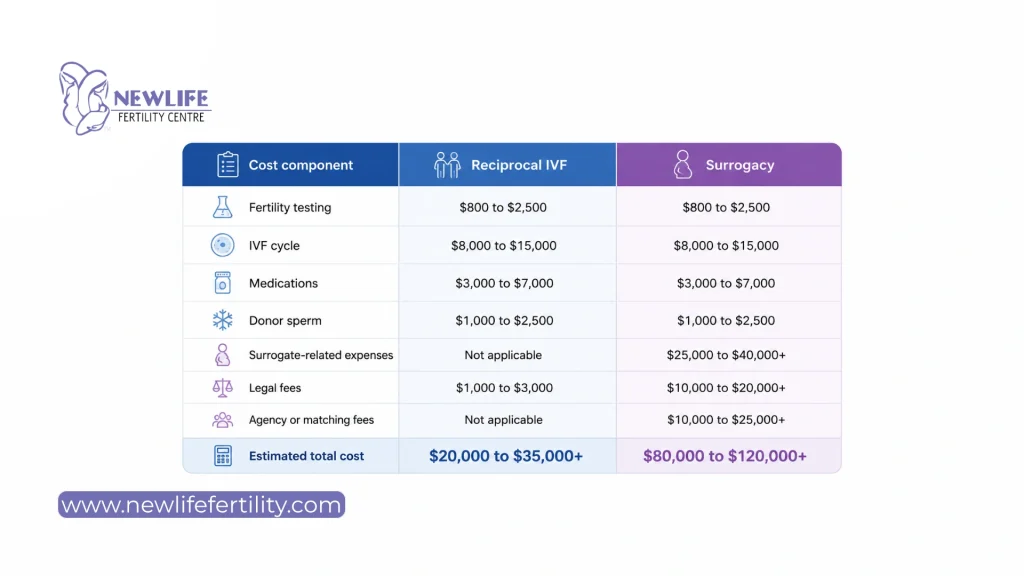
Cost is often one of the biggest factors couples consider when deciding between reciprocal IVF and surrogacy.
While both options can help you build a family, the financial commitment required for each path is very different.
Cost of reciprocal IVF
A complete reciprocal IVF cycle in Canada typically costs between $20,000 and $35,000. This estimate may include fertility testing for both partners, donor sperm, fertility medications, egg retrieval, embryo creation, embryo transfer, and embryo freezing or storage fees.
Depending on your insurance coverage, some expenses, particularly fertility medications, may be partially reimbursed.
Cost of surrogacy
Surrogacy is considerably more expensive and often costs between $80,000 and $120,000 or more in Canada.
In addition to the IVF process itself, intended parents must account for legal fees, surrogate-related expenses, medical costs, insurance considerations, travel expenses, and potential agency or matching fees. These additional requirements contribute significantly to the overall cost.
Why is surrogacy more expensive?
The primary reason surrogacy costs more is that it involves additional medical, legal, and logistical steps beyond a standard IVF cycle.
The intended parents must complete IVF treatment to create embryos, while the surrogate undergoes her own medical preparation, embryo transfer, pregnancy care, and delivery. Legal agreements and ongoing coordination between multiple parties also add to the overall expense.
Cost comparison of reciprocal IVF vs surrogacy
| Cost component | Reciprocal IVF | Surrogacy |
| Fertility testing | $800 to $2,500 | $800 to $2,500 |
| IVF cycle | $8,000 to $15,000 | $8,000 to $15,000 |
| Medications | $3,000 to $7,000 | $3,000 to $7,000 |
| Donor sperm | $1,000 to $2,500 | $1,000 to $2,500 |
| Surrogate-related expenses | Not applicable | $25,000 to $40,000+ |
| Legal fees | $1,000 to $3,000 | $10,000 to $20,000+ |
| Agency or matching fees | Not applicable | $10,000 to $25,000+ |
| Estimated total cost | $20,000 to $35,000+ | $80,000 to $120,000+ |
For couples who are medically eligible for both options, the difference in cost can be substantial. However, financial considerations are just one part of the decision. Medical eligibility, personal preferences, and family-building goals are equally important when determining which path is right for you.
Success rates of reciprocal IVF and surrogacy

The success rates of reciprocal IVF and surrogacy depend less on the treatment itself and more on factors such as egg quality, embryo quality, age, and the health of the person carrying the pregnancy.
In both cases, the quality of the embryo plays a major role in determining the likelihood of a successful pregnancy.
Reciprocal IVF success rates
Reciprocal IVF uses the same medical process as traditional IVF, so success rates are generally similar.
Success is influenced primarily by the age and ovarian reserve of the partner providing the eggs. In general, younger egg providers tend to have higher success rates because egg quality naturally declines with age.
For many women under 35, IVF success rates per cycle are often higher than those seen in older age groups. However, individual outcomes vary based on medical history, fertility health, and embryo quality.
Surrogacy success rates
Surrogacy success rates are also heavily influenced by embryo quality. In addition, surrogates typically undergo extensive medical screening to confirm they are healthy candidates for pregnancy.
Because surrogates are carefully selected and have a history of successful pregnancies in many cases, success rates can be very favorable. However, surrogacy does not automatically guarantee a higher chance of success.
Which option has higher success rates?
There is no universal answer because success depends on the specific circumstances of each couple.
If one partner is healthy and able to safely carry a pregnancy, reciprocal IVF and surrogacy can offer comparable chances of success when high-quality embryos are used. The best option often depends less on success rates and more on medical suitability, personal preferences, and family-building goals.
Medical reasons couples choose surrogacy instead of reciprocal IVF

For some couples, surrogacy is not simply an alternative to reciprocal IVF. It may be the safest or only medically appropriate path to parenthood.
A fertility specialist may recommend surrogacy when carrying a pregnancy is not possible or would present significant health risks.
Common reasons include:
- Certain uterine abnormalities or the absence of a uterus
- Recurrent pregnancy loss
- Serious medical conditions that make pregnancy unsafe
- Certain autoimmune disorders or chronic illnesses
- Previous unsuccessful fertility treatments where carrying a pregnancy is no longer considered a viable option
In these situations, surrogacy can provide an opportunity to have a biological child without exposing either intended parent to unnecessary medical risks.
If you’re unsure whether reciprocal IVF or surrogacy is the better option, a comprehensive fertility evaluation can help determine which path is most appropriate based on your medical history, reproductive health, and family-building goals.
Legal considerations in Canada

Both reciprocal IVF and surrogacy involve legal considerations, but the legal process is generally much more straightforward with reciprocal IVF.
Because family law and parentage rules vary between provinces, it’s important to understand the legal requirements that apply where you live.
Reciprocal IVF legal considerations
For many same-sex female couples in Canada, reciprocal IVF offers a relatively simple legal pathway to parenthood.
In most provinces, both partners can be recognized as the child’s legal parents. However, the process for establishing parentage and completing birth registration requirements can differ depending on provincial legislation.
Before beginning treatment, it’s a good idea to discuss any parentage-related requirements with your fertility clinic and seek legal guidance if needed.
Surrogacy legal considerations
Surrogacy involves additional legal requirements because a third party is carrying the pregnancy.
In Canada, surrogacy is governed by the Assisted Human Reproduction Act, which permits altruistic surrogacy but prohibits paying a surrogate beyond reimbursement for eligible pregnancy-related expenses.
Before embryo transfer takes place, intended parents and the surrogate typically enter into a legal surrogacy agreement outlining the rights, responsibilities, and expectations of everyone involved.
Parentage rules after birth also vary by province. Depending on where you live, additional legal steps may be required to establish the intended parents as the child’s legal parents.
Because surrogacy laws can be complex, intended parents should work with a lawyer experienced in Canadian reproductive and family law before beginning the process.
While reciprocal IVF generally involves fewer legal steps, both paths benefit from proper legal guidance to ensure parentage and family rights are protected from the start.
Pros and cons of reciprocal IVF

Like any fertility treatment, reciprocal IVF offers unique advantages and potential limitations. Understanding both can help you determine whether it aligns with your family’s goals and circumstances.
Benefits of reciprocal IVF
- Allows both partners to participate directly in the family-building journey
- One partner provides the eggs while the other carries the pregnancy
- Generally more affordable than surrogacy
- Typically has a shorter timeline, often taking a few months from treatment to pregnancy
- Involves a relatively straightforward legal process in most Canadian provinces
- Does not require a third party to carry the pregnancy
Limitations of reciprocal IVF
- Requires one partner to have healthy eggs available for retrieval
- Requires the other partner to be medically able to carry a pregnancy
- Success rates are influenced by age, egg quality, and overall fertility health
- More than one treatment cycle may be needed to achieve pregnancy
- Not suitable for couples where neither partner can safely carry a pregnancy
Pros and cons of surrogacy

Surrogacy can be an excellent family-building option for some couples, particularly when pregnancy is not medically possible. However, it also comes with additional considerations.
Benefits of surrogacy
- Provides a path to parenthood when neither partner can safely carry a pregnancy
- Removes pregnancy-related health risks for the intended parents
- Can be an option for individuals with significant medical or reproductive challenges
- Surrogates undergo extensive medical screening before participating
- May offer an opportunity to have a biological child when carrying a pregnancy is not possible
Limitations of surrogacy
- Significantly more expensive than reciprocal IVF
- Often involves a longer timeline due to matching, legal, and medical requirements
- Requires legal agreements and ongoing legal guidance
- Finding a suitable surrogate can take time
- Intended parents do not personally experience pregnancy
Which option is right for your family?

The right choice depends on your medical circumstances, family-building goals, personal preferences, and financial considerations.
Reciprocal IVF may be right for you if:
- One partner would like to provide eggs
- One partner is medically able to carry a pregnancy
- Shared participation in the pregnancy journey is important to you
- You are looking for a lower-cost option compared with surrogacy
- A shorter treatment timeline is a priority
Surrogacy may be right for you if:
- Neither partner can safely carry a pregnancy
- Medical conditions make pregnancy high risk or impossible
- Recurrent pregnancy loss or uterine factors prevent carrying a pregnancy
- Previous fertility treatments have not resulted in a successful pregnancy
- A fertility specialist recommends avoiding pregnancy for medical reasons
There is no universally “better” option between reciprocal IVF and surrogacy. The best choice is the one that aligns with your medical needs, personal values, and long-term family goals.
A consultation with a fertility specialist can help you understand your options, evaluate your eligibility, and determine which path offers the best opportunity to build the family you envision.
What does the choice between reciprocal IVF and surrogacy mean for your family?
Choosing between reciprocal IVF and surrogacy is one of the most personal decisions you’ll make on your family-building journey. While both options can help you achieve the same goal of becoming parents, the right path depends on your unique medical circumstances, personal preferences, timeline, and financial considerations.
For some couples, reciprocal IVF offers a meaningful opportunity for both partners to participate directly in the pregnancy journey. For others, surrogacy provides a safe and effective path to parenthood when carrying a pregnancy is not medically possible.
The most important thing to remember is that there is no one-size-fits-all answer. What works best for another couple may not be the right fit for yours. The best decision is one based on a clear understanding of your fertility health, available options, and long-term family goals.

At NewLife Fertility, we work closely with same-sex female couples to help them navigate every stage of the family-building process. Whether you’re exploring reciprocal IVF, surrogacy, or simply trying to understand your options, our team is here to provide expert guidance, personalized recommendations, and compassionate support.
Book your free consultation with NewLife Fertility today to discuss your goals, evaluate your options, and take the next step toward building the family you’ve been dreaming of.
Frequently asked questions about reciprocal IVF vs surrogacy
No. In reciprocal IVF, one partner provides the eggs while the other carries the pregnancy. In surrogacy, a third-party surrogate carries the pregnancy on behalf of the intended parents. The two options differ in terms of medical involvement, costs, timelines, and legal requirements.
Surrogacy is significantly more expensive than reciprocal IVF. In Canada, reciprocal IVF typically costs between $20,000 and $35,000, while surrogacy often costs $80,000 to $120,000 or more due to additional medical, legal, and surrogate-related expenses.
Yes. One of the main benefits of reciprocal IVF is that both partners can participate directly in the process. One partner provides the eggs used to create the embryo, while the other carries the pregnancy and gives birth.
Surrogacy may be recommended when neither partner can safely carry a pregnancy. This can occur due to certain uterine conditions, recurrent pregnancy loss, serious health concerns, or previous unsuccessful fertility treatments.
Yes. Same-sex female couples can pursue surrogacy in Canada. However, the process must comply with Canadian surrogacy laws, and legal agreements are typically required before treatment begins.
Yes. Reciprocal IVF is legal and available across Canada. In most provinces, both partners can be recognized as legal parents, although parentage requirements may vary depending on provincial legislation.
Yes. Altruistic surrogacy is legal in Canada under the Assisted Human Reproduction Act. Surrogates may be reimbursed for eligible pregnancy-related expenses, but paying a surrogate beyond those expenses is not permitted.
Success rates for both reciprocal IVF and surrogacy depend on factors such as age, egg quality, embryo quality, and the health of the person carrying the pregnancy. A fertility specialist can assess your individual circumstances and provide a more accurate estimate of your chances of success.