Thinking about doing a natural cycle FET this time, but not sure what that actually means?
Your doctor just told you that you can do a natural cycle, and now you’re sitting with a dozen questions you didn’t know you had.
Less medication sounds good. But does “natural” mean no medication at all? Will your body actually do what it needs to do on its own? Is this safer, or are you giving up some control? And honestly, is it better than a medicated cycle, or is that just something people wish were true?
If those questions feel familiar, you’re in the right place.
Natural cycle frozen embryo transfer is one of those topics where the name creates as much confusion as it does clear up. Because “natural” sounds simple, but reality has more nuance than a single word can carry.
In this guide, I’m going to walk you through exactly what a natural FET is, how it works step by step, who it’s right for, and what to realistically expect, so you can go into your next conversation with your doctor feeling clear, not overwhelmed.
Let’s start from the beginning.
What is a natural frozen embryo transfer?

A natural frozen embryo transfer is a type of FET cycle where your body’s own hormonal cycle, specifically your natural ovulation, is used to prepare your uterus for the embryo transfer, rather than using external hormones to artificially create that preparation.
In a standard medicated FET, your clinic suppresses your natural cycle and then uses estrogen and progesterone to build your uterine lining in a controlled and predictable way. The clinic decides when your lining is ready, and the timing is largely in their hands.
In a natural FET, the process works differently. Your body ovulates on its own. That ovulation triggers your uterus to begin producing progesterone naturally. Your clinic monitors this process closely by tracking follicle growth, the LH surge, and ovulation and then uses that timing to schedule your embryo transfer with precision.
The core idea is simple. Instead of replacing your hormonal environment with medication, the clinic works with the hormonal environment your body is already creating.
It is also worth noting that “natural” does not always mean zero medication. Depending on your protocol, you may still receive a trigger shot to control the exact timing of ovulation, and some clinics add progesterone support in the luteal phase.
But the fundamental driver of your cycle, ovulation itself, comes from your own body, not from externally administered hormones.
Natural cycle vs medicated FET: What’s the difference?
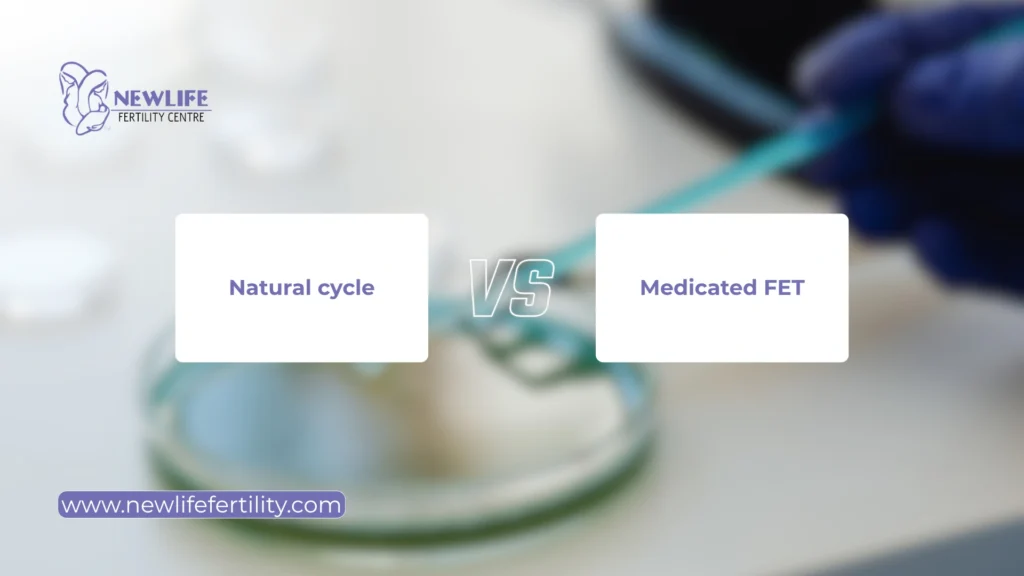
This is often the first thing patients want to understand, and it is worth slowing down here because the differences go beyond just more medication versus less medication.
In a medicated FET, your natural cycle is usually suppressed. This may be done with specific medications or sometimes just with estrogen alone. The clinic then gives you estrogen to build your uterine lining and progesterone to trigger the receptive phase.
Because the clinic is controlling the hormones, the timing of the transfer becomes predictable and flexible. If your lining is not thick enough, they can adjust your dose. If scheduling needs to change, there is more room to do so.
In a natural FET, your cycle does most of the work. The clinic monitors you closely using ultrasounds and blood tests to track follicle growth and detect your LH surge. Once ovulation is confirmed, they count forward from that point to the time of your embryo transfer precisely.
Key differences in practical terms
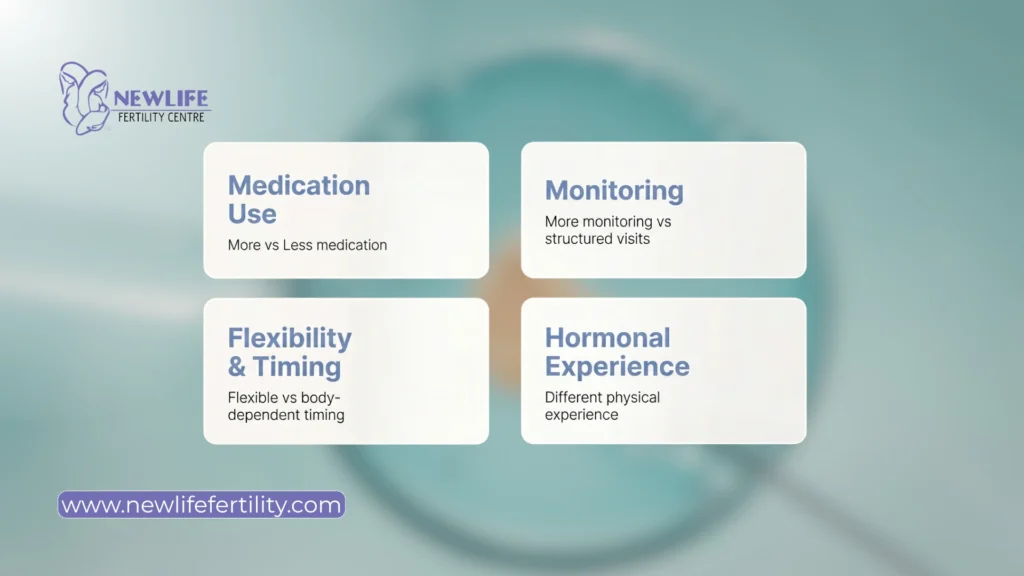
Medication use
Medicated FET involves more medication, usually estrogen for several weeks followed by progesterone support.
Natural FET uses fewer medications, although a trigger shot or progesterone support may still be included.
Monitoring
Natural FET often requires more frequent monitoring visits in the early part of your cycle because your body is leading the process.
Flexibility and scheduling
Medicated cycles offer more control over timing. Natural cycles depend on when your body ovulates, which cannot always be predicted exactly.
Hormonal experience
Some women feel physically or emotionally better in a natural cycle since there is less medication involved. Others may not notice a major difference.
Personal opinion:
One thing is important to say clearly. Neither protocol is universally better.
Both natural and medicated FET cycles have strong success rates. Your doctor recommends one based on your cycle regularity, medical history, and what gives you the best chance of success.
Because the goal is not to choose the most natural option. The goal is to choose the right option for your body.
Who is a good candidate for natural cycle FET?

Natural cycle FET works best when your body can be relied upon to do what it needs to do. That means the ideal candidate is someone with a regular, predictable menstrual cycle, typically between 26 and 35 days, where ovulation happens consistently and can be tracked with reasonable accuracy.
Women who ovulate regularly, have predictable LH surges, and have no significant hormonal irregularities tend to be well suited for a natural protocol. If you have tracked your cycles before, whether for fertility awareness or just curiosity, and noticed that your periods come consistently, that is a good sign.
Who may not be an ideal candidate?

Women with irregular cycles, anovulatory cycles where ovulation does not reliably occur, or conditions like PCOS that make ovulation unpredictable may find that natural cycles are harder to monitor and time accurately.
Women who have had failed natural cycles previously, or whose clinic has found that their lining responds better to medicated support, may also be guided toward a medicated protocol instead.
It is also worth noting that the decision is not based on ovulation regularity alone. Your doctor will consider your previous transfer history, your hormone levels, how your lining responded in past cycles, and sometimes the type and quality of embryos being transferred.
This is a conversation, not a checklist. Your doctor is the right person to make that decision with you.
Natural frozen embryo transfer timeline (step-by-step)
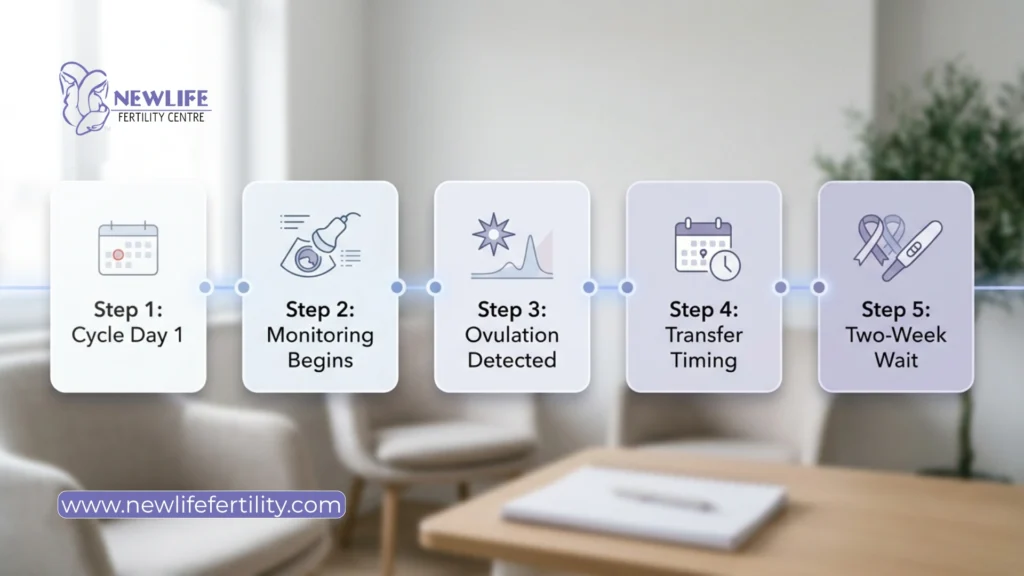
This is one of the most practically useful sections for anyone actively planning a natural FET. Let’s walk through exactly how the cycle unfolds.
Step 1: Cycle day 1 (your period arrives)
The cycle begins when your period starts. This is Day 1.
You will usually notify your clinic on this day or the following morning. They will schedule your baseline scan, typically around Day 2 or Day 3.
This scan checks your uterine lining and antral follicle count to confirm your body is starting the cycle cleanly, with no leftover cysts or concerns from the previous cycle.
Step 2: Follicle tracking and ovulation monitoring begin
From around Day 8 to 10, depending on your cycle length, your clinic begins monitoring you closely.
This phase involves:
- Regular transvaginal ultrasounds every 2 to 3 days
- Blood tests to track estrogen and LH levels
The goal is to track the growth of your dominant follicle and detect when ovulation is approaching.
Your clinic is usually looking for:
- Follicle size of around 18 to 22 mm
- A rising LH level indicating the surge
This is the most monitoring-intensive phase of a natural FET, so it helps to be flexible with appointments during this time.
Step 3: Ovulation detection
Once your LH surge is detected through blood work or sometimes home ovulation kits, your clinic knows that ovulation is about to happen.
In a fully natural cycle, they use this timing directly to plan your transfer.
In a modified natural cycle, a trigger injection, usually hCG, may be given to control the exact timing of ovulation.
Ovulation typically occurs
- About 36 to 40 hours after a trigger shot
- About 24 to 36 hours after a natural LH surge
Step 4: Timing the embryo transfer
The timing of your embryo transfer is calculated based on ovulation.
If you are transferring a Day 5 blastocyst, the transfer is usually scheduled 5 days after ovulation. This matches how things would happen in a natural conception cycle.
This synchronization between your uterus and the embryo’s developmental stage is the key reason your cycle is tracked so closely.
Once ovulation is confirmed, your clinic will finalize your transfer date. Being flexible during this window can help reduce stress.
Step 5: The post-transfer phase (two-week wait)
After the transfer, you enter the two-week wait.
Depending on your clinic’s protocol, you may or may not be given progesterone support during this phase. Some clinics add it as a precaution, while others rely on your body’s natural progesterone production if ovulation has occurred properly.
Your clinic will guide you on this based on your specific case.
The beta hCG pregnancy test is usually done around 10 to 14 days after the transfer.
Modified natural cycle FET: What’s different?
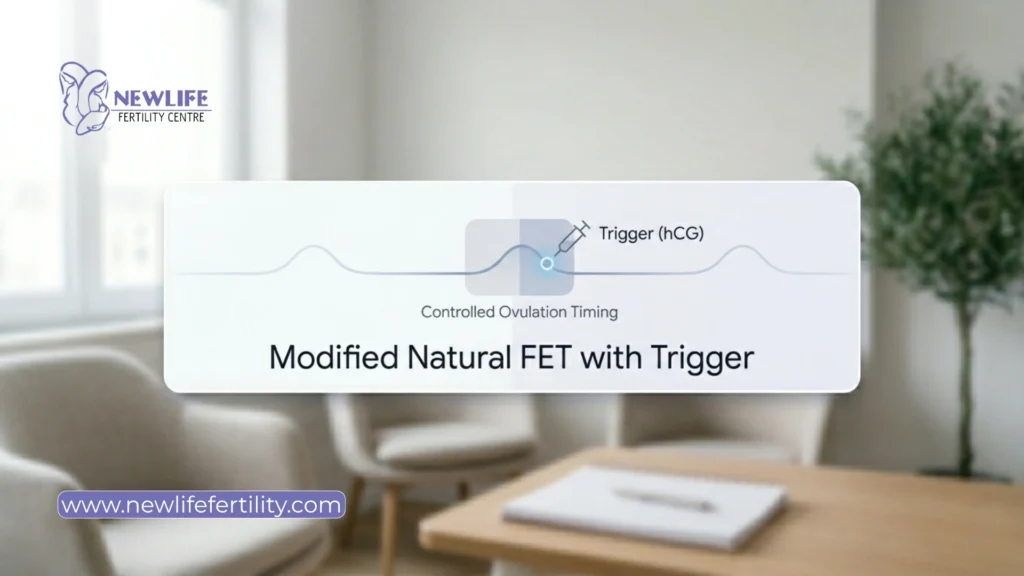
You may have heard the term “modified natural cycle” and wondered how it differs from a standard natural FET. The distinction is worth understanding, because many clinics use this protocol more often than a fully natural one.
In a modified natural cycle FET, the basic structure is the same. You ovulate naturally, your own hormones prepare your uterine lining, and transfer timing is based on your actual ovulation.
The key difference is the addition of a trigger shot, usually hCG, given once your dominant follicle reaches the target size.
Think of it this way. Natural, but with a little more precision.
The trigger shot does not replace your natural ovulation. It simply ensures that ovulation happens at a predictable and confirmed time. This gives the clinic more confidence in scheduling your transfer and reduces the risk of missing ovulation if your LH surge is brief or harder to detect.
Some modified natural protocols also include progesterone support after transfer, even if your corpus luteum is expected to function normally.
For most patients, a modified natural cycle feels very similar to a fully natural one. The experience is largely the same, but the clinic has slightly more control over timing without significantly changing your hormonal environment.
Natural FET protocol: Do you still need medications?

This is one of the most common points of confusion, so it helps to be direct. “Natural” does not automatically mean zero medication.
What “natural” means here is that your ovulation, the hormonal process that prepares your uterus, comes from your own body rather than from externally given estrogen.
That said, depending on your specific protocol, you may still be prescribed some medications.
Common medications used in natural FET
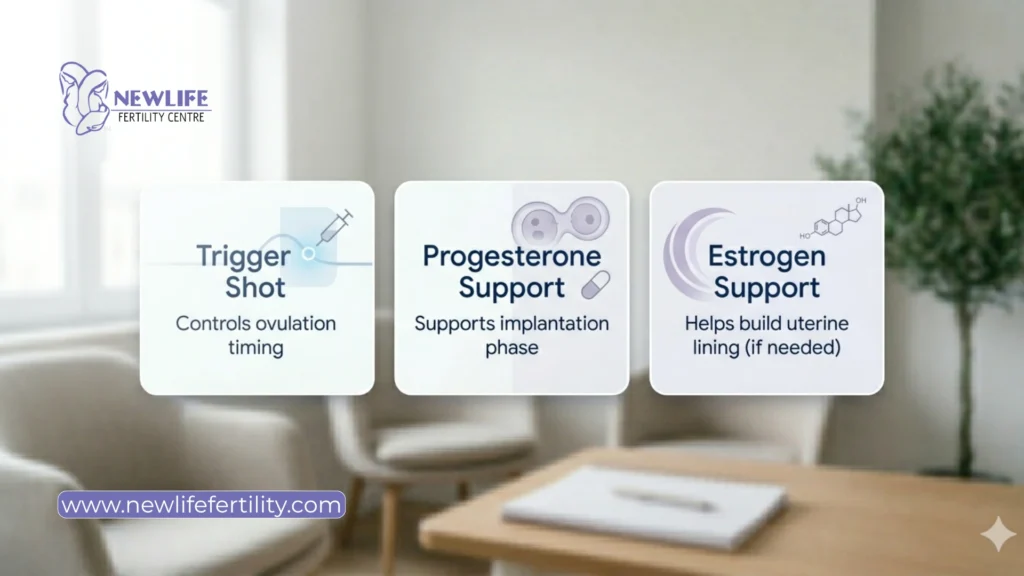
Trigger shot
A trigger injection, such as hCG or a GnRH agonist, may be used to control the exact timing of ovulation. This is especially common in modified natural cycles.
Progesterone support
Many clinics add progesterone after transfer during the luteal phase. This is often done as a precaution, particularly if there is any concern about corpus luteum function.
Occasional estrogen support
In some cases, a low dose of estrogen may be added during the follicular phase if monitoring shows that the uterine lining needs additional support.
The overall medication load is still much lower than in a fully medicated FET, and many women find the experience physically and emotionally lighter.
The key idea to remember is this. “Natural” describes where the hormonal drive is coming from, your body. It does not guarantee that no medication will be used at all.
Your clinic will provide your exact protocol in writing before your cycle begins. If anything feels unclear, it is always worth asking your care team to walk you through what you will be taking and when.
Natural cycle FET success rates: Is it better?
This is the question most patients are really asking when they explore natural FET, and the answer is more nuanced than a simple yes or no.
Research comparing natural and medicated FET cycles has generally shown that success rates are similar between the two approaches, especially for women who are good candidates for a natural cycle.
Several large studies and reviews have found no meaningful difference in live birth rates between natural and medicated FET in women who ovulate regularly.
Some research suggests there may be a slight advantage for natural cycles in certain patients, possibly because the uterine environment is more physiologically aligned with the body’s natural processes. However, these findings are not consistent enough to draw a firm conclusion.
The more important point is this. Success rates depend heavily on the individual.
A natural cycle can work very well for someone with regular ovulation and stable hormone patterns. The same approach may not work as well for someone with irregular cycles or hormonal imbalances.
Your doctor is not choosing a protocol based on trends or preferences. They are choosing based on what is most likely to work for your specific body, medical history, and embryo quality.
That individualized approach will always be more reliable than general statistics.
Can you get pregnant naturally before a frozen embryo transfer?

Yes, this is biologically possible, and it is a question more patients have than clinics often expect.
In a natural FET cycle, you are ovulating. If you have unprotected intercourse during the monitoring phase, there is a real possibility of natural conception.
Most clinics advise abstinence or barrier contraception during this window. This is done both to avoid an unintended pregnancy and because a natural conception during a monitored FET cycle can create clinical complications.
This is not something to feel embarrassed about asking. It is a practical question with a clear answer.
Follow your clinic’s guidance on intercourse timing during your cycle. If anything feels unclear, ask your nurse coordinator directly. They have heard this question many times, and getting clarity here is important.
Symptoms after a natural frozen embryo transfer

The two-week wait after a natural FET comes with its own set of physical sensations and a lot of overthinking about what those sensations might mean. Let’s talk about what is commonly experienced and what it actually tells you.
Mild uterine cramping in the days after transfer is common and usually reflects normal uterine activity after the procedure. Vaginal discharge is also common, especially if you are using progesterone pessaries. The consistency and color can vary depending on the type of progesterone used.
Breast tenderness, bloating, and fatigue are also frequently reported during this phase, whether or not the transfer has been successful.
Here is the honest truth that every patient deserves to hear clearly. Symptoms during the two-week wait are not reliable indicators of success or failure.
The hormonal environment during this phase, especially with added progesterone, can create sensations that feel very similar to early pregnancy symptoms. Some women experience many symptoms and still have a negative result. Others experience almost none and still have a positive outcome.
It is completely natural to notice and track every change in your body, but this usually does not provide clear answers.
If you experience heavy bleeding, severe one-sided pain, or anything that feels distinctly wrong rather than just uncomfortable, contact your clinic.
Otherwise, the most helpful thing you can do during this time is rest, stay gently occupied, and wait for your beta hCG result. That will give you the clarity you are looking for.
Preparing for a natural cycle frozen embryo transfer

Preparation for a natural FET is less about following a strict medication schedule and more about understanding your cycle and staying available for monitoring.
The most important practical step is knowing where you are in your cycle. If you are not already tracking your period, this is a good time to start. Pay attention to your cycle length, the approximate day of ovulation if you can track it, and any irregular patterns. This helps your clinic anticipate your monitoring window more accurately.
Flexibility in your schedule, especially around Days 8 to 14 of your cycle, is important. Monitoring in a natural FET can require appointments on short notice as ovulation approaches.
If your work or travel schedule is tight during this time, speak to your clinic in advance. They may be able to plan around it or advise if adjustments are needed.
On the lifestyle side, the guidance is simple and practical. Eat balanced meals, get enough sleep, reduce alcohol intake, and manage stress where you can. These factors do not control the outcome on their own, but they support the hormonal environment your body is creating.
If you have had irregular cycles recently, whether due to stress, travel, illness, or a previous treatment cycle, let your doctor know before starting. They may want to monitor an additional cycle first or adjust your approach accordingly.
Is a natural frozen embryo transfer the right choice for you?
There is something reassuring about the idea of working with your body rather than overriding it. And for many women, a natural frozen embryo transfer is genuinely the right approach. But the right choice is always the one that fits your body, your history, and your specific clinical situation.
Natural and medicated FET cycles are both effective and well researched. Neither is universally better. What makes one approach more suitable than the other is how well it aligns with your cycle, your hormone patterns, and your previous experiences with treatment.
If your cycles are regular and ovulation is predictable, a natural frozen embryo transfer may be a strong option. If your doctor has suggested it, it usually means they believe your body can support the process well. If you are still deciding, the goal is not to pick the most natural or the most controlled approach. The goal is to choose the one that gives your embryo the best possible environment to implant and grow.
If you are still unsure, that is completely normal. These decisions are nuanced, and they deserve more than guesswork.
NewLife Fertility Centre provides guidance and personalised care for frozen embryo transfer to support your next fertility step.
At NewLife Fertility, we take the time to understand your cycle history, previous treatments, and overall health before recommending a path forward. Sometimes, a single conversation can bring the clarity you have been looking for.
👉 Book your free consultation with NewLife Fertility and let’s walk through your options together, so your next step feels clear, confident, and right for you.
Frequently asked questions about natural frozen embryo transfer
It is a frozen embryo transfer protocol where your body’s own ovulation prepares the uterus, instead of relying on external hormones. Your clinic monitors your natural cycle and times the transfer based on your actual ovulation.
It depends on your clinic’s protocol. Some clinics add vaginal progesterone support in the luteal phase as a precaution, while others rely on the progesterone your body produces naturally after ovulation. Your plan will be explained before your cycle begins.
Both natural and medicated FET protocols are well established and considered safe. Natural cycles involve less medication, which some patients prefer, but there is no major safety difference between the two approaches.
A modified natural cycle includes a trigger shot, usually hCG, to ensure ovulation happens at a predictable time. It follows your natural hormonal process but adds more control over timing.
Ovulation is tracked using transvaginal ultrasounds to monitor follicle growth and blood tests to measure hormone levels like estrogen and LH. Some clinics may also use home ovulation tests to detect the LH surge.
Not for everyone. Success rates are similar in women who ovulate regularly. The right choice depends on your cycle, medical history, and what your doctor believes will give you the best chance of success.
If ovulation happens earlier than expected or the LH surge is missed, the cycle may need to be cancelled and restarted. This is why close monitoring is important in natural cycles.
Irregular cycles can make ovulation timing unpredictable, which makes natural FET more difficult to manage. Your doctor will review your cycle history and may recommend a medicated approach if needed.