You just got through egg retrieval.
That was not easy. And you know it.
Now you’re sitting there wondering,
“So… when does the transfer actually happen?”
Maybe your doctor gave you a rough idea.
Maybe they didn’t.
Either way, the waiting feels longer than expected. A little confusing. And honestly… a little scary.
“Is this delay normal?”
“Am I already behind?”
“Why can’t they just do the transfer now?”
If these thoughts have been looping in your head, you’re not alone. Almost everyone going through IVF reaches this exact phase and feels the same way.
Here’s the truth most people don’t tell you upfront:
There’s usually a gap between egg retrieval and frozen embryo transfer, and it’s there for a reason.
And once you understand that timeline, things start to feel a lot more in control.
In this guide, I’ll walk you through:
- how long the wait usually is
- what happens during that time
- and why this “waiting phase” actually matters
All in simple, clear language. No overwhelm.
Let’s go.
How long after egg retrieval is frozen embryo transfer?
Let me give you the quick answer first.
Typically, frozen embryo transfer happens about 2 to 6 weeks after egg retrieval.
But here’s the thing. That window can stretch a bit longer. Sometimes up to 8 weeks or more, depending on your body, your cycle, and your clinic’s approach.
“Wait, that long?!”
Yes. And it’s completely okay.
Your timeline might not match your friend’s.
Or something you read in a late-night Google search.
And that’s fine.
Everybody responds differently.
Every IVF journey moves at its own pace.
What matters most is not how fast things happen, but whether your body is truly ready for transfer.
Timeline from egg retrieval to frozen embryo transfer (step by step)
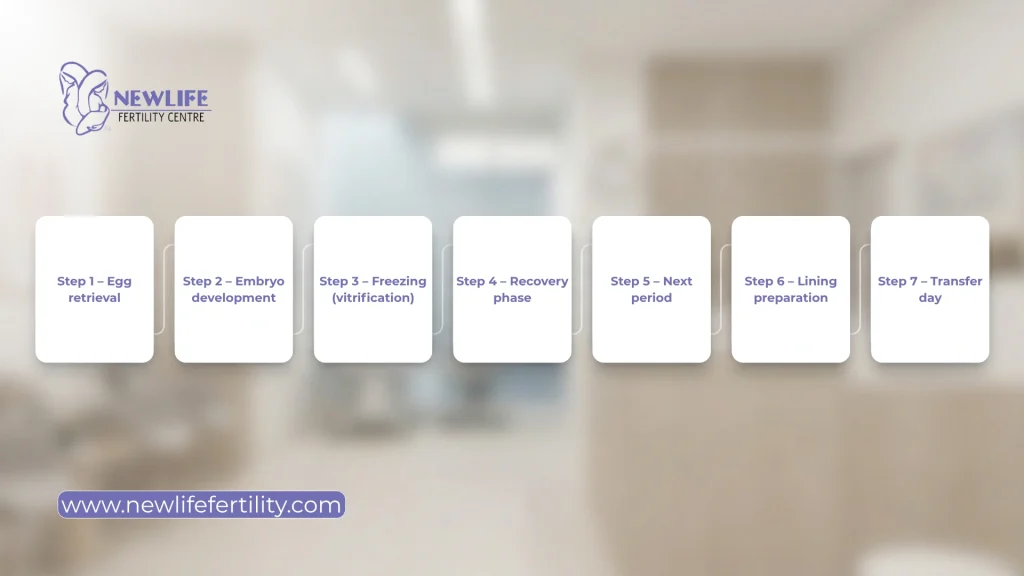
Here’s what actually happens between egg retrieval day and your transfer day.
Step 1: Egg retrieval day (day 0)
This is where your journey starts.
Your eggs are collected under sedation. The procedure usually takes about 20 to 30 minutes.
Once the eggs are retrieved, they go straight to the embryology lab. Fertilization begins, either through conventional IVF or ICSI.
Your only job on this day?
Rest. Recover. Take it slow.
Step 2: Embryo development (day 3 to day 5 or 6)
Now the real magic happens, just not where you can see it.
Your embryos are growing. Dividing. Developing.
By day 5 or 6, the strongest ones reach the blastocyst stage. This is the stage most clinics prefer for freezing because it has a higher chance of implantation later.
Not every embryo will make it here.
And yes, that can feel hard.
But the ones that do are the ones with the best potential moving forward.
Step 3: Embryo freezing (same cycle)
The best-quality blastocysts are now frozen using a method called vitrification.
It’s a rapid freezing process that helps preserve embryo quality very effectively.
This is why it’s called a frozen embryo transfer. The embryos are not transferred right away. They are safely stored until your body is ready.
Today, many clinics follow a “freeze-all” approach.
Because transferring in the same cycle doesn’t always give the best results.
Step 4: Your body recovery phase (1 to 2 weeks)
This part is often underestimated.
After egg retrieval, your hormone levels are unusually high. Your ovaries have worked hard, and your body needs time to settle.
Your uterus also needs time to return to a more natural, balanced state. Jumping into a transfer too soon can actually reduce your chances.
This is also when the risk of Ovarian Hyperstimulation Syndrome is highest.
Some women feel mild bloating or discomfort.
Others may feel more intense symptoms.
Either way, this recovery phase is not a delay.
It’s preparation.
Step 5: Waiting for your next period (around 10 to 14 days)
Once your body begins to stabilize, your next menstrual cycle starts.
And this is a key moment.
Your period marks the beginning of your frozen embryo transfer cycle. It’s not a step back. It’s actually your body getting ready for the next phase.
You might even feel a sense of relief here.
Like things are finally moving again.
Step 6: Uterine lining preparation (2 to 3 weeks)
This is often the longest part of the process.
Your doctor will prescribe estrogen to help thicken your uterine lining. A healthy lining is essential for implantation.
You’ll have a few scans to monitor progress. Once your lining reaches the right thickness, usually around 7 to 8 mm or more, progesterone is added.
Progesterone helps prepare the uterus to receive the embryo.
This entire phase typically takes around 2 to 3 weeks.
Step 7: Frozen embryo transfer day
And now, the day you’ve been waiting for.
The procedure itself is quick. Usually 10 to 15 minutes.
No general anesthesia in most cases. Some clinics may give a mild sedative, but many women say it feels similar to a routine exam. Slightly uncomfortable, but not painful.
The embryo is gently placed into your uterus using a thin catheter, guided by ultrasound.
And just like that, it’s done.
Now begins the two-week wait.
But that’s a story for another day.
Why is frozen embryo transfer not done immediately after egg retrieval?

This is the question almost everyone asks.
And honestly, it makes complete sense.
After everything you’ve already been through, you just want things to move faster.
But here’s the truth.
Doing the transfer immediately is often not the best idea.
After egg retrieval, your body is in a highly stimulated hormonal state.
Estrogen and progesterone levels are much higher than normal.
And this can actually make your uterine lining less receptive to an embryo.
In simple terms?
Your uterus might not be ready yet.
It’s not about delay. It’s about timing.
When you wait, your body gets the chance to:
- reset hormonally
- return to a more natural balance
- prepare the uterine lining properly
And that preparation can make a real difference.
Research and clinical experience have shown that frozen embryo transfers often have equal or even better success rates compared to fresh transfers, especially when the uterus is fully ready.
So that waiting period you’re in right now?
It’s not wasted time.
It’s your body getting ready for the best possible chance.
What affects the time between egg retrieval and FET?

Everyone’s timeline looks a little different. And there are good reasons for that.
Here’s what can influence how long you wait:
- Your menstrual cycle timing: Your FET cycle usually begins with your next period. That’s what sets the timeline in motion.
- Risk of Ovarian Hyperstimulation Syndrome: If there are symptoms or a higher risk, your doctor may delay the transfer to keep things safe.
- Hormonal balance: Estrogen and progesterone levels need to settle down after stimulation before moving ahead.
- Uterine lining readiness: The lining needs to reach the right thickness and structure for implantation to happen.
- Genetic testing (PGT): If your embryos are being tested, results can take around 1 to 3 weeks.
- Clinic protocol: Different clinics follow slightly different approaches and timelines.
- Your doctor’s recommendation: Based on your medical history, your doctor may adjust the plan to give you the best chance.
None of these are bad signs.
They’re all part of making sure everything is truly ready before your transfer happens.
Shortest vs longest timeline: What’s normal?
Let’s be direct here.
Fastest timeline
About 2 to 3 weeks after retrieval.
Rare, but possible in very straightforward cases.
Average timeline
Around 4 to 6 weeks.
This is what most women experience.
Longer timeline
6 to 10 weeks or more.
This usually happens when genetic testing (PGT) is involved, when your body needs extra recovery time, or when cycle timing doesn’t line up right away.
And here’s the important part.
All of these timelines are completely normal.
You might catch yourself thinking,
“But my friend had her transfer in 3 weeks… and mine is taking 8.”
That doesn’t mean something is wrong with you.
It just means your journey has different steps.
And that’s okay.
Does waiting longer reduce your chances?

Short answer: No. Not necessarily.
In fact, in many cases, the opposite is true.
When your body has had enough time to recover and your uterine lining is properly prepared, your chances of implantation can actually improve.
A rushed transfer, especially when your body is still hormonally imbalanced or your lining isn’t ideal, can work against you.
So if your doctor is taking a slower, more measured approach, it’s not a delay for no reason.
It’s a strategy.
They’re giving your body the time it needs to be in the best possible condition for a successful transfer.
And that can make all the difference.
What should you do during the waiting period?

This part matters more than you think.
The waiting phase can feel slow, heavy, and full of overthinking.
But how you take care of yourself here really does make a difference.
Here’s how to make it a little easier on yourself:
- Focus on recovery: Your body has just been through a lot. Give it time to rest and heal.
- Eat nourishing meals: Nothing extreme. Just simple, balanced, home-style food that makes you feel good.
- Stay lightly active: Gentle walks, stretching, light movement. Skip intense workouts for now.
- Limit the late-night Googling: You know how that goes. One search turns into ten, and suddenly everything feels worse. Try to step away.
- Talk to someone you trust: A partner, a close friend, or even a counsellor. You don’t have to carry this alone.
- Stay in touch with your clinic: If something feels off or confusing, reach out. That’s what they’re there for.
You’ve already done one of the hardest parts.
Now, this phase is about allowing your body and the process to do their job.
When should you talk to your doctor?

Don’t wait it out if something feels off. It’s always okay to check in.
Please reach out to your clinic if:
- Your delay feels much longer than expected: Especially if it doesn’t match what your doctor initially discussed.
- You’re experiencing unusual pain or bloating after retrieval: Mild discomfort is common, but anything intense or worsening should be checked.
- Your period hasn’t arrived within the expected window: This can affect when your FET cycle starts.
- You’re confused about your medication schedule: It’s important to be clear on timing and dosage.
- Something just doesn’t feel right: Trust that instinct. You know your body best.
Your fertility team is there to support you.
There’s no such thing as a “small” question here.
No concern is silly.
If you’re unsure, ask.
Always ask.
What does your frozen embryo transfer timeline after egg retrieval really mean for you?

Here’s what I want you to take away from all of this.
The time between egg retrieval and your frozen embryo transfer is not wasted. It’s not a delay. And it’s definitely not a sign that something is going wrong.
It’s your body being given the space to heal, reset, and prepare for what comes next.
Every step you’ve gone through so far, the recovery, the wait for your period, and the lining preparation, is happening for a reason. And that reason is simple. To give your embryo the best possible chance.
You are not behind.
You are not doing anything wrong.
You are simply on your own timeline.
And that timeline is valid.
Frozen embryo transfer after egg retrieval is guided with expert care at NewLife Fertility Centre
If you still feel unsure about where you stand or what your next step should be, having the right guidance can make a big difference. The team at NewLife Fertility is here to support you with clear answers, personalized care, and a plan that actually fits your body and your journey.
If you’re ready to move forward with clarity and confidence, you can book your free consultation and talk to a fertility expert who understands exactly what you’re going through.
Frequently asked questions about frozen embryo transfer after egg retrieval
Most women have their frozen embryo transfer between 14 to 42 days after egg retrieval. This range depends on how quickly your body recovers, when your next period starts, and how your uterine lining responds to preparation. Some cycles move faster, while others take a bit more time to ensure everything is properly aligned for implantation.
The typical gap between egg retrieval and frozen embryo transfer is around 4 to 6 weeks. However, if additional steps like genetic testing (PGT) are involved, this timeline can extend to 8 to 10 weeks or more. Both shorter and longer timelines are considered normal and are usually planned based on your specific medical situation.
In most cases, frozen embryo transfer is not done immediately after egg retrieval. Your body needs time to recover from hormonal stimulation, and your uterus needs to return to a more natural state. Proper lining preparation is essential for implantation, which is why doctors usually wait before proceeding with a frozen transfer cycle.
On average, frozen embryo transfer is done around 4 to 6 weeks after egg retrieval. In simpler cases, it may happen sooner, around 2 to 3 weeks. In other situations, especially when recovery takes longer or additional testing is involved, the process may extend beyond 8 weeks. All of these timelines can be completely normal.
A longer gap is not always better, but adequate preparation time is important. The goal is to ensure your uterine lining is in the best condition for implantation. Taking the right amount of time can improve outcomes, while rushing the process may reduce success rates. It is always about readiness, not speed.