It’s 6 AM.
You haven’t even opened your eyes yet.
But your brain is already scanning your body like a full-body MRI machine.
“Was that a cramp just now?”
“My breasts feel sore. Is that progesterone? Or is it…?”
“Wait. Yesterday I had symptoms. Today I feel nothing. Is that bad?”
“What does nothing mean?”
Sound familiar?
If you’ve recently had a frozen embryo transfer and you’re reading this right now, there’s a good chance you’re in the middle of the two-week wait.
And honestly? You’re probably exhausted.
Not just physically.
You may feel emotionally drained from scrutinizing every minute feeling in your body every hour of every day.
You are not alone in this.
Almost every woman after a frozen embryo transfer goes through this exact symptom-checking spiral.
It’s human. It’s understandable. And after everything you’ve gone through to get to this stage, it makes complete sense.
But here’s the thing most people do not explain clearly enough.
Symptoms after FET are incredibly confusing because progesterone, the medication most women take after transfer, can mimic pregnancy symptoms almost perfectly.
So it becomes very hard to tell:
- what might be implantation
- what is medication
- and what is anxiety doing what anxiety does best
That’s exactly why this guide exists.
By the time you finish reading, you’ll understand:
→ What symptoms are common day by day after frozen embryo transfer.
→ What is considered normal and what may need attention.
→ Why having no symptoms is not automatically bad news.
→ Which symptoms are commonly caused by progesterone.
→ And when it’s time to stop symptom-spiraling and focus on what actually matters.
Let’s walk through this together. Day by day.
What causes symptoms after frozen embryo transfer?

Before we go day by day, this is something really important to understand.
After your frozen embryo transfer, symptoms can come from several different sources. And understanding where they may be coming from can save you a lot of unnecessary panic.
Progesterone supplementation is the biggest one.
Progesterone can cause:
- bloating
- fatigue
- breast tenderness
- cramping
- mood swings
- emotional sensitivity
And because most women take progesterone after FET, many of the symptoms you feel during the two-week wait may simply be the medication doing exactly what it is supposed to do.
Estrogen medications can also contribute to symptoms like bloating, headaches, and mood changes.
The transfer procedure itself may cause mild pelvic discomfort or cramping during the first few days after transfer.
Implantation, when it happens, may sometimes cause:
- light spotting
- mild cramping
- small twinges or pulling sensations
And then there’s the one people often underestimate:
Stress and anxiety.
The two-week wait is genuinely emotionally intense.
And stress absolutely shows up physically in the body through:
- headaches
- tightness
- fatigue
- digestive changes
- poor sleep
- increased body awareness
Here’s the most important thing to take away from this section:
👉 Symptoms alone cannot confirm or rule out pregnancy.
Read that again.
No single symptom, not even the “classic” implantation symptoms you read about online, can reliably tell you whether your transfer worked.
Only your beta hCG blood test can do that.
Keeping this in mind while reading the day-by-day symptom breakdown below can genuinely protect you from a lot of unnecessary emotional spiraling.
Frozen embryo transfer symptoms day by day
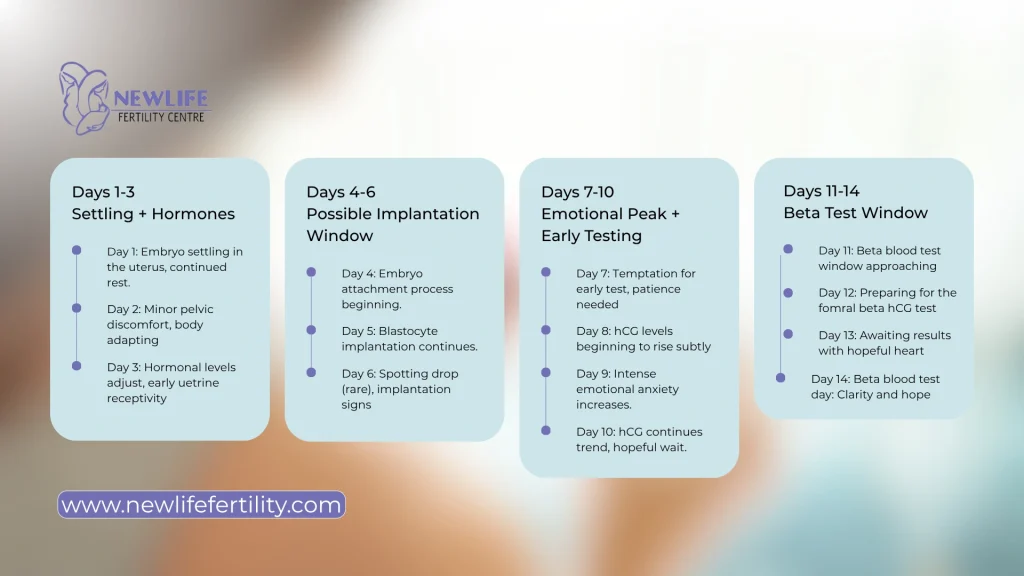
Day 1 after frozen embryo transfer
Your embryo has just been transferred.
Your body is adjusting. Your uterus has been through a procedure. You are on hormones.
What you might feel
Mild cramping or pelvic pressure is very common on day 1. Some women feel bloated. Some feel absolutely nothing. Many feel tired from the procedure, the medications, the nerves, and the emotional build-up of the entire process.
What’s happening inside?
Not much yet in terms of implantation.
Your embryo is still floating and settling inside the uterus. Implantation has most likely not happened yet.
So most symptoms you feel right now are usually related to:
- the transfer procedure itself
- progesterone support
- or emotional and physical stress
The takeaway
Rest. Hydrate. Be gentle with yourself.
And try not to read too much into day 1 sensations.
Day 2 after frozen embryo transfer
The day after transfer often feels emotionally strange because you are waiting for something to happen but cannot see or control any of it.
What you might feel
Pelvic heaviness or pressure may continue. Some women notice bloating, mild discharge, or fatigue.
And many women feel absolutely nothing at all.
What’s happening inside?
Your embryo is still settling into the uterine environment.
No symptoms on day 2 does not mean anything has gone wrong.
The takeaway
Feeling nothing on day 2 is completely normal.
Your body is not required to “prove” implantation through symptoms this early.
Day 3 after frozen embryo transfer
By day 3, progesterone is usually well established in your system.
What you might feel
Cramping is common and often progesterone-related at this stage. Fatigue may increase. Some women begin noticing breast tenderness or bloating becoming more obvious.
What’s happening inside?
These symptoms are still usually explained by hormones rather than implantation itself.
Progesterone can mimic early pregnancy symptoms extremely well.
The takeaway
Day 3 symptoms are most often medication-driven, not reliable implantation signals.
Day 4 after frozen embryo transfer
This is where things start feeling emotionally more intense for many people.
What’s happening inside?
For some embryos, the implantation window may begin opening around day 4.
But “possible implantation timing” does not mean implantation has definitely happened.
What you might feel
Light cramps. Small pelvic twinges. Pressure low in the abdomen. Emotional sensitivity and anxiety are also very common around this stage.
Important reality check
Please do not treat day 4 cramps as proof of implantation.
They may be implantation-related.
They may also be completely caused by progesterone.
There is honestly no reliable way to tell the difference based on symptoms alone.
The takeaway
Day 4 may overlap with early implantation for some women, but symptoms are still not diagnostic.
Day 5 after frozen embryo transfer
Welcome to one of the most Googled days in the entire IVF process.
If you searched:
- “5dp5dt symptoms”
- “day 5 after FET cramping”
- “5 days after frozen embryo transfer symptoms”
you are very far from alone.
What you might feel
Mild cramping. Pelvic twinges. Fatigue. Bloating. Breast soreness. Occasionally light spotting.
Or absolutely nothing.
Both experiences are completely normal.
A lot of women panic here because they compare symptoms online:
“She had cramps and got a positive!”
“I have no symptoms. Did mine fail?”
Here’s the honest truth:
Symptom intensity on day 5 does not reliably predict your result.
Some women with no symptoms get strong positive beta tests.
Some women with every symptom imaginable still get negative results.
The takeaway
Day 5 is emotionally intense, but symptoms and lack of symptoms are both normal at this stage.
Day 6 after frozen embryo transfer
By day 6, some symptoms start feeling more emotionally loaded.
What you might feel
Light spotting. Brown discharge. Increased fatigue. Sore breasts. Mild cramps.
About spotting and brown discharge
This is one of the most searched day-6 concerns after FET.
Light pink or brown spotting around this stage can happen for several reasons:
- progesterone irritation
- cervical sensitivity
- or possible implantation-related bleeding
The important word here is light.
Light spotting or brown discharge is usually not considered alarming.
But heavy bleeding, bright red bleeding, or bleeding that increases significantly should always be discussed with your clinic.
The takeaway
Light spotting at day 6 can be completely normal and does not automatically confirm or rule out implantation.
Day 7 after frozen embryo transfer
One week after transfer.
This is often where the emotional weight of the two-week wait really starts building.
What you might feel
Stronger progesterone symptoms like:
- cramps
- bloating
- fatigue
- mood swings
- breast tenderness
Some women notice symptoms increasing.
Others notice symptoms fading.
Both can happen in successful cycles.
Should you test on day 7?
That is a personal decision.
But it’s important to know that a negative test at day 7 does not mean your transfer failed.
hCG levels may simply still be too low to detect.
Many successful pregnancies do not show positive home tests until day 9 or later.
The takeaway
Day 7 symptoms are still heavily influenced by progesterone, and home testing this early can be emotionally misleading.
Day 8 after frozen embryo transfer
This is a very high-anxiety day for many IVF patients.
A lot of women suddenly notice symptoms becoming quieter or disappearing entirely.
And panic often follows immediately.
“My symptoms disappeared. Does that mean it failed?”
Please hear this clearly:
Many successful pregnancies involve very few symptoms at day 8.
Some involve no symptoms at all.
What you might feel
You may notice:
- fatigue
- breast tenderness
- bloating
- or absolutely nothing remarkable
The takeaway
“No symptoms at day 8 after frozen embryo transfer” is one of the most searched IVF concerns online.
And it is incredibly common.
Day 9 after frozen embryo transfer
By day 9, hCG may be rising if implantation was successful.
What you might feel
Some women begin noticing:
- increased fatigue
- spotting
- cramps
- more discharge
- or a vague feeling that something feels different
Others still feel nothing noticeable.
What’s important to remember
Symptoms still cannot confirm pregnancy at this stage.
Even at day 9, symptom patterns vary enormously between successful pregnancies.
The takeaway
Day 9 is when some early pregnancy symptoms may begin appearing, but symptom timing differs greatly from person to person.
Day 10 after frozen embryo transfer
You are getting closer to more reliable answers now.
What you might feel
Some women report:
- stronger fatigue
- nausea
- breast soreness
- frequent urination
And some still have no symptoms at all.
What about testing?
Home pregnancy tests become more reliable around day 10 after a 5-day blastocyst transfer.
But your clinic’s beta hCG blood test is still far more accurate than a home urine test.
The takeaway
Day 10 symptoms can vary widely, and blood testing remains more reliable than symptom analysis.
Days 11 to 14 after frozen embryo transfer
This is the final stretch of the two-week wait.
And honestly, it is often the hardest part emotionally.
What you might feel
Symptoms may:
- increase
- disappear
- fluctuate
- or stay completely minimal
All of these patterns can happen in pregnancies that go on to become positive.
Progesterone is still heavily influencing how your body feels.
What matters most now
Your beta hCG blood test matters far more than symptoms during this phase.
Symptoms during the two-week wait are not reliable predictors of success or failure.
The blood test is what gives you the real answer.
Is cramping after frozen embryo transfer normal?

Yes. In most cases, mild cramping after frozen embryo transfer is completely normal.
Cramping after FET can happen for several different reasons:
→ Progesterone supplementation
This is one of the most common causes of cramping after transfer.
→ The transfer procedure itself
The uterus can feel slightly irritated or sensitive after the catheter placement during embryo transfer.
→ Possible implantation
Some women do experience light cramping around implantation timing, although there is no way to confirm implantation based on cramps alone.
→ Hormonal changes during the luteal phase
Your uterus is in a hormonally active state right now, which can naturally create sensations like pressure, pulling, or cramping.
When should you contact your clinic?
You should reach out to your fertility team if cramping becomes:
- severe
- steadily worsening
- accompanied by heavy bleeding
- associated with fever
- or paired with severe swelling or significant pain
Those situations deserve medical attention.
But mild, occasional cramping that feels similar to period cramps is extremely common after frozen embryo transfer and is usually not considered alarming.
Is spotting or brown discharge after frozen embryo transfer normal?

Yes. Light spotting and brown discharge after frozen embryo transfer are both very commonly reported during the two-week wait.
And understandably, they can trigger a lot of anxiety.
What can cause spotting after FET?

→ Progesterone suppositories or pessaries
These can irritate the cervix and cause light spotting or brown discharge. This is extremely common and usually not dangerous.
→ Possible implantation bleeding
Some women notice very light pink or brown spotting around implantation timing. It is usually brief and mild.
→ Cervical sensitivity during the luteal phase
Hormonal changes after transfer can make the cervix more sensitive and prone to light spotting.
When should you contact your clinic?
You should call your clinic if you experience:
- heavy bleeding similar to a period
- bleeding that becomes progressively heavier
- bright red bleeding increasing in volume
- severe cramping along with bleeding
Those situations deserve medical guidance.
But light brown spotting that comes and goes is within the normal range for many women after frozen embryo transfer.
No symptoms after frozen embryo transfer: Is that bad?

Let’s answer this as clearly and honestly as possible.
No.
Having no symptoms after frozen embryo transfer is not automatically bad news.
It does not mean implantation failed.
It does not mean your embryo stopped growing.
And it does not predict your final result.
Many women go through the entire two-week wait with very few symptoms, or no symptoms at all, and still go on to have positive beta hCG results and healthy pregnancies.
And the opposite is also true.
Some women experience:
- cramping
- sore breasts
- bloating
- nausea
- spotting
- fatigue
and still receive negative pregnancy tests.
That’s because symptom intensity is not a reliable predictor of implantation success.
Every body responds differently during an FET cycle.
Some women are extremely sensitive to progesterone and hormones. Others barely feel the medications at all.
That difference is physiology, not a sign of success or failure.
So if you feel nothing right now, please try not to panic.
Your body is not required to “perform symptoms” to prove implantation is happening.
Sometimes the loudest thing about a successful cycle is how quiet it feels.
When do pregnancy symptoms start after frozen embryo transfer?

This is one of the most important things to understand clearly during the two-week wait.
Most symptoms you feel before your beta hCG test are usually caused by progesterone, not pregnancy itself.
That’s because true pregnancy symptoms are driven by rising hCG levels.
And hCG takes time to build.
Symptoms like:
- morning sickness
- stronger breast changes
- smell sensitivity
- food aversions
- noticeable nausea
are typically connected to increasing hCG after implantation has already happened.
For women after a 5-day blastocyst frozen embryo transfer, implantation often happens around days 4 to 6 after transfer.
After implantation, hCG begins rising gradually.
But for many women, clear pregnancy symptoms do not become obvious until:
- after a positive beta hCG blood test
- or even several weeks later
That’s why the early two-week wait feels so confusing.
Before your beta test, almost every symptom:
- cramping
- bloating
- fatigue
- sore breasts
- mood swings
can be explained equally well by progesterone support medications.
And honestly, that uncertainty is emotionally exhausting.
But it’s important to remember this:
You do not need to decode every symptom as a sign of success or failure.
Your body is responding to hormones, medications, stress, and healing all at the same time.
And symptoms alone cannot reliably tell you whether the transfer worked.
What symptoms are caused by progesterone after FET?

This may honestly be one of the most helpful things to understand during the entire two-week wait.
Because progesterone is responsible for most of the symptoms women feel after frozen embryo transfer.
And that’s exactly why symptom analysis becomes so confusing.
Progesterone, whether taken as injections, suppositories, or gel, commonly causes:
→ Bloating.
→ Fatigue and sleepiness.
→ Breast tenderness or soreness.
→ Mood swings and emotional sensitivity.
→ Cramping and pelvic pressure.
→ Headaches.
→ Constipation.
→ Increased vaginal discharge.
Now here’s the frustrating part.
These are also the exact symptoms listed in almost every “early pregnancy symptoms” article online.
Which means:
- progesterone symptoms
- and early pregnancy symptoms
can feel almost identical.
That is not because you are “overthinking.”
It is because, physiologically, they genuinely overlap.
So if you’re sitting there trying to figure out:
“Is this progesterone or pregnancy?”
the honest answer is:
There is usually no reliable way to separate them based on symptoms alone during the two-week wait.
And honestly, biology could have been a little less confusing about this.
Symptoms that should NOT be ignored after frozen embryo transfer

While most symptoms during the two-week wait are completely normal and medication-related, some symptoms deserve immediate attention from your clinic.
Please contact your fertility team if you experience:
→ Severe abdominal pain that keeps worsening.
→ Heavy bleeding that is much stronger than light spotting.
→ Fever above 38°C (100.4°F).
→ Shortness of breath.
→ Severe abdominal swelling or rapid bloating.
→ Symptoms of OHSS (ovarian hyperstimulation syndrome), especially if you were already considered high-risk during treatment. These may include:
- severe bloating
- nausea
- vomiting
- breathing difficulty
- rapid weight gain
Most post-transfer symptoms are harmless.
But when something feels severe, unusual, or significantly different from what your clinic prepared you for, it is always better to reach out.
Your clinic would much rather hear from you early than have you wait too long on something important.
When in doubt, call.
Why symptom comparison after FET can become emotionally exhausting

You know the spiral.
You end up reading a Reddit thread at 11 PM.
One person had cramps on day 5 and got a positive result.
Someone else had no symptoms at all and still got a positive.
Another person had every symptom imaginable and got a negative.
And suddenly you are deeper into Google, more anxious than before, and trying to compare your body to complete strangers online.
This is the symptom comparison spiral.
And honestly, it happens to almost everyone during the two-week wait.
The problem is not that you are looking for reassurance or information.
That part is completely human.
The problem is that IVF forums and symptom timelines can create the illusion that there is a predictable pattern you can decode.
But there usually is not.
Your body is not their body.
Your hormones are not their hormones.
Your embryo is not their embryo.
Your timeline is not their timeline.
What happened in someone else’s cycle tells you very little about what is happening in yours.
And that uncertainty is one of the hardest emotional parts of IVF.
The two-week wait is already emotionally exhausting on its own.
Constant symptom comparison often adds more anxiety instead of clarity.
So if you catch yourself spiralling through forums at midnight trying to “solve” your symptoms, please know this:
You are not doing anything wrong.
You are just trying to find certainty during a process that gives very little of it.
And you deserve to move through this waiting period with as much calm and self-compassion as possible.
What should you focus on during the two-week wait?

If symptoms cannot reliably tell you the answer, what are you actually supposed to do with yourself during these two weeks?
A few things genuinely help.
Take your medications consistently
This is one of the few things fully within your control right now. Progesterone and estrogen support play an important role in preparing and maintaining the environment needed for implantation. Try not to miss doses.
Move gently
You do not need strict bed rest after frozen embryo transfer. Gentle walking and light daily movement are generally considered safe. But this is probably not the best time for intense workouts or physically exhausting activity.
Protect your sleep
Fatigue during the two-week wait is real. Rest matters. Sleep is not “doing nothing.” Your body is going through a hormonally intense process right now.
Stay hydrated
Especially if you are taking progesterone suppositories or other hormone support medications. Hydration helps support your body through treatment.
Give your mind somewhere else to go
A TV show. A comfort movie. A book. Work. A small project. Anything that occasionally interrupts the symptom-scanning cycle can help emotionally.
Lean on your support system
Whether it is a partner, friend, family member, therapist, or counsellor, let someone be present with you during this waiting period. IVF can feel isolating, and you do not have to carry all of it silently.
Set limits around IVF forums and symptom comparison
This one is difficult, especially late at night when anxiety peaks. But reading hundreds of other people’s symptom stories usually creates more confusion than comfort.
Most of the time, it increases anxiety instead of reducing it.
And during the two-week wait, protecting your emotional peace matters too.
What frozen embryo transfer symptoms are really telling you and what comes next
Well, during the two-week wait after FET, your symptoms are mostly telling you one thing: your medications are working.
Your progesterone is doing what it’s supposed to do. Your body is in luteal phase support. Your uterine lining is being maintained.
That’s what most of your symptoms reflect.
Implantation, if it happens, may add a few sensations, a twinge, a light spot of blood, a momentary cramp. But these are indistinguishable from progesterone effects.
And no symptom, not even the most textbook “implantation sign”, can confirm or deny that your transfer was successful.
The only thing that can tell you that is your beta hCG blood test.
Everything else, every cramp, every tired moment, every tender breast, every day with no symptoms at all, is your body moving through this process the way your body moves through it.
And that’s okay.
You are doing everything right.
The wait is the hardest part. But it is finite.
Your beta test will give you the answer that your symptoms cannot.
And whatever that result is, you will not be facing it alone.

At NewLife Fertility, we walk with our patients through every part of this journey, not just the medical steps but also the emotional weight of every waiting day in between. Our team understands what it feels like to stare at a calendar and count down hours. We’re here to give you clarity, support, and a care plan that’s built entirely around you.
If you’re considering frozen embryo transfer or you’re already in the process and have questions, we’d love to talk.
Book your free consultation with NewLife Fertility today.
Frequently asked questions about frozen embryo transfer symptoms day by day
Mild cramping, bloating, fatigue, breast tenderness, pelvic pressure, and light discharge are all very commonly reported after frozen embryo transfer. In many cases, these symptoms are caused by progesterone support medications rather than implantation itself. And importantly, having no symptoms at all during the two-week wait is also completely normal.
Not necessarily. Mild cramping after frozen embryo transfer is extremely common and is usually linked to progesterone medications or the transfer procedure itself. While some women do experience cramps around implantation timing, cramping alone cannot confirm implantation or predict whether the transfer was successful.
Yes. Absolutely. Many women experience very few symptoms, or no symptoms at all, during the two-week wait and still go on to receive positive beta hCG results. Symptom intensity varies greatly from person to person and is not a reliable predictor of pregnancy outcome.
True pregnancy symptoms caused by rising hCG levels usually begin after implantation has occurred and hCG has had enough time to build in the body. For many women, noticeable pregnancy symptoms do not become obvious until after a confirmed positive beta hCG blood test. Before that point, most symptoms are usually progesterone-related.
Light brown or pinkish spotting after frozen embryo transfer is commonly reported and is often related to progesterone suppositories irritating the cervix. In some cases, it may also happen around implantation timing. However, heavy bright red bleeding or bleeding that steadily increases should always be reported to your clinic promptly.
Yes. Symptoms during the two-week wait often fluctuate. Some women notice symptoms fading, disappearing completely, or suddenly returning a few days later. This is very common and does not reliably predict success or failure. Many successful pregnancies begin with inconsistent or minimal symptoms during the early post-transfer phase.