Your doctor just said three words that sent you straight to Google.
“Natural or medicated?”
And now you’re staring at a screen full of terms like “HRT cycle,” “non-medicated FET,” “controlled cycle,” “luteal phase support,” and somehow you feel more confused than before you started searching.
You’re not alone. This is one of the most common points of overwhelm for women going through IVF.
Because here’s the thing. Nobody explains the difference in plain English. They give you the clinical version. The one that assumes you went to medical school.
So let’s fix that.
In this guide, I’ll walk you through exactly what natural and medicated frozen embryo transfer actually mean, how each one works in your body, who each one is better for, and how to think about which path might be right for your situation. All these without any jargon.
Let’s get started.
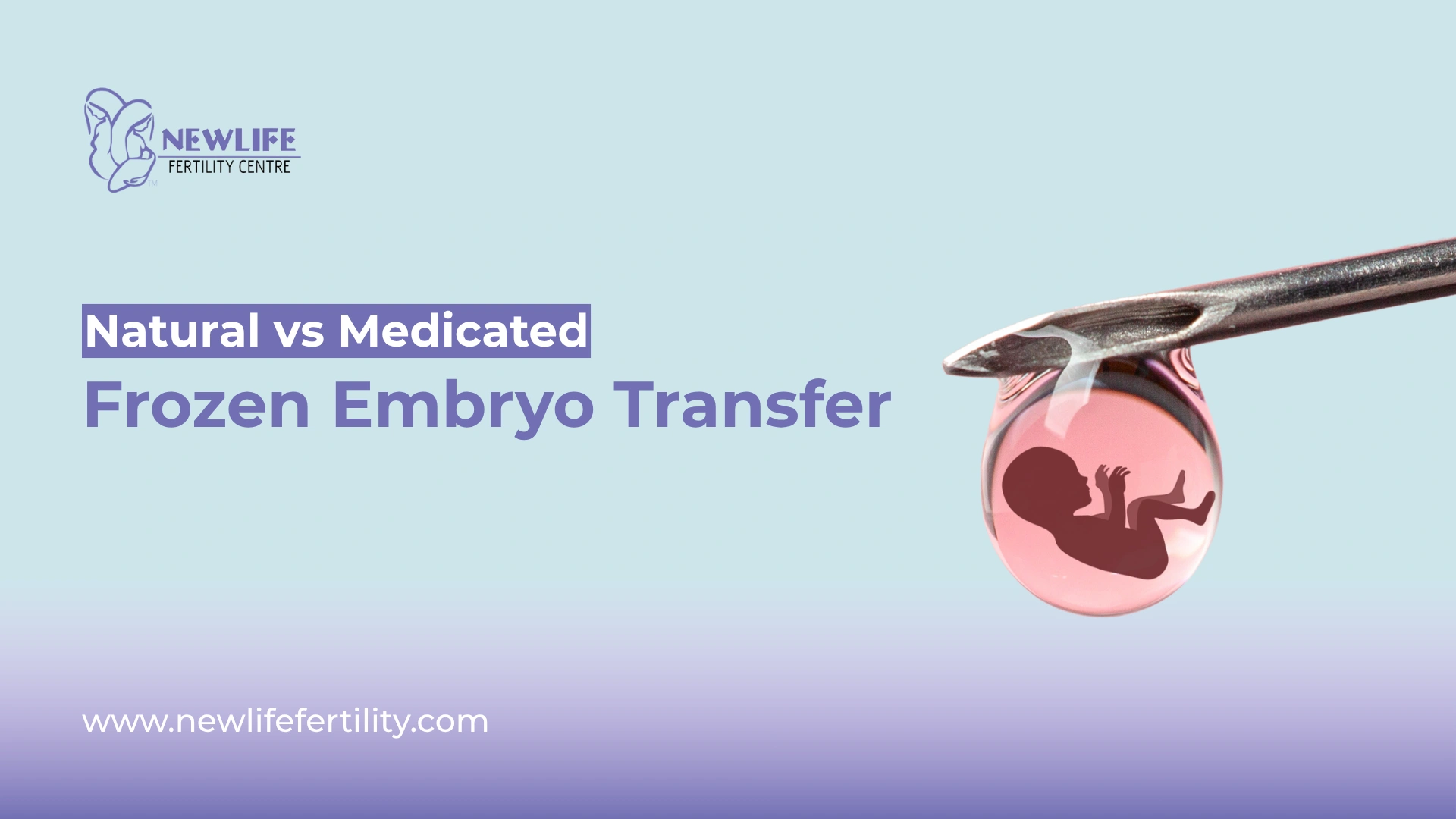
What is a natural frozen embryo transfer cycle?
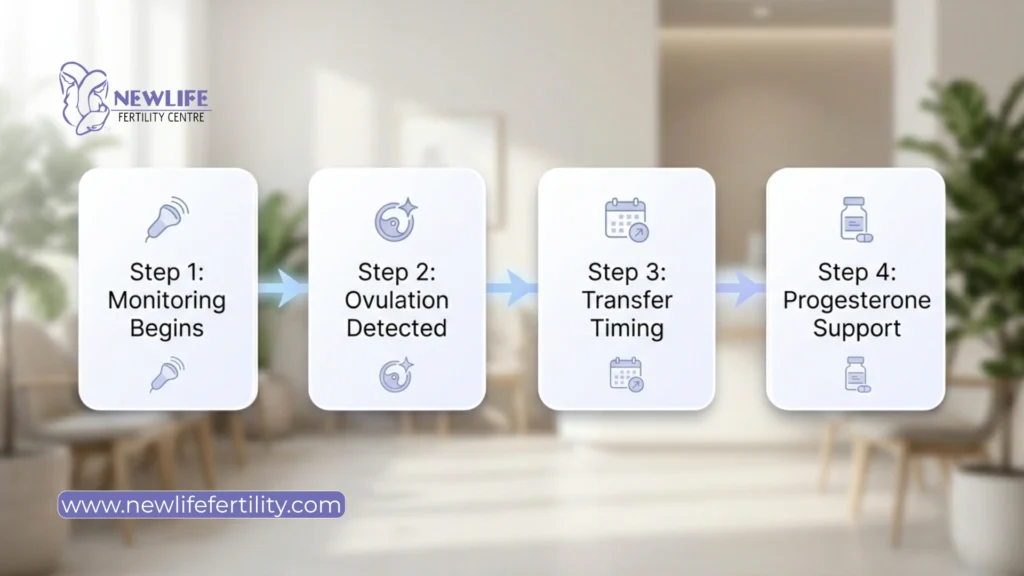
Think of natural FET as letting your body run the show.
Your clinic monitors your natural menstrual cycle, tracking when your follicle grows, when ovulation happens, and when your uterine lining reaches the right thickness. Once all those signals line up, the embryo transfer is scheduled around your body’s natural timing.
No suppression medications. No artificial hormones to force the cycle.
Here’s how it typically unfolds, step by step:
Step 1: Cycle monitoring begins
Around Day 10 to 12 of your cycle, you start going in for ultrasounds and blood tests. Your clinic is watching for follicle growth and rising estrogen levels.
Step 2: Ovulation detection
Through blood tests that track your LH surge or urine ovulation predictor kits, your team pinpoints exactly when you ovulate. This is the key moment.
Step 3: Transfer timing
Once ovulation is confirmed, your transfer is usually scheduled 5 to 6 days later. This matches the timing of when an embryo would naturally reach the uterus.
Step 4: Progesterone support
Even in a natural cycle, most clinics add progesterone after ovulation to support the uterine lining. Some do not, depending on the clinic’s protocol.
Many women prefer this approach because it feels more in sync with their body. There is less medication, fewer side effects, and the process works with your natural hormones instead of overriding them.
But this only works well if your cycle is consistent.
If you ovulate regularly, at predictable times, and your cycles are fairly steady, natural FET can be a great option. If your cycle is irregular or unpredictable, it becomes much harder to time things accurately.
What is a medicated (HRT) frozen embryo transfer cycle?
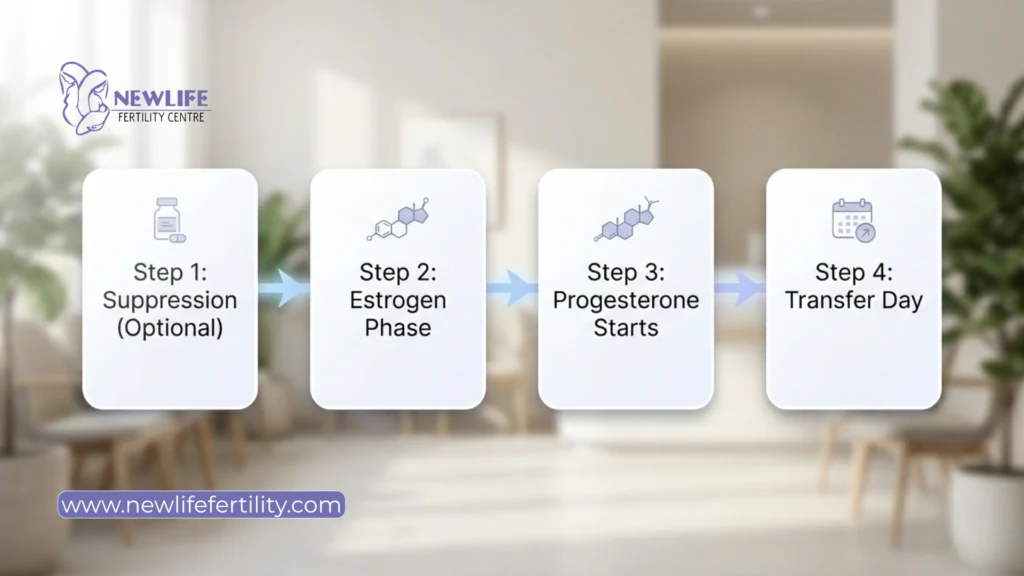
“Medicated” sounds intimidating. It really isn’t.
Here’s the simple version. In a medicated FET, your clinic uses hormones to prepare your uterine lining on a controlled schedule, without relying on your body to ovulate naturally.
You might also hear this called an HRT cycle, a hormone replacement cycle, or a controlled cycle. They all mean the same thing.
Here’s how it works step by step:
Step 1: Suppression (sometimes)
Depending on your protocol, you may take a short course of medication to temporarily pause your natural cycle. This gives your clinic a clean slate to work with. Not all protocols include this step.
Step 2: Estrogen phase
You start taking estrogen, usually through patches, pills, or injections, to build up your uterine lining. Your clinic monitors lining thickness through ultrasounds until it reaches the ideal range, typically around 7 to 8 mm or more.
Step 3: Progesterone starts
Once your lining is ready, progesterone is added. This mimics what happens after ovulation and prepares the uterus to receive an embryo.
Step 4: Transfer day
Your transfer is scheduled a fixed number of days after progesterone begins. Because the timing is fully controlled, your clinic knows exactly when your implantation window opens and can plan accordingly.
One thing to clear up right away. “Medicated,” “HRT,” “hormone replacement,” and “controlled cycle” all refer to the same approach.
The biggest advantage here is predictability. Your clinic can schedule your transfer date in advance. There is no waiting for ovulation, and if your cycle is irregular or you have conditions like PCOS, this approach removes that uncertainty.
The trade-off is more medication and more structured monitoring, and for some women, the process can feel a bit more clinical.
Natural vs medicated FET: Key differences

Let’s put them side by side in a way that actually tells you something useful.
Hormone use
Natural FET relies on your body’s own hormones, with little to no support in the early phase. Medicated FET introduces estrogen externally right from the beginning.
Cycle control
In a natural cycle, your body leads the process. In a medicated cycle, your clinic controls the timeline almost entirely. This makes a big difference when it comes to planning and scheduling.
Flexibility
Natural FET is less flexible because the transfer depends on when you ovulate. Medicated FET is highly flexible, allowing your clinic to schedule the transfer around your availability, travel, and logistics.
Clinic visits
Natural FET requires close monitoring to catch ovulation at the right time, which can mean multiple visits in a short window. Medicated FET usually follows a more structured and evenly spaced schedule.
Cost
Medicated FET often includes more medications, which can increase cost. Natural FET typically involves fewer prescriptions, though monitoring visits may balance that out. The exact difference depends on your clinic and location.
Emotional experience
Some women feel that natural FET is more in sync with their body, with less intervention. Others find medicated FET less stressful because the fixed schedule removes the uncertainty of waiting for ovulation. Both experiences are completely valid.
Pros and cons of natural vs medicated FET
No approach is perfect. Here’s the honest breakdown.
Natural FET

What works in its favour:
You take fewer medications, which means fewer side effects and a lighter daily routine. For women who are sensitive to hormones or had a difficult time during IVF stimulation, this can feel like real relief.
The process feels more physiological. Your body’s own hormones are doing the work, and many women say they feel more like themselves during a natural FET cycle.
There is also some emerging evidence that natural cycles may offer a slightly more receptive endometrium in certain cases, since the uterine environment reflects your body’s natural hormonal rhythm.
Where it gets complicated:
Natural FET requires consistent ovulation. If your cycle is irregular due to PCOS, thyroid issues, low ovarian reserve, or other factors, timing becomes difficult or even unreliable.
It also gives your clinic less control over scheduling. If your LH surge happens on a weekend, that is when the transfer window opens. Not all clinics have full flexibility for monitoring or transfers on those days, which can make things logistically challenging.
And if ovulation does not happen or happens unexpectedly, the cycle may need to be cancelled and restarted.
Medicated FET
What works in its favour:
Predictability is the biggest advantage. Once your lining is ready and progesterone begins, your transfer date is fixed. This makes planning easier for you, your partner, and your clinic.
It works regardless of whether you ovulate naturally. Women with PCOS, irregular cycles, or anovulatory cycles often rely on a medicated protocol because there is no consistent natural cycle to track.
It also gives your medical team more control over timing. Since they know exactly when progesterone starts, they can precisely align the implantation window.
Where it gets more difficult:
The medication load can feel significant. Daily estrogen through patches or pills, progesterone support, and regular monitoring can become physically and emotionally tiring for some women.
Side effects such as bloating, mood changes, breast tenderness, and fatigue are common. Some women experience them mildly, while others find them more noticeable.
And for those who were hoping for a lighter phase after IVF stimulation, a fully medicated FET can feel like the process is still ongoing rather than a break.
Success rates: Natural vs medicated FET
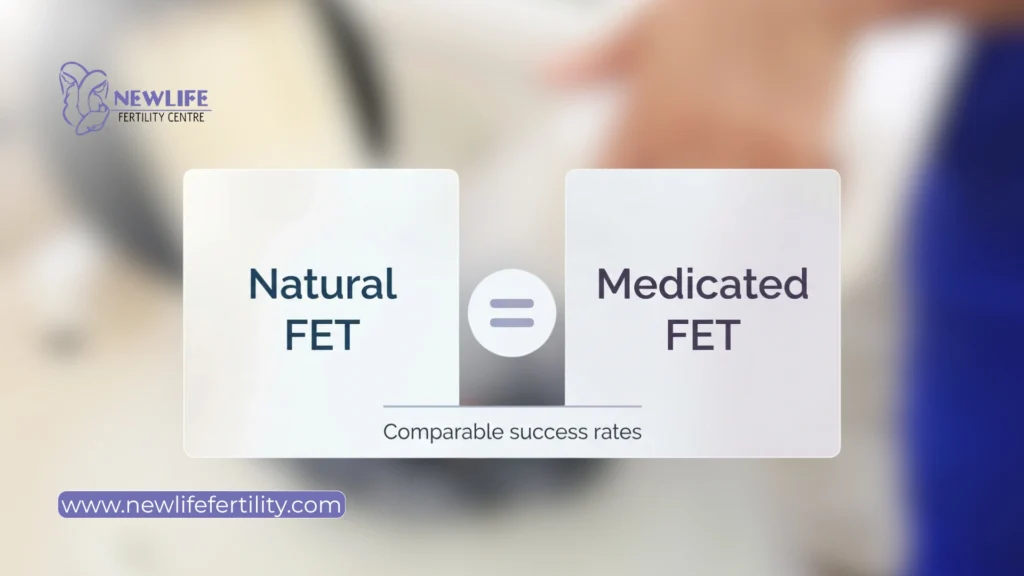
Here’s the honest answer, because you deserve one.
Both approaches have comparable success rates in many cases.
Numerous studies have compared natural and medicated FET outcomes, and the data consistently shows that neither protocol is dramatically superior across the board. Success depends far more on embryo quality, uterine health, age, and your individual reproductive factors than on which protocol you follow.
That said, context still matters.
For women with regular ovulatory cycles, natural FET tends to perform very well. Some studies even suggest a slightly lower risk of certain pregnancy complications, such as preterm birth or low birth weight, in natural cycles. Research in this area is still evolving, but it is worth noting.
For women with irregular cycles or conditions like PCOS, medicated FET often leads to better outcomes. Not because it is inherently better, but because natural FET can be difficult to time reliably in these situations.
What your doctor is not saying is that one protocol always wins. Because it does not. The best protocol is the one that fits your body, your history, and your specific situation.
If someone online, or even a well meaning friend, tells you “natural is always better” or “medicated gives higher success rates,” take that as an oversimplification.
Which one is right for you? Real-life scenarios

This is the section most guides skip. Let’s not.
Your cycles are regular and predictable
You can almost set a clock by your period. You ovulate around the same time each month. In this case, natural FET is often a strong option worth discussing with your doctor.
You have PCOS or irregular cycles
Your cycle length varies, you may skip ovulation, or your LH surge is unpredictable. Medicated FET is usually recommended here. Not because it is better overall, but because natural FET becomes very difficult to time accurately.
You’ve had a previous failed FET
Your doctor may suggest switching protocols to create a different uterine environment. If your first transfer was medicated, they might recommend trying a natural cycle, or the other way around. This is a common and valid approach.
You want to minimize medication
If your stimulation phase feels overwhelming and you want a lighter experience, natural FET is worth exploring. Just be open about how regular your cycles are so your doctor can guide you properly.
You need scheduling predictability
If you have a demanding job, travel plans, or limited availability for your partner, medicated FET offers a fixed timeline. That predictability can make a big difference.
You’ve had implantation failure or recurrent pregnancy loss
In this case, your doctor may recommend deeper evaluation before choosing a protocol. This could include tests like ERA or other assessments, rather than simply switching between natural and medicated cycles.
None of these are final answers. They are starting points for a more informed conversation with your medical team.
Questions to ask your doctor before choosing

Walk into that appointment prepared. Here’s what’s worth asking:
- Is my cycle regular enough to be a good candidate for natural FET?
- What do my hormone levels suggest about which protocol might suit me better?
- Based on cases similar to mine, which approach tends to work better?
- If I’ve had a failed FET before, would switching protocols make sense?
- What are the specific risks or challenges in my situation with each option?
- How does your clinic handle scheduling and monitoring for natural vs medicated, and does that make one option more practical for me?
Your doctor’s answers will be far more relevant to your outcome than anything you read online, including this article.
Use this as your starting point, not your finish line.
Common myths about natural vs medicated FET

A few things worth clearing up before you go down a forum rabbit hole.
“Natural is always better because it’s more gentle.”
Not necessarily. Natural FET is still a medical process. If your cycle is not ideal for accurate timing, pushing for a natural approach does not make it safer, it makes it harder to execute well. “More natural” does not automatically mean better for your situation.
“Medicated FET lowers your chances because of all the hormones.”
The evidence does not support this. Medicated FET has success rates comparable to natural FET across large populations. The hormones are not harming your chances. They are used to create the right uterine environment for implantation.
“One protocol works for everyone.”
If that were true, there would only be one protocol. There is not. Fertility treatment is highly individual. What worked for someone else, even someone close to you, is not a reliable guide for what will work for you.
“If I had a failed FET, the protocol must be the problem.”
A failed FET is incredibly difficult, and it is natural to look for a clear reason. But protocol choice is just one piece of a much larger picture. Embryo quality, uterine receptivity, timing, and other factors all play a role. What matters most is a thoughtful review with your doctor, not a quick switch based on assumption.
Natural vs medicated frozen embryo transfer: Which path feels right for you?
Both natural and medicated frozen embryo transfers are valid, well-established, and clinically proven approaches. Neither is automatically better. Neither is a shortcut or a compromise.
The right choice is the one that fits your body, your cycle, your medical history, and the guidance of a doctor who understands your full picture.
What matters most is not just which protocol you choose, but that you understand why you are choosing it. That clarity makes a big difference. It helps you move forward with confidence instead of second-guessing every step along the way.
If you are feeling unsure, that is completely normal. This is not a small decision, and you are not expected to figure it out alone.
NewLife Fertility Centre provides expert guidance and personalised care for frozen embryo transfer to support your next step.
At NewLife Fertility, we take the time to look at your individual case, explain your options in simple terms, and help you choose a path that actually makes sense for you. No pressure. No one-size-fits-all recommendations.
If you are at this stage and want real clarity, you can book your free consultation with NewLife Fertility and have an honest conversation about what approach fits you best.
Frequently asked questions about natural vs medicated FET
A non-medicated FET is the same as a natural FET. It uses your body’s own cycle by tracking ovulation and timing the transfer accordingly, without using estrogen to build the uterine lining artificially.
Neither approach is inherently safer for most women. Natural FET involves fewer medications, so medication-related side effects may be lower. However, it is not risk-free. Cycles can be cancelled if ovulation is missed or unpredictable. The safer option depends on your individual health and cycle pattern.
Yes, switching protocols is common. It is often considered after a failed transfer or when your doctor wants to try a different approach. Clinically, the transition between protocols is straightforward.
Neither protocol consistently outperforms the other. Success rates are broadly similar, especially in women with regular cycles and normal ovarian function. What matters more is your age, embryo quality, and uterine health.
HRT stands for hormone replacement therapy. In FET, it refers to the medicated approach where estrogen is used to build the uterine lining, followed by progesterone to prepare it for implantation. It is also called a controlled or medicated cycle, and these terms are used interchangeably.