You did everything right.
The medications, the appointments, the waiting, the hope.
And now you are either staring at a negative result or your period has started, and one question keeps coming back:
“Why did my frozen embryo transfer fail?”
This is usually the moment where everything feels unclear.
You might be wondering:
- Did something go wrong in my body?
- Was it the embryo?
- Did I miss something?
- What happens next?
First, let’s be clear about one thing.
A failed frozen embryo transfer is more common than you think, and in many cases, it happens even when everything is done perfectly.
That does not make it easier. But it does mean there are real reasons behind it, clear explanations, and practical next steps you can take.
In this guide, we will walk through:
- Why frozen embryo transfer fails
- Symptoms and signs to expect
- Miscarriage risks and what they mean
- And most importantly, what to do after a failed FET
No confusing medical jargon. No false reassurance. Just clear, honest answers, one step at a time.
What does a failed frozen embryo transfer mean?

If I put it simply, then a failed FET means the embryo did not successfully implant in the uterine lining after being transferred.
That can mean two things:
- No implantation: the embryo never attached to the uterus at all
- Early miscarriage: the embryo attached briefly but could not develop further. This is sometimes called a chemical pregnancy
Both are heartbreaking. And both are more common than anyone tells you before starting fertility treatment.
Here is the most important thing to know:
One failed FET does not mean you cannot get pregnant.
It does not mean your body is broken. It does not mean IVF will not work for you. Many women, in fact most, go on to conceive in a later cycle.
A failure is painful data. Not a final answer.
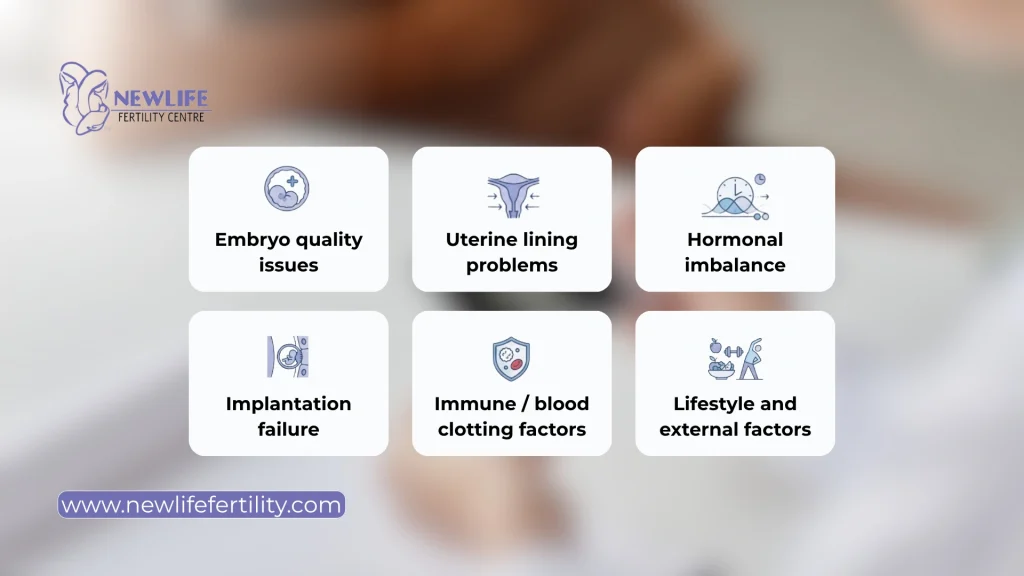
Why did my frozen embryo transfer fail?
This is the big question.
And honestly, sometimes there is not one single clear answer. But let’s break down the most common reasons so you have real clarity, not guesswork.
Embryo quality issues
This is one of the most common reasons behind a failed FET.
Even an embryo that looks perfect under a microscope can carry chromosomal abnormalities that prevent it from implanting or developing. This becomes more common with age, as egg quality naturally declines.
The hard truth is that even the best labs cannot always predict this. It is not your fault. It is biology.
Uterine lining problems
For an embryo to implant, the uterine lining needs to be thick enough and receptive.
If the lining is too thin, usually below 7 mm, implantation becomes more difficult. Some women may also have a nonreceptive endometrium, where the lining is not ready at the right time even if it looks normal.
The good part is that this is something your doctor can evaluate and often improve in the next cycle.
Hormonal imbalance
Timing matters a lot in a frozen embryo transfer.
Progesterone and estrogen need to be at the right levels at the right time. If progesterone rises too early or too late, the window of implantation shifts and the embryo may miss it.
Even small hormonal changes can affect the outcome. The positive side is that this is often a fixable cause.
Implantation failure
Sometimes the embryo reaches the uterus but does not attach properly.
This can be linked to the embryo, the lining, or how both interact. When this happens more than once, doctors may call it repeated implantation failure and suggest specific tests or treatment changes.
Immune or blood clotting factors
These are less common, but still important to understand.
In some cases, the immune system may treat the embryo as a foreign body. Blood clotting conditions can also affect blood flow to the uterus and impact implantation.
These are usually investigated after repeated failures, but if you have a history of autoimmune or clotting issues, it is worth discussing earlier.
Lifestyle and external factors
Things like smoking, heavy alcohol use, poor sleep, and overall health can influence your body’s environment.
Stress is often blamed, but here is the truth. Stress alone is very unlikely to cause a failed FET. It can play a small role, but it is not the main reason.
So please do not blame yourself.
In many cases, there is no single clear reason for a failed FET.
And yes, that can feel frustrating.
But it also means there is no one thing to blame, especially not yourself.
Frozen embryo transfer failure symptoms
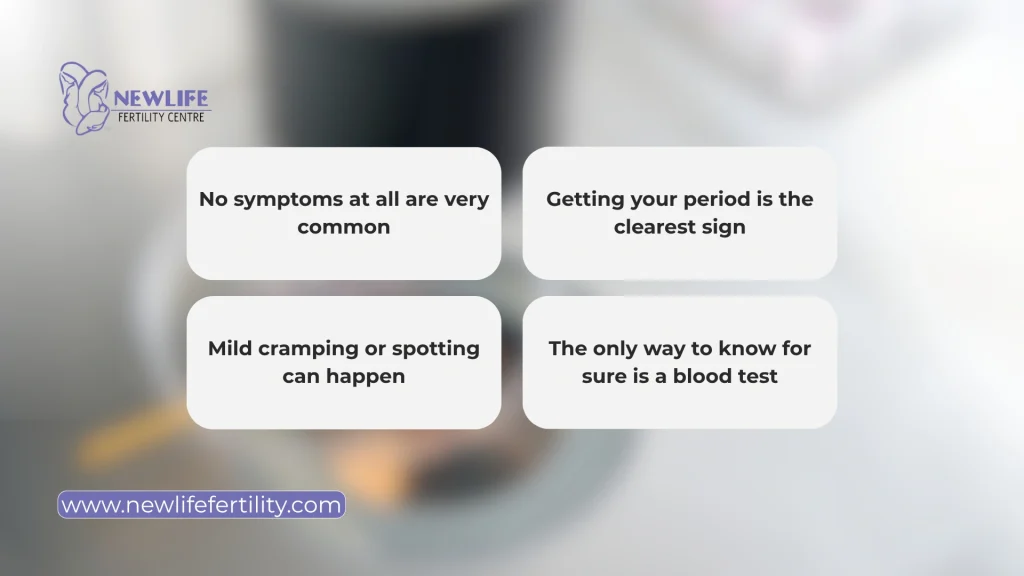
After a failed FET, it is completely normal to watch every sensation in your body and try to understand what it means.
Here is what you should know.
No symptoms at all are very common
Not feeling anything does not mean it worked. And having symptoms does not mean it failed. Symptoms alone are not reliable either way.
Getting your period is the clearest sign
If your period starts, it usually means the FET did not result in a pregnancy. This typically happens around 10 to 14 days after the transfer.
Your period may feel slightly different than usual, sometimes heavier or with more cramping, because of the hormonal medications.
Mild cramping or spotting can happen
This is where it gets confusing. Light spotting or cramps can occur after a failed FET, but they can also happen during implantation. So these signs cannot confirm anything on their own.
The only way to know for sure is a blood test
A beta hCG blood test is the only reliable way to confirm whether the transfer worked or not.
Miscarriage after frozen embryo transfer

Sometimes a frozen embryo transfer shows a positive result at first, and then the pregnancy is lost. This can feel especially difficult because there was hope, even if only for a short time.
Early miscarriage after FET
An early miscarriage after FET, often called a biochemical pregnancy, happens when the embryo implants briefly but stops developing, usually before 5 to 6 weeks.
You may see your hCG levels rise at first and then drop.
It is more common than many people expect. And it is not something you caused.
Miscarriage symptoms after FET
Some of the more common signs include:
- Bleeding that is heavier than light spotting
- Cramping that feels stronger than usual
- A sudden loss of early pregnancy symptoms
If you notice these after a positive test, it is important to contact your clinic right away.
Frozen embryo transfer miscarriage rate
The risk of miscarriage after a positive FET depends mainly on age and embryo quality.
- For women under 35, it is usually around 15 to 20 percent
- For women over 40, it can be closer to 30 to 40 percent or higher
This increase is mostly linked to chromosomal abnormalities, which become more common with age.
These numbers can feel overwhelming. But it is important to remember that most FET cycles that result in a positive test continue into a healthy pregnancy.
And even after a miscarriage, many women go on to have a successful pregnancy in a later cycle.
What are the chances of failure in a frozen embryo transfer?

Let’s talk honestly about the numbers.
The success rate for a frozen embryo transfer is usually around 30 to 50 percent per cycle. This depends on factors like age, embryo quality, and the clinic. Which means that failure is, statistically, quite common.
For women under 35 with good quality embryos, success rates tend to be higher. For women over 40, they are lower.
Here is the part that matters most.
Success rates improve over multiple cycles. Many women who do not succeed in their first FET go on to have a successful second or third attempt. When you look at cumulative success rates, which means your chances across multiple cycles, they are much higher than a single attempt.
One failed attempt does not define your outcome.
First frozen embryo transfer failed. What next?
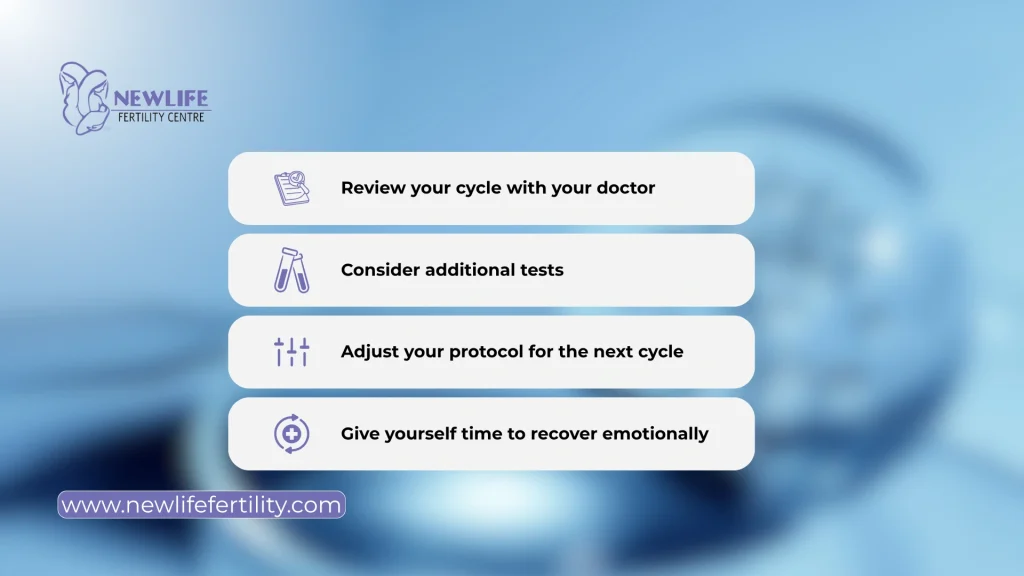
Okay. This is the most important part of the whole blog.
You have processed the news. Now the question is simple. What do you actually do next?
Step 1: Review your cycle with your doctor
Book a follow-up consultation focused on reviewing your cycle.
Ask your doctor to walk you through everything:
- How was your uterine lining?
- What was the embryo quality or grade?
- Were your hormone levels optimal?
- Is there anything that may have affected implantation?
This conversation is not about blaming yourself or the process. It is about understanding what happened so you can make better decisions going forward.
Step 2: Consider additional tests
Based on your case, your doctor may suggest further testing. This can include:
- Uterine evaluation, such as an ERA test to check implantation timing
- Hysteroscopy to examine the uterus
- Blood tests for immune or clotting factors
- Genetic testing of embryos, such as PGT A
These tests are not always needed after a first failed FET. But if there have been repeated failures, they can provide valuable insights.
Step 3: Adjust your protocol for the next cycle
A failed FET often leads to changes in your treatment plan, and that is actually a positive step.
Your doctor may:
- Adjust medication timing
- Change how estrogen is given
- Modify progesterone support
- Suggest a natural cycle instead of a medicated one, or the other way around
Even small adjustments can improve your chances in the next cycle. This is where learning from the previous attempt really helps.
Step 4: Give yourself time to recover emotionally
This part matters just as much as the medical steps.
A failed FET is a real loss. It is okay to feel disappointed, frustrated, or tired. It is also okay to take a break before trying again.
Taking a month or even a few months to recover does not mean you are giving up. It means you are taking care of yourself so you can move forward with more strength and clarity.
There is no rush. Go at a pace that feels right for you.
How long to wait after a failed frozen embryo transfer?

Most doctors recommend waiting at least one full menstrual cycle, usually around 4 to 6 weeks, before trying another FET.
This gives your body time to recover from the hormonal medications and return to its normal baseline.
But the real answer is, it depends.
It depends on your physical recovery, your emotional readiness, and whether your doctor wants to run any additional tests or make changes to your next cycle plan.
There is no one timeline that fits everyone. The right time to try again is when you feel ready, both physically and mentally.
Questions to ask your doctor after a failed FET

Walk into your follow-up appointment with these questions written down. You deserve clear and honest answers.
- Why do you think my FET failed? Try to get a specific explanation, not just “these things happen.”
- Was embryo quality a factor? If there were chromosomal issues, it can influence what you consider next.
- Should I have additional testing? Ask about tests like ERA, hysteroscopy, immune panels, or PGT A if relevant.
- Should we change the protocol? What will be different in the next cycle, and why?
- What are my chances in the next cycle? Ask for numbers based on your case, not general averages.
- How many embryos do we have left? This helps you plan your next steps more clearly.
You are not just a patient in this process. You are an active part of every decision. Ask what you need to feel informed and confident.
Frozen embryo transfer after failed IVF is it different?

A common point of confusion is the difference between a failed IVF cycle and a failed FET.
In a fresh IVF cycle, eggs are retrieved, fertilized, and transferred within the same cycle, usually 3 to 5 days after retrieval.
In a frozen embryo transfer, embryos from a previous retrieval are thawed and transferred in a separate cycle.
A failed FET does not mean IVF itself has failed.
You may still have frozen embryos from your earlier cycle, and those embryos can still lead to a successful pregnancy.
In fact, success rates with FET are comparable to, and in some cases even better than, fresh transfers.
The embryos you have frozen still carry real potential for a successful outcome.
Can you improve success after a failed FET?

Yes, you can improve your chances. But it is important to stay realistic about what that means.
There is no single supplement or lifestyle change that guarantees success. What you can do is support your body and create the best possible conditions for the next cycle.
Follow your medication protocol carefully
Timing plays a bigger role than most people expect. Take every dose as prescribed. Setting reminders can help you stay consistent.
Keep stress manageable
You do not need to eliminate stress completely. That is not realistic. Focus on getting enough sleep, reducing unnecessary pressure, and asking for support when you need it.
Maintain overall health
Balanced nutrition, regular light movement, and avoiding alcohol and smoking can support your reproductive health. These may not be the deciding factor, but they do help your body function better.
Stay in close touch with your clinic
Keep your doctor informed about anything you notice. Even small changes or symptoms can be important. It is always better to share than to assume something is not relevant.
Give the process time
Sometimes it takes a few cycles and small adjustments before things work. That is a normal part of fertility treatment for many people.
What comes next after a failed frozen embryo transfer?
A failed frozen embryo transfer is one of the hardest things to go through.
The hope, the waiting, and the disappointment can feel overwhelming. And it is completely okay to feel that way.
At the same time, there is something important to hold on to. Failure is a part of the journey for many people who do go on to have a successful pregnancy. The stories you hear about success after multiple attempts are not rare. They are real, and they happen every day.
This is not the end of your story.
It is one chapter, a painful one, but not the final one.
Take the time you need to process what happened. Give yourself space to recover, both physically and emotionally. When you feel ready, start gathering the right information, ask the right questions, and take the next step with clarity.
And you do not have to do this alone.
NewLife Fertility Centre provides trusted guidance, personalised care, and next-step support for frozen embryo transfer.
At NewLife Fertility, we understand how personal and complex this journey can feel. Our team works closely with you to review your previous cycle, identify possible reasons, and create a plan that gives you the best possible chance moving forward.
If you are unsure about your next step or simply want clear answers, you can book your free consultation with NewLife Fertility and talk to a specialist who will guide you with honesty and care.
You have already come this far. That takes strength. And when you are ready, the next step is waiting for you.