“My clinic just scheduled my FET on Day 22. Is that too late?”
That’s one of the most common things fertility patients say online.
And if you’re reading this right now, chances are you just got your transfer date, Googled it, and now you’re panicking because someone on Reddit said theirs was on Day 17.
Take a breath.
You’re not behind. You’re not too late. And no, your clinic didn’t make a mistake.
Here’s the thing nobody tells you clearly enough:
There is no single fixed cycle day for a Frozen Embryo Transfer.
Not Day 17. Not Day 21. Not Day 23.
The “right” day is different for every patient, and it’s decided by your body, your hormones, your lining, and your treatment protocol. Not a calendar.
Let’s break the whole thing down so you actually understand it, and stop comparing your cycle to someone else’s.
On which day of cycle is frozen embryo transfer done?

Let’s answer the main question directly.
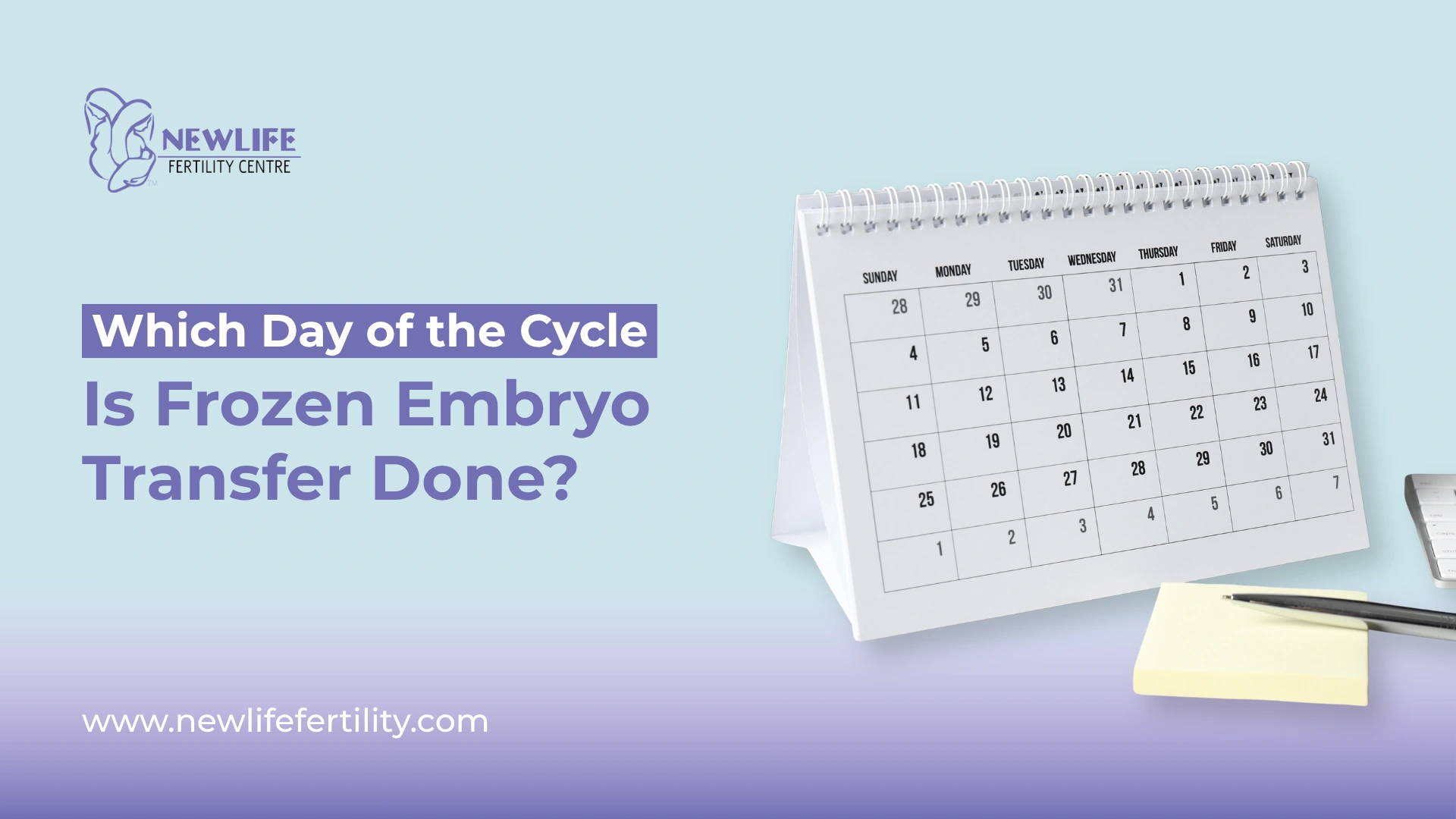
Most frozen embryo transfers happen somewhere between Cycle Day 17 and Day 23.
That’s the most common window. But completely normal transfers also happen:
→ Earlier, Day 15 or Day 16
→ Later, Day 24, 25, 26, or even Day 28
So if your transfer is scheduled for Day 22 or Day 23, that’s not unusual at all. It’s actually well within the typical range.
“But why is there such a wide range?”
Because your transfer date isn’t based on a number. It’s based on readiness.
Your clinic is waiting for three things to line up:
→ Your uterine lining to be thick enough and ready
→ Your ovulation timing (in natural cycles)
→ The right number of progesterone days for your embryo’s age
When those three things are ready, that’s your transfer day.
Important: The goal is not to transfer on a specific calendar day. The goal is to transfer when your uterus and embryo are best synchronized. That synchronization is everything.
Why FET timing is different for every patient

Natural cycle vs. medicated cycle
Your protocol changes everything.
Natural cycle FET follows your own ovulation. Transfer timing depends on when you ovulate, which is different for every woman, and sometimes different cycle to cycle.
Medicated cycle FET uses estrogen and progesterone medications to control and prepare your lining artificially. Because the clinic controls the medications, they also have more flexibility in deciding the transfer window.
Both are valid. Both work. But they lead to different timelines.
If you’re in a natural cycle and ovulated on Day 14, your transfer will look different than someone in a medicated cycle who started progesterone on Day 15. Comparing the two cycle days is like comparing two completely different journeys.
Related: Natural vs. Medicated FET – What’s the Difference?
Embryo age also shifts the transfer day
This one surprises a lot of patients.
Whether your frozen embryo is a Day 3 embryo or a Day 5 blastocyst changes your transfer timing.
A Day 5 blastocyst has already matured for five days in the lab. That means it needs a very specific number of days of progesterone exposure inside your uterus to sync up properly. If your clinic uses Day 5 blastocysts, which most clinics do now, they’ll calculate your transfer date based on exactly that.
A Day 3 embryo is less developed, needs different timing, and is less commonly used today.
So when someone tells you “my transfer was on Day 18,” the question is, Day 3 or Day 5 embryo? Same cycle day can mean completely different progesterone windows depending on that one factor.
Related: Blastocyst vs. Day 3 Embryo Transfer – Key Differences
Your lining and hormones matter more than the calendar
Your clinic is not watching the calendar. They’re watching your body.
Before scheduling your transfer, they’re monitoring:
→ Endometrial lining thickness, usually needs to reach at least 7 to 8 mm
→ Estrogen levels, to confirm your lining is responding to medications
→ Progesterone levels, to time the “window of implantation” correctly
→ Ovulation, especially in natural cycles
If your lining develops slower than expected, your transfer will be pushed a day or two later. That’s not a bad sign. That’s your clinic being careful.
A thin lining transferred too early is worse than a perfect lining transferred three days “late.”
Related: Progesterone in FET – Why Timing Matters So Much
Frozen embryo transfer cycle timeline
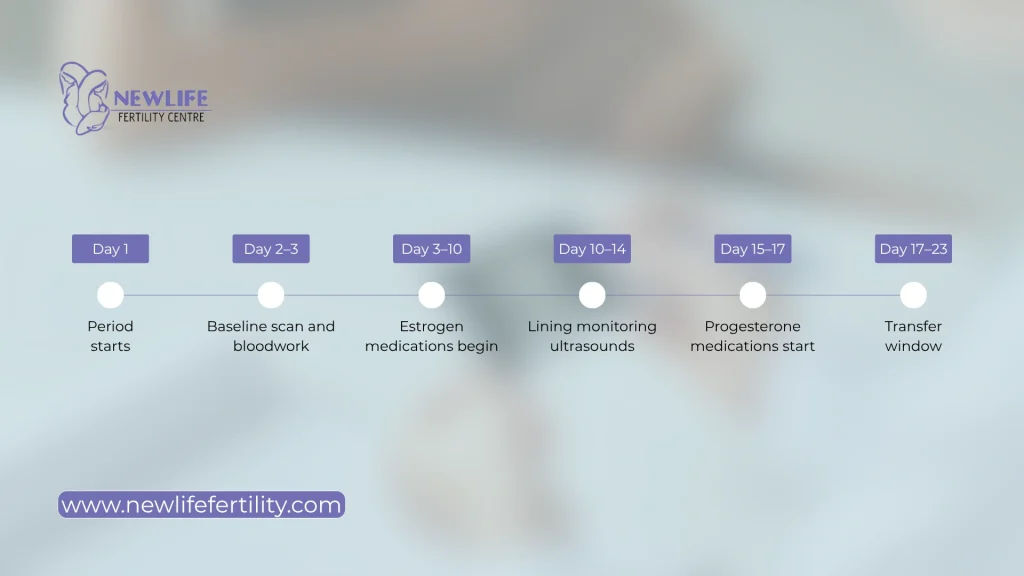
Here’s a typical FET cycle laid out day by day, so you can see the whole picture, not just the transfer date.
| Cycle Day | What Usually Happens |
| Day 1 | Period starts, this is Day 1 of your FET cycle |
| Day 2–3 | Baseline scan and bloodwork |
| Day 3–10 | Estrogen medications begin (in medicated cycles) |
| Day 10–14 | Lining monitoring ultrasounds |
| Day 15–17 | Progesterone medications start |
| Day 17–23 | Transfer window, most transfers happen here |
Notice something?
The transfer is near the end of the cycle, not the beginning. By the time you reach your transfer date, you’ve already done most of the hard work, scans, medications, monitoring.
And yes, your exact timeline may look different. If your lining needs more time, Day 17 becomes Day 20. If you responded quickly, Day 17 is fine. Both outcomes are completely normal.
Related: FET Medications – What You’ll Take and Why
Frozen embryo transfer on different cycle days explained
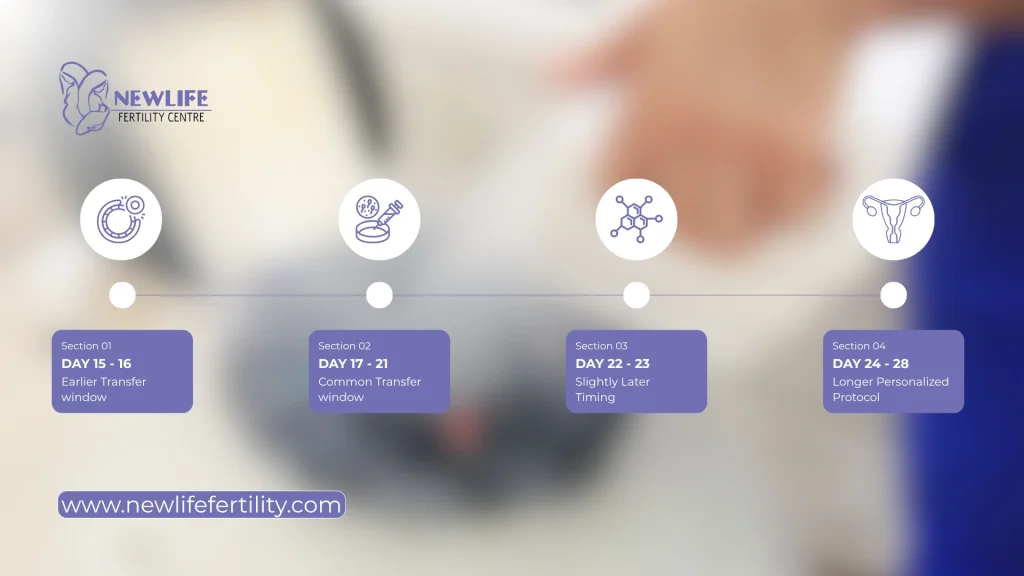
Let’s go through the different transfer day scenarios one by one.
Because “is my day normal?” is clearly what everyone wants to know, and the honest answer is: probably yes.
Frozen embryo transfer on Day 15 or Day 16
This is seen in natural cycle FETs where ovulation happened a little earlier, usually around Day 10 to Day 12.
Transfer on Day 15 or 16 is less common, but it’s not a concern. It just means your body was ahead of the typical schedule. If your clinic confirmed your ovulation and your lining was ready, early is fine.
Frozen embryo transfer on Day 17 to Day 21
This is the sweet spot. The most common range for medicated FET cycles.
If your transfer is anywhere in this window, you’re exactly where most patients are. Progesterone typically starts on Day 15 to Day 16, and a Day 5 blastocyst transfer happens about 5 to 6 days after progesterone starts, which lands right here.
No overthinking needed.
Frozen embryo transfer on Day 22 or Day 23
This is probably the most Googled scenario, because patients in this range often panic.
Please don’t.
Transfer on Day 22 or Day 23 is completely normal and more common than you think. It usually happens because:
→ Your lining took a few extra days to reach the right thickness
→ Your progesterone start was slightly delayed for monitoring reasons
→ You had a weekend or a scheduling adjustment
→ Your clinic simply prefers a slightly longer estrogen priming window
None of the above are red flags. A Day 22 or Day 23 transfer is not “late.” It’s just your protocol.
Your embryo does not know what day of the cycle it is. It only knows whether your uterus is ready or not.
Frozen embryo transfer on Day 24 to Day 28
Less common, but absolutely possible.
Women with naturally longer cycles, slower lining response, or certain protocol variations may transfer later in the month. Clinics personalize timing for a reason.
If your transfer is past Day 23, the best thing you can do is ask your clinic why, not to challenge their decision, but to understand it. They’ll have a clear reason, and knowing it will calm you down far more than anything you’ll read online.
How doctors decide the best day for your transfer

Your doctor isn’t picking your transfer date randomly.
They’re looking at a combination of factors, and they only schedule the transfer once everything is aligned:
→ Ovulation timing, confirmed via ultrasound or blood test in natural cycles
→ Lining thickness, typically confirmed at 7 mm or more
→ Hormone levels, estrogen and progesterone checked via bloodwork
→ Embryo stage, Day 3 or Day 5, because each needs different progesterone exposure
→ Days of progesterone, usually 5 full days before a Day 5 blastocyst transfer
When all of these are ready at the same time, that’s your transfer day.
If any one of them isn’t ready, your doctor will wait. Because rushing the transfer when the body isn’t ready doesn’t improve outcomes. It risks them.
And while timing alone does not guarantee success, proper synchronization between the embryo and the uterus plays an important role in improving implantation chances.
Related: Frozen Embryo Transfer Success Rate – What Affects Success Most?
How long is a frozen embryo transfer cycle?
Short answer: usually 3 to 6 weeks from the start of your cycle to transfer day.
It depends on:
→ Whether your cycle is natural or medicated
→ How quickly your lining responds to estrogen
→ How many monitoring appointments your clinic needs
→ Any adjustments along the way
Most patients in a medicated cycle are done within 4 to 5 weeks. Natural cycles can sometimes move a little faster, depending on ovulation.
If your cycle feels long, it’s usually because your body needs more preparation time, which is actually a good sign. A well-prepared uterus is the whole point.
Related: How Long After Egg Retrieval Is Frozen Embryo Transfer Done?
Is it normal if my FET date changes?

Yes. Very normal.
Clinics adjust transfer dates all the time. The lining wasn’t thick enough. A hormone level needed rechecking. A monitoring scan showed something worth watching. A weekend fell in the middle of an ideal window.
None of these automatically mean something is wrong.
“But I already told my family the date!”
That’s genuinely stressful, and it’s okay to feel frustrated when your date shifts.
But here’s the part that matters: changing your transfer date to better sync your uterus and embryo protects your chances of success. Your clinic isn’t being careless. They’re being precise.
A slightly delayed transfer that lands in the perfect window is far better than a rushed transfer on the “expected” day.
Questions to ask your clinic about your FET timing

If you’re confused about your schedule, here are the exact questions worth asking your fertility team:
→ Why was this specific transfer day chosen for me?
→ Is my cycle natural, modified, natural, or fully medicated?
→ When did ovulation occur, and how was it confirmed?
→ How many days of progesterone do I need before transfer?
→ Could my transfer date still change, and what would cause that?
→ Is my embryo Day 3 or Day 5, and how does that affect timing?
Write these down. Bring them to your next appointment. You deserve clear answers, not vague reassurances.
Frequently asked questions about frozen embryo transfer cycle day

What cycle day is frozen embryo transfer usually done?
Most FETs happen between Cycle Day 17 and Day 23. The exact day depends on your protocol, lining development, and embryo stage.
What day of cycle do they do frozen embryo transfer?
There’s no single fixed day. Each patient’s transfer is scheduled based on ovulation timing, lining readiness, hormone levels, and embryo age.
Can frozen embryo transfer happen on Day 28?
Yes, it can. Women with longer cycles or slower lining response may transfer later. It’s less common, but completely possible and not a cause for concern.
Is FET usually done on Day 21?
Day 21 is within the typical range but not universal. Some patients transfer earlier, some later. What matters is that the lining and hormones are ready, not the calendar number.
Why is my transfer later than someone else’s?
Because your body is different. Your lining may need more time. Your protocol may be different. Your ovulation may have occurred later. Stop comparing, different timelines are the rule, not the exception.
Does embryo age affect transfer timing?
Absolutely. A Day 5 blastocyst needs a specific number of progesterone days to sync with the uterus. A Day 3 embryo has different timing needs. Your clinic calculates this precisely.
Can my FET cycle be delayed?
Yes, and it happens often. Thin lining, hormone levels needing adjustment, or scheduling factors can all shift your transfer day. This does not reduce your chances of success.
How many days after progesterone is embryo transfer done?
For a Day 5 blastocyst, transfer typically happens after 5 full days of progesterone. For a Day 3 embryo, it’s usually after 3 days. Your clinic will tell you exactly.
What cycle day is right for your frozen embryo transfer? Only your body knows.
Different cycle days are normal.
Day 17 is normal. Day 21 is normal. Day 23 is normal.
The number on the calendar is not what makes a FET successful. What makes it successful is timing your uterus and embryo perfectly, and that timeline is personal to you.
Please stop comparing your cycle day to what you read in a forum at midnight. The person who transferred on Day 17 had a completely different protocol, a different embryo, and a different body than you. Their timeline tells you nothing about yours.

At NewLife Fertility, we believe every patient deserves a transfer plan that’s built around their body, not a fixed schedule. Our team monitors your lining, hormones, and embryo readiness at every step so your transfer happens at exactly the right moment, not just the expected one.
If you’re ever unsure about your timeline, confused about your protocol, or just need someone to walk you through what’s happening, we’re here for that conversation.
Book your free consultation with the NewLife Fertility team today and get clarity on your FET cycle from people who genuinely care about your outcome.